

Tax advisory professionals frequently navigate a high-stakes landscape where minor client misunderstandings can quickly escalate into costly professional liability disputes. Before exploring defensive strategies, we must first acknowledge how rapidly shifting tax codes and increased regulatory scrutiny complicate modern compliance. Standardizing your engagement letters grants your firm invaluable peace of mind, transforming potential legal vulnerabilities into highly predictable, manageable risks.
To manage client expectations effectively, these agreements must stipulate the precise boundaries of your service. For instance, incorporating concrete limitations-such as explicitly defining the scope of a multi-state nexus study or outlining the client's sole responsibility for the accuracy of source financial data-provides clear legal proof of your agreed-upon duties.
This article will analyze the critical clauses every tax advisory template requires, best practices for implementation, and how structured agreements ultimately safeguard your firm's profitability and reputation.
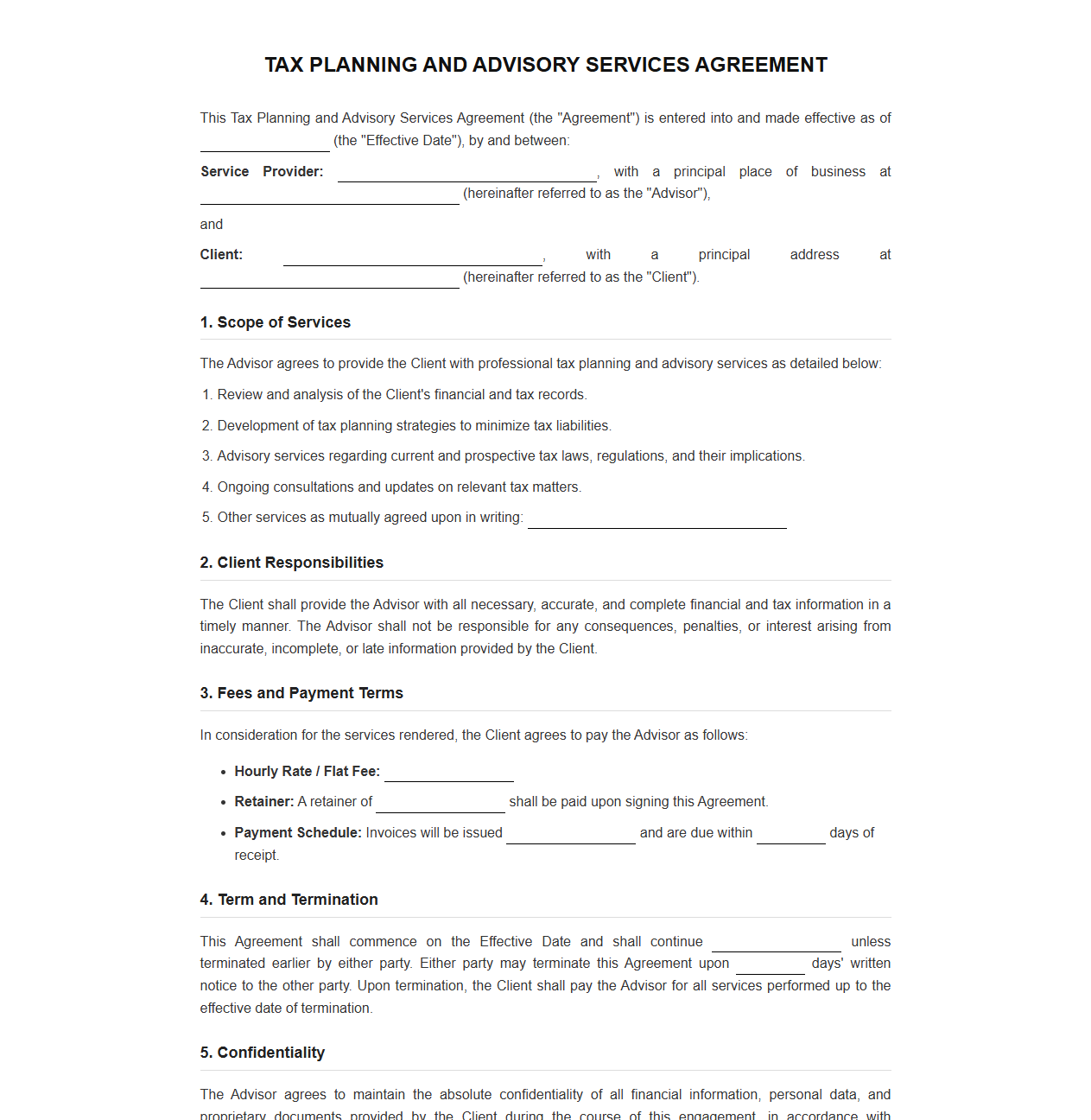
Tax Planning and Advisory Services Agreement Template
 Download: .PDF
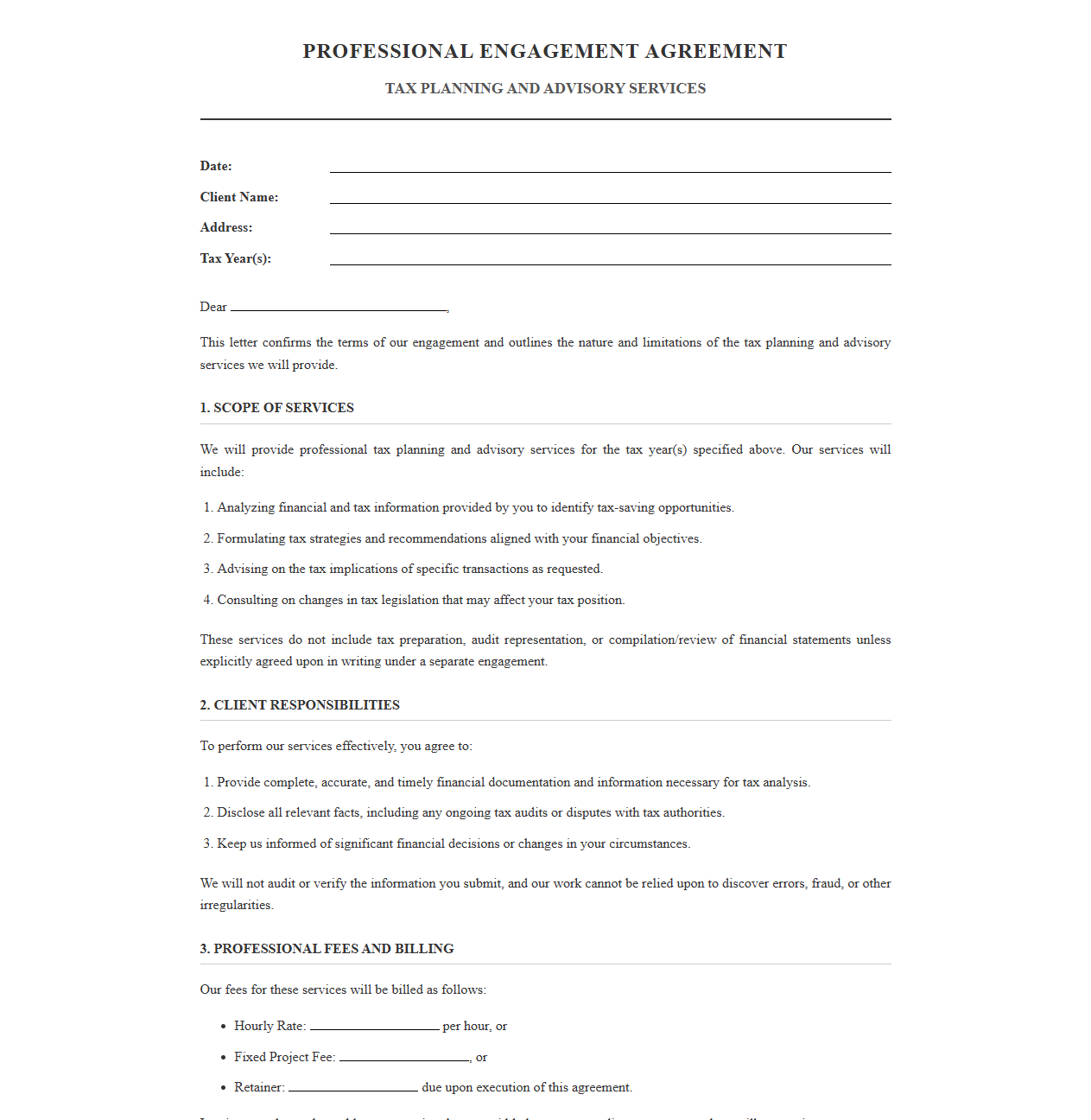
Professional Tax Advisory and Planning Engagement Letter
 Download: .PDF
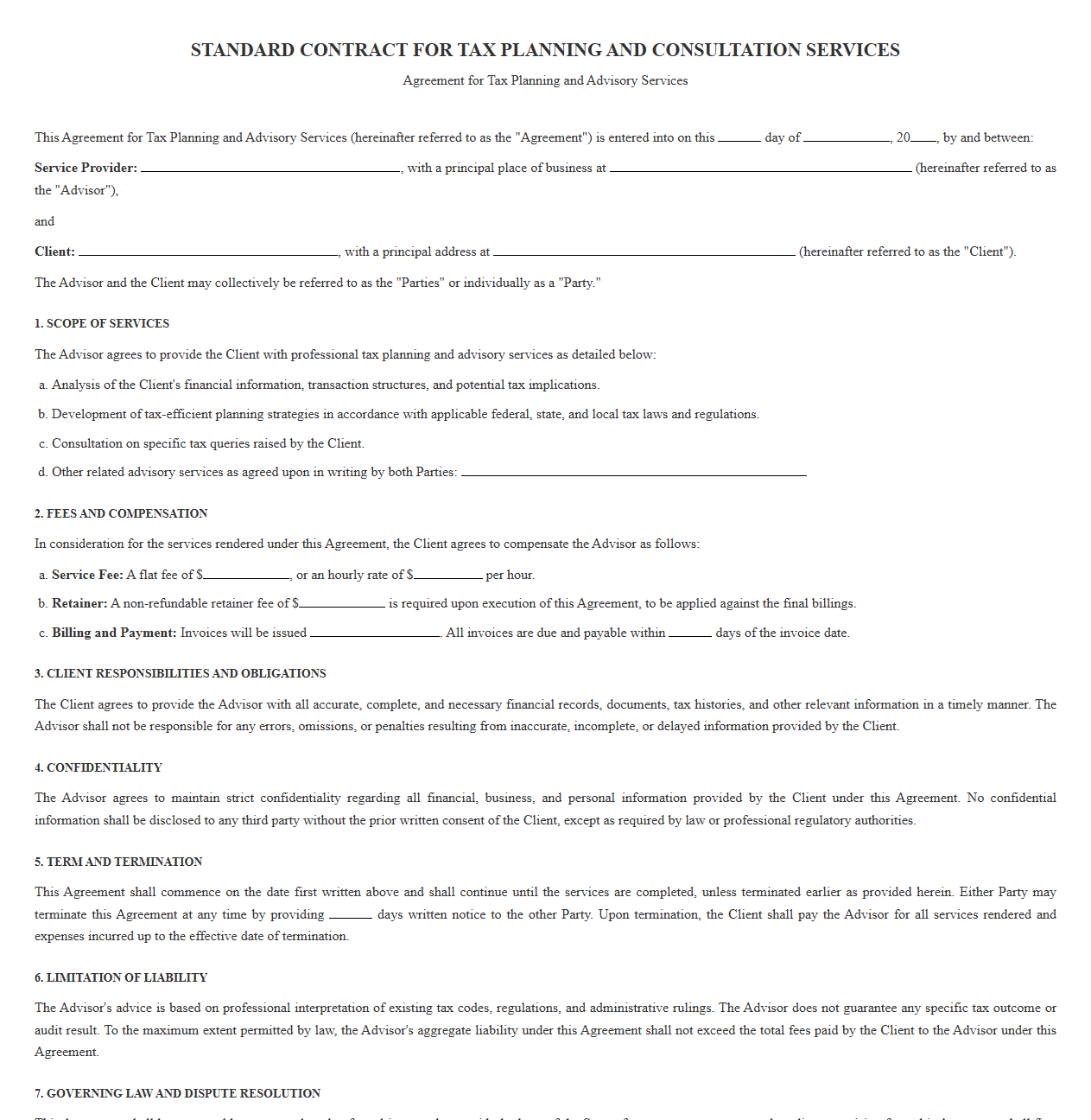
Standard Contract for Tax Planning and Consultation Services
 Download: .PDF
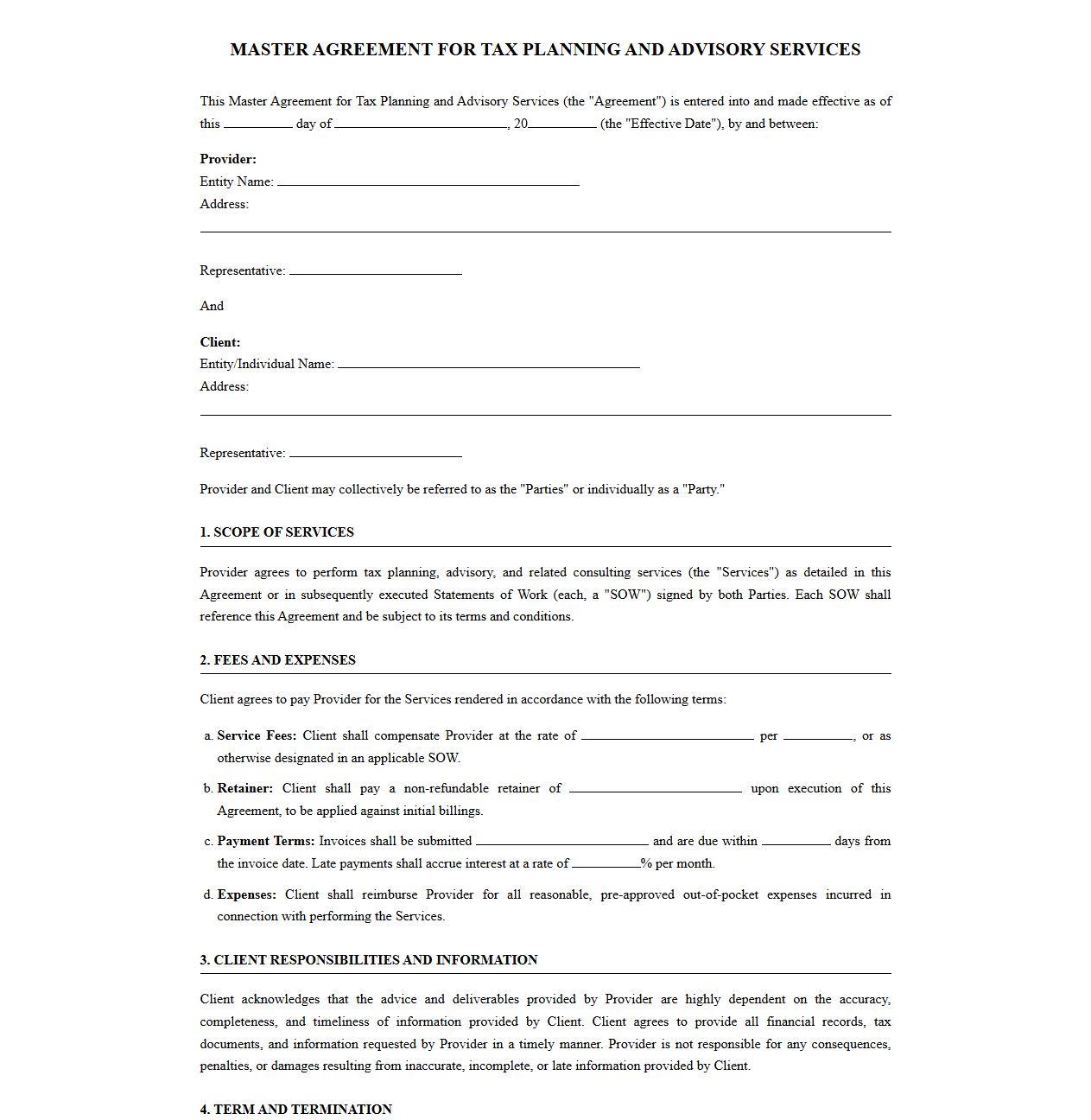
Master Agreement for Tax Planning and Advisory Services
 Download: .PDF
Corporate Tax Planning and Advisory Service Agreement
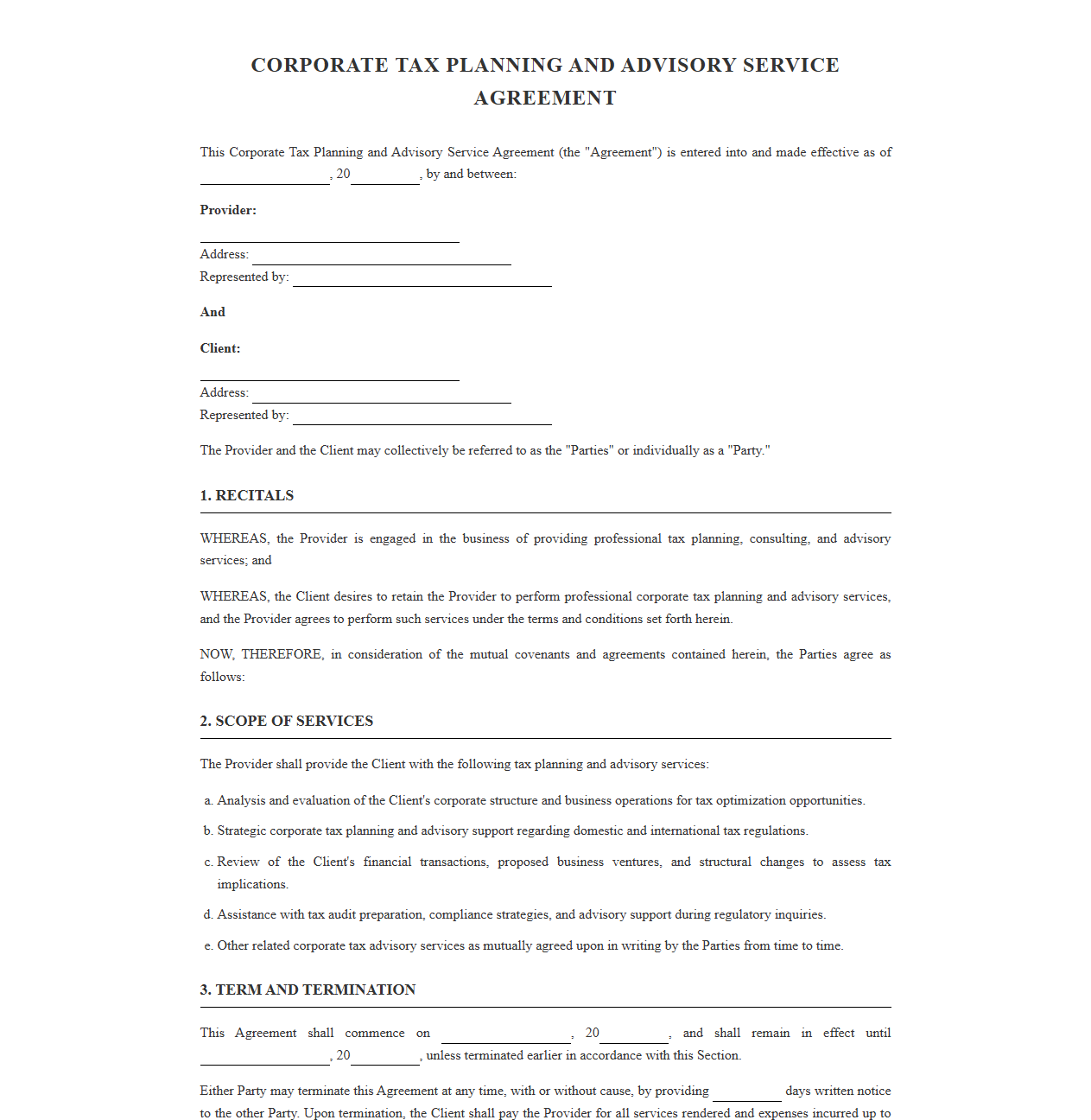 Download: .PDF
Strategic Tax Advisory and Planning Service Contract
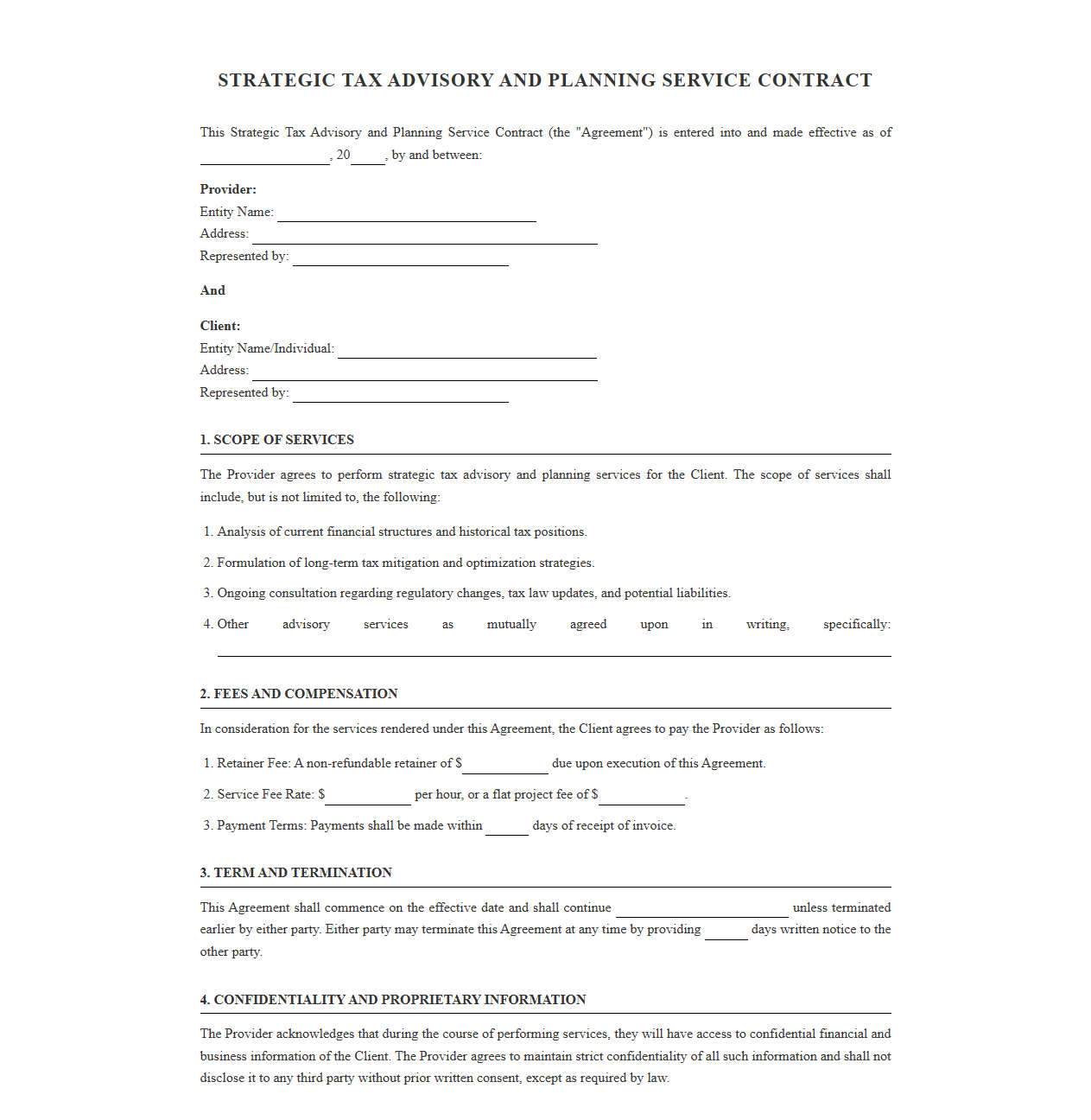 Download: .PDF
Client Agreement for Tax Planning and Consultation
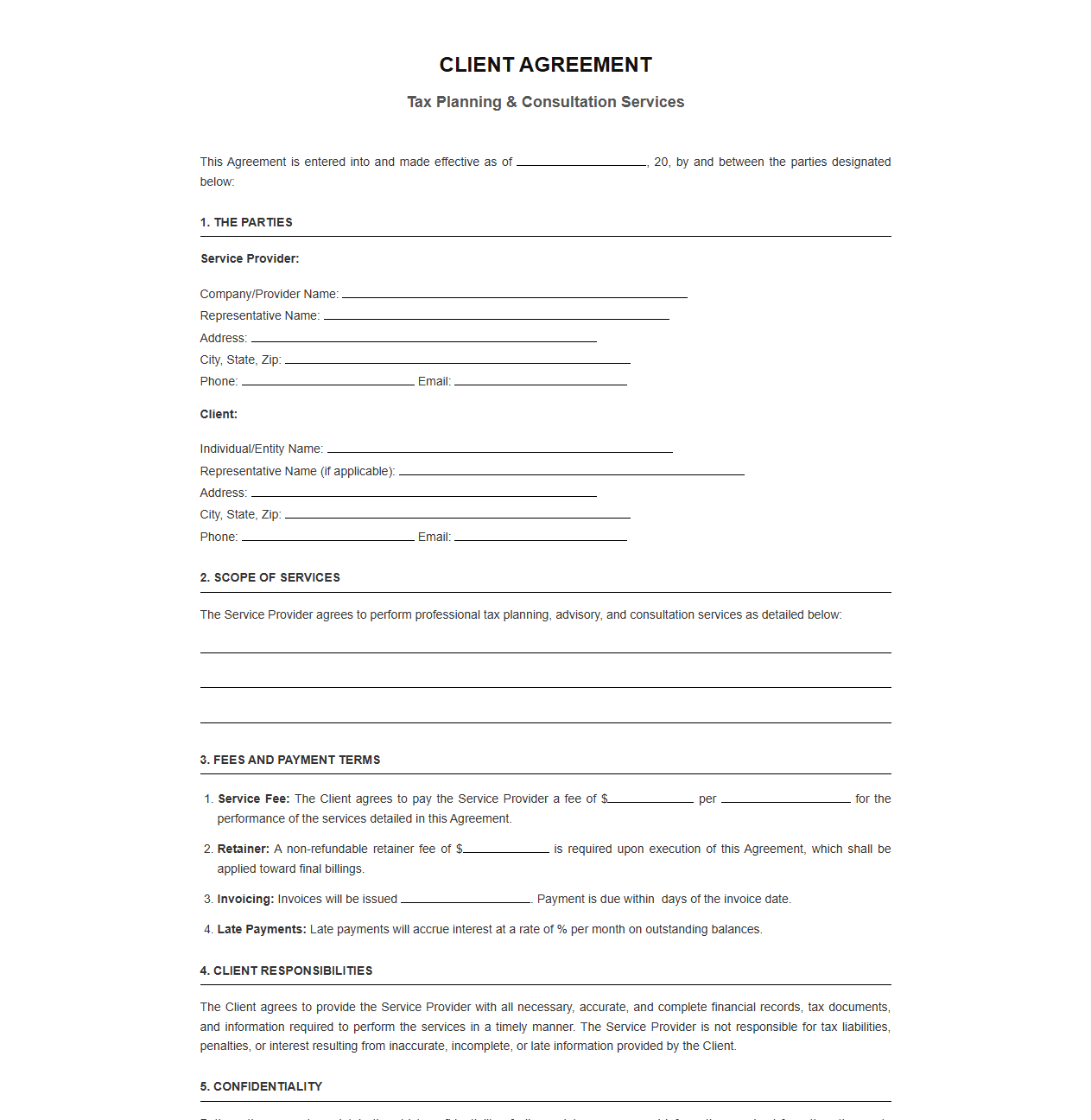 Download: .PDF
Tax Advisory and Financial Planning Services Agreement
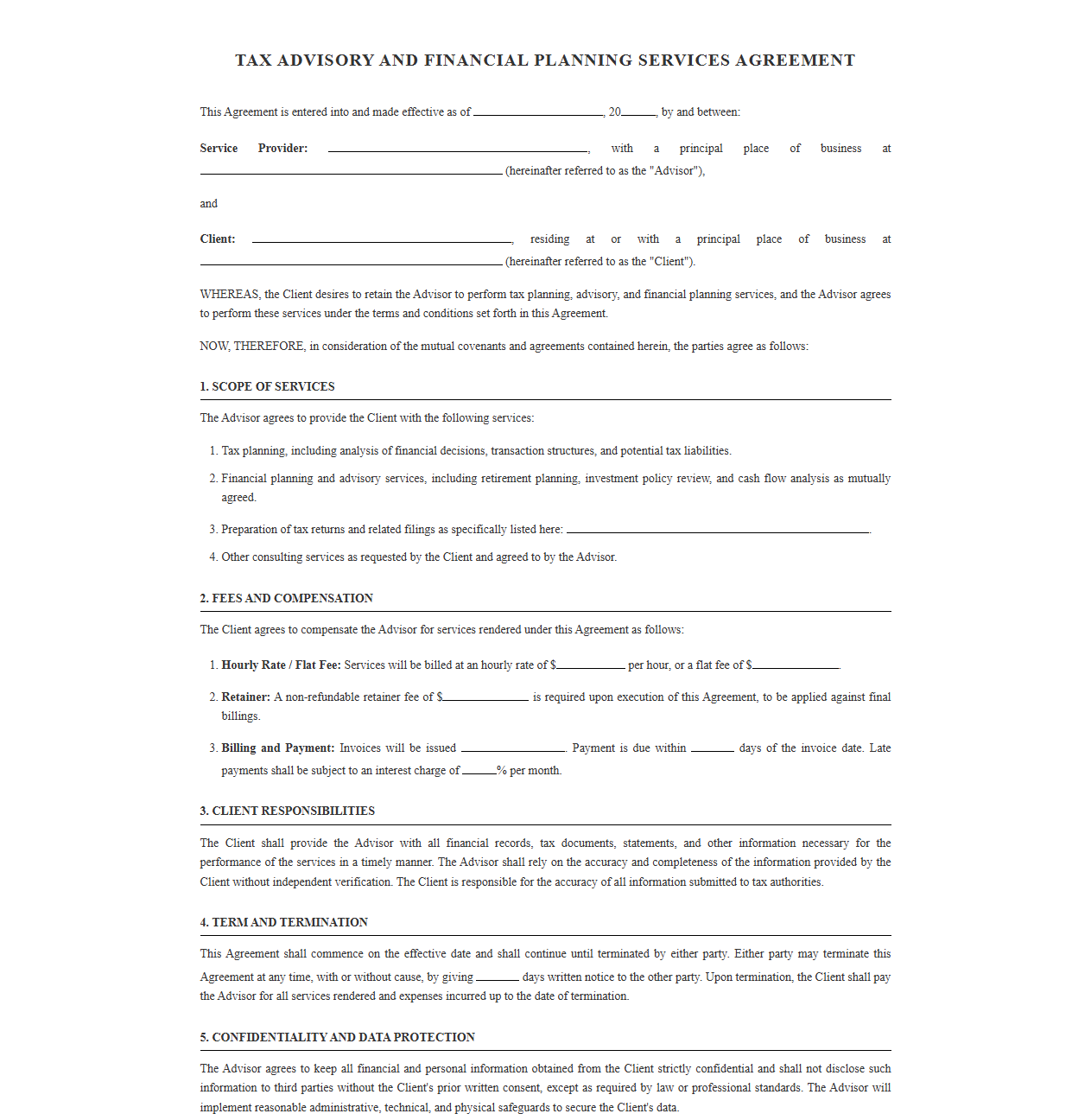 Download: .PDF
The Hidden Risks in Tax Advisory Services
Operating a tax advisory practice without formal, written agreements is equivalent to navigating a financial minefield without a map. Tax professionals regularly deal with complex, shifting regulations, leaving them highly exposed to significant legal and financial consequences. Without a structured agreement, a simple misunderstanding regarding tax filing deadlines or deduction strategies can quickly escalate into costly litigation, devastating malpractice claims, and severe reputational damage. Advisors must recognize that verbal agreements or handshake deals offer absolutely no protection when a regulatory body initiates an audit or a client faces unexpected penalties.
The Engagement Letter as a Shield
To mitigate these pervasive operational hazards, a structured engagement letter serves as the absolute cornerstone of professional risk management. This document functions as a legally binding contract that establishes clear boundaries and mutual expectations between the advisor and the client from day one. By clearly outlining the exact parameters of the professional relationship, it prevents misunderstandings and aligns both parties on deliverables. A well-drafted engagement letter transforms a potentially adversarial relationship into a collaborative, transparent partnership built on mutual trust.
Defining the Scope: What is (and Isn't) Included
A primary driver of professional disputes in tax advisory is scope creep-the gradual, unapproved expansion of services beyond the initial agreement. To prevent unauthorized reliance and protect firm resources, tax advisors must draft a precise scope of services section that clearly delineates what is included and, crucially, what is excluded from the engagement.
- Specify the exact tax returns to be prepared, including the specific tax years and jurisdictions.
- Explicitly exclude services such as bookkeeping, audit representation, or forensic accounting unless specifically contracted.
- Clarify that the firm will not audit or independently verify the financial information provided by the client.
- Establish a formal change-order protocol for any additional advisory services requested during the tax year.
Crafting Robust Limitation of Liability Clauses
Even with clear scopes, disputes can still arise, making limitation of liability clauses essential safeguards. These clauses legally restrict the financial damages a client can recover in the event of an error, omission, or breach of contract. A well-designed clause sets liability caps, typically restricting damages to the total fees paid for the specific tax service, while also defining indemnification parameters to protect the firm from third-party claims.
The advisory firm's total liability for any errors, omissions, or breaches arising under this agreement shall be strictly capped at the total fees paid by the client for the specific service in question, and the client agrees to indemnify the firm against any third-party claims resulting from inaccurate client data.
Establishing Clear Client Responsibilities
A tax advisor's work is only as reliable as the data they receive. Therefore, agreements must contain explicit clauses holding the client entirely responsible for the accuracy, completeness, and timeliness of all provided financial records. Under no circumstances should the advisor bear the blame for penalties resulting from omitted income, undocumented expenses, or delayed documentation. Establishing these clear boundaries ensures clients understand that their active participation and honesty are fundamental to the successful execution of the advisory services.
Standardizing the Implementation Workflow
Protecting your firm requires moving beyond theoretical safeguards and integrating structured templates into your daily operations. Establishing a standardized implementation workflow ensures that no client work begins without a signed, legally binding agreement in place.
- Develop a library of standardized engagement templates tailored to different service offerings, such as individual tax preparation, corporate compliance, and ongoing advisory.
- Embed the agreement signing process directly into your digital onboarding portal, requiring electronic signatures before client portals are unlocked.
- Establish an annual renewal trigger that automatically sends updated engagement letters to recurring clients before the start of each tax season.
- Train staff to pause work immediately if a client requests assistance that falls outside the active, signed agreement.
Securing Your Firm's Future
Implementing structured engagement agreements is not merely a defensive exercise; it is a strategic business practice that elevates your entire operation. By replacing ambiguity with precision, you protect your firm from catastrophic liabilities while demonstrating a high level of professionalism to your clients. Embracing standardized risk management templates secures your firm's financial future, enhances client satisfaction, and establishes your advisory practice as a trusted, highly secure authority in the marketplace.

Leave a comment