

Financial advisors and accountants frequently struggle with scope creep and unpredictable monthly revenue, often performing unbilled hours out of goodwill to maintain client relationships. As the industry shifts from reactive, hourly billing toward proactive, relationship-based advisory models, establishing a clear operational framework becomes essential.
A structured retainer agreement grants practitioners both predictable cash flow and stronger client commitment, transforming sporadic consultations into steady partnerships. Crucially, these contracts must stipulate precise boundaries-clearly defining what services are covered under the recurring fee and what triggers out-of-scope billing. For instance, an agreement might specify that quarterly tax planning and monthly reconciliations are included, while IRS audit representation requires a separate engagement.
In this guide, we provide downloadable, professional retainer templates and explore best practices for structuring your agreements to protect your firm's profitability and foster lasting client trust.
Financial Advisory and Accounting Retainer Agreement
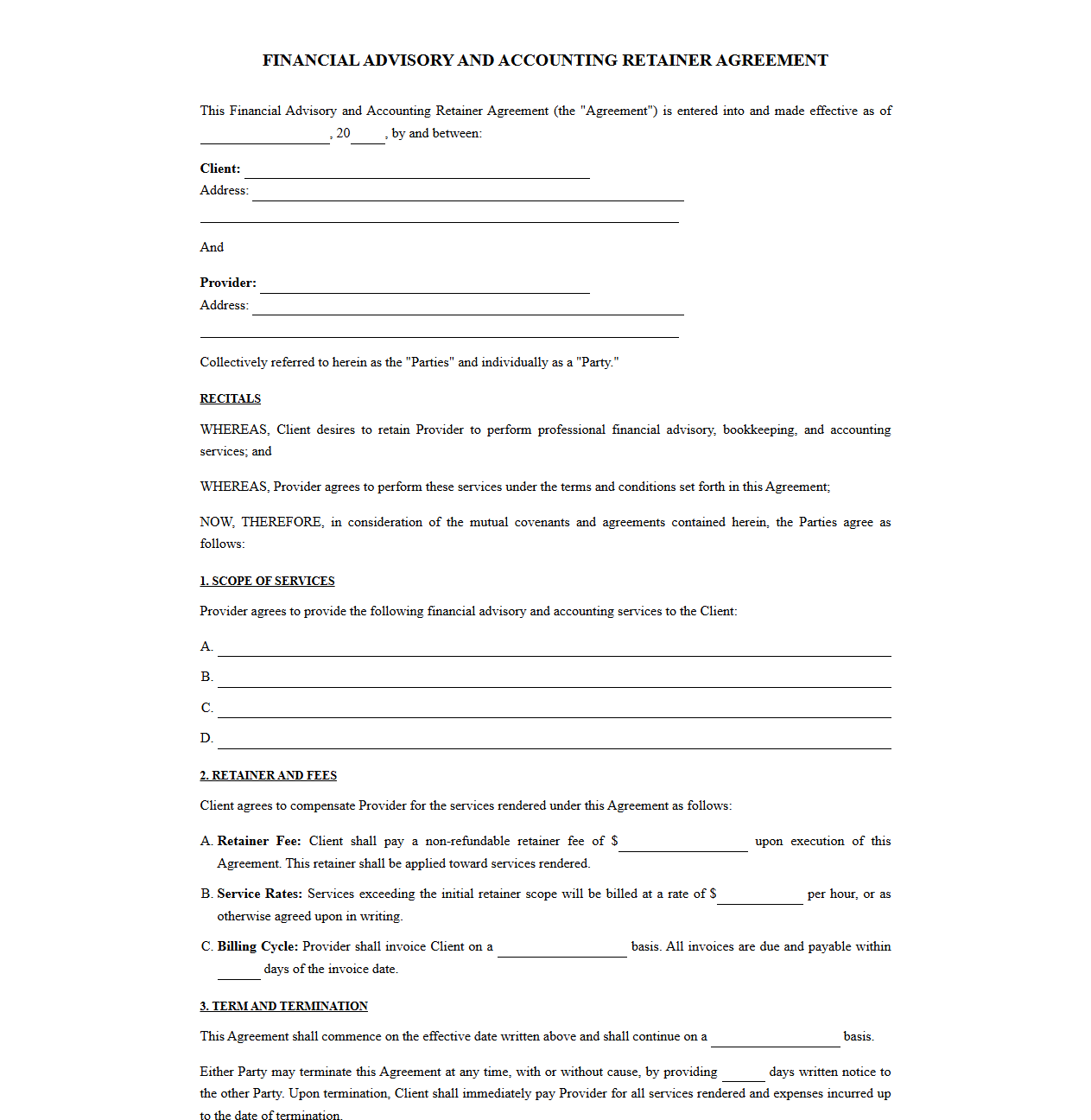 Download: .PDF
Retainer Agreement for Accounting and Financial Advisory Services
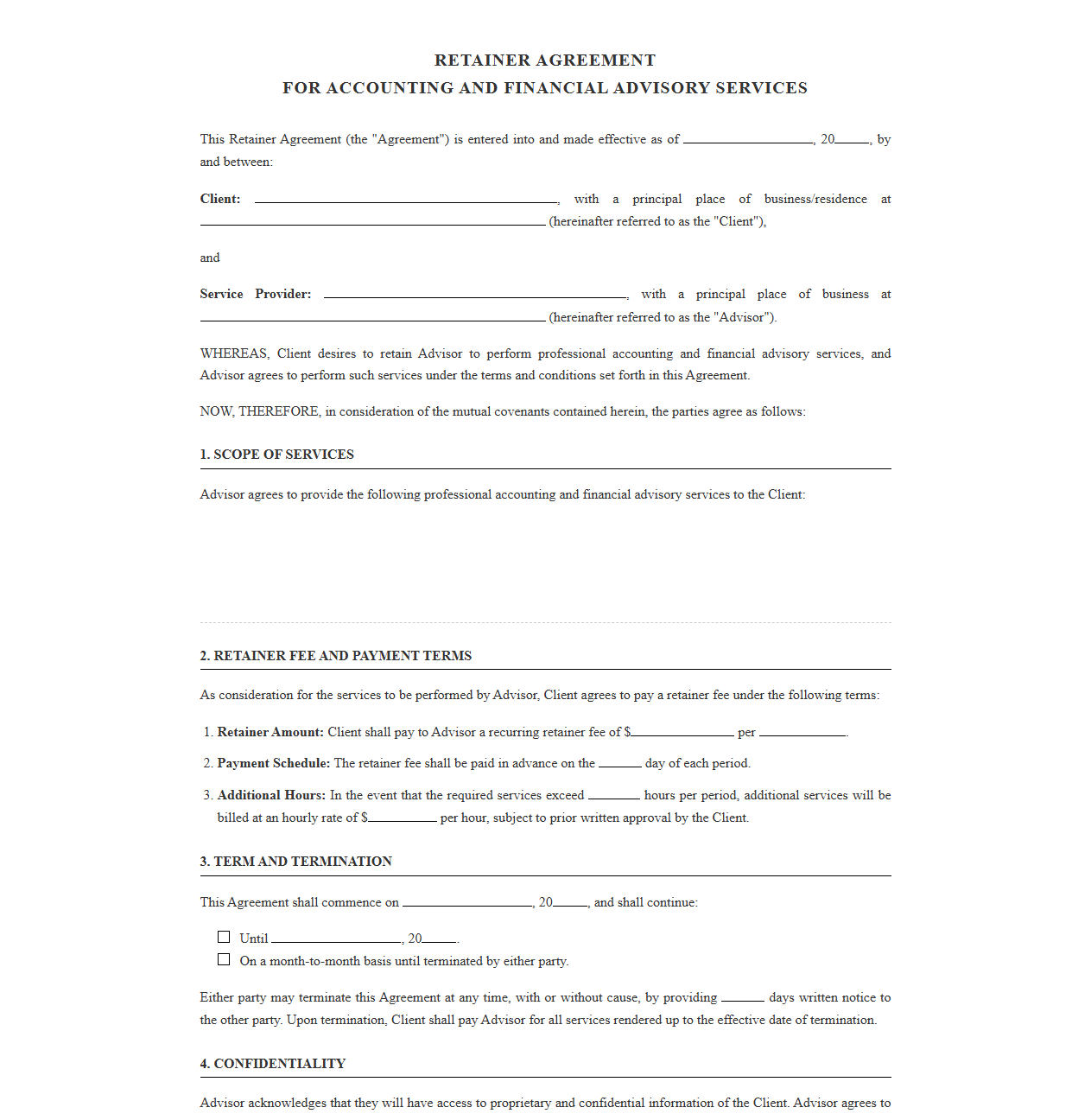 Download: .PDF
Accounting and Financial Advisory Retainer Contract
 Download: .PDF
Financial Advisory and Accounting Services Retainer Agreement
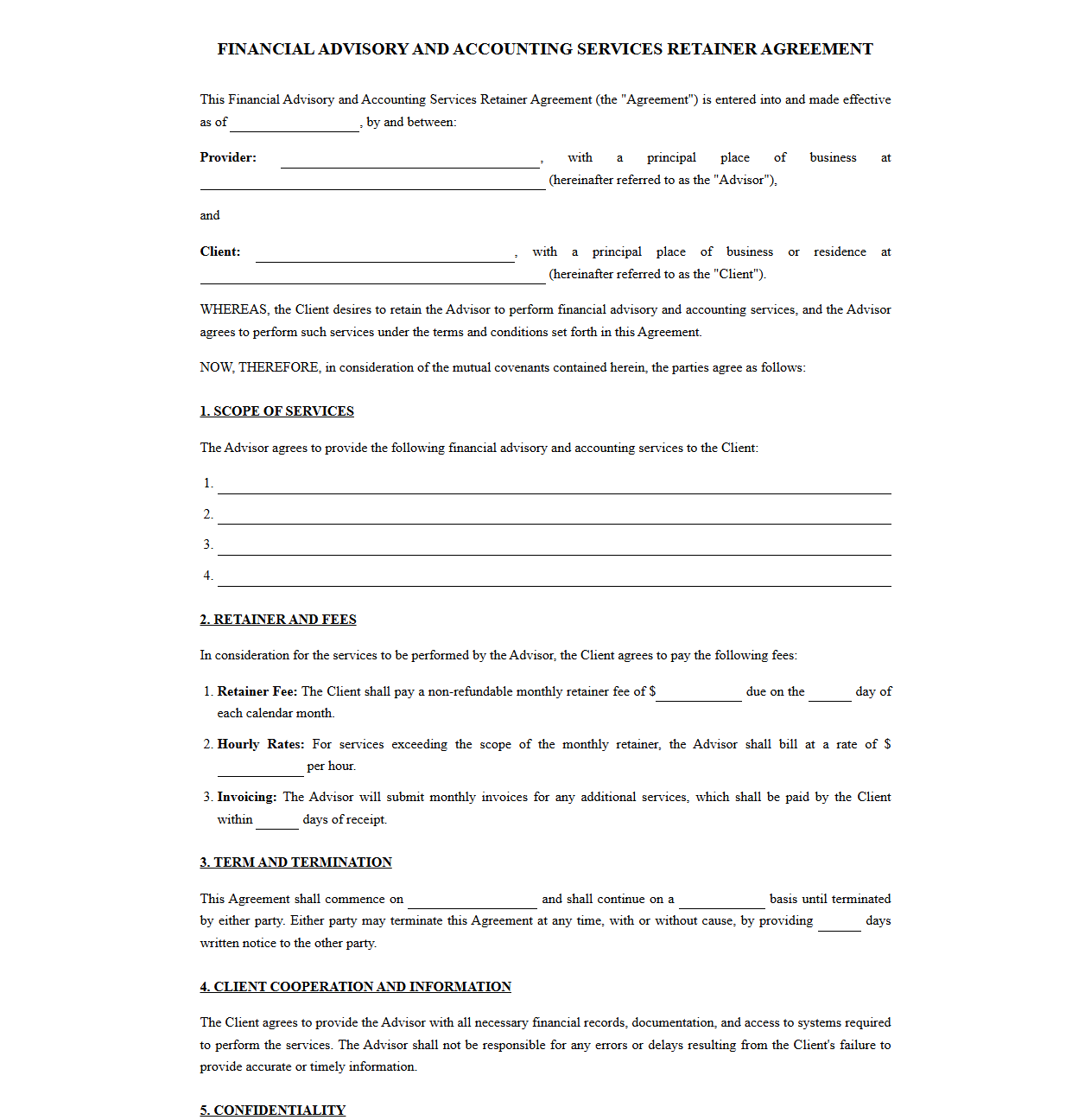 Download: .PDF
Professional Accounting and Financial Advisory Retainer Agreement
 Download: .PDF
Comprehensive Financial Advisory and Accounting Retainer Agreement
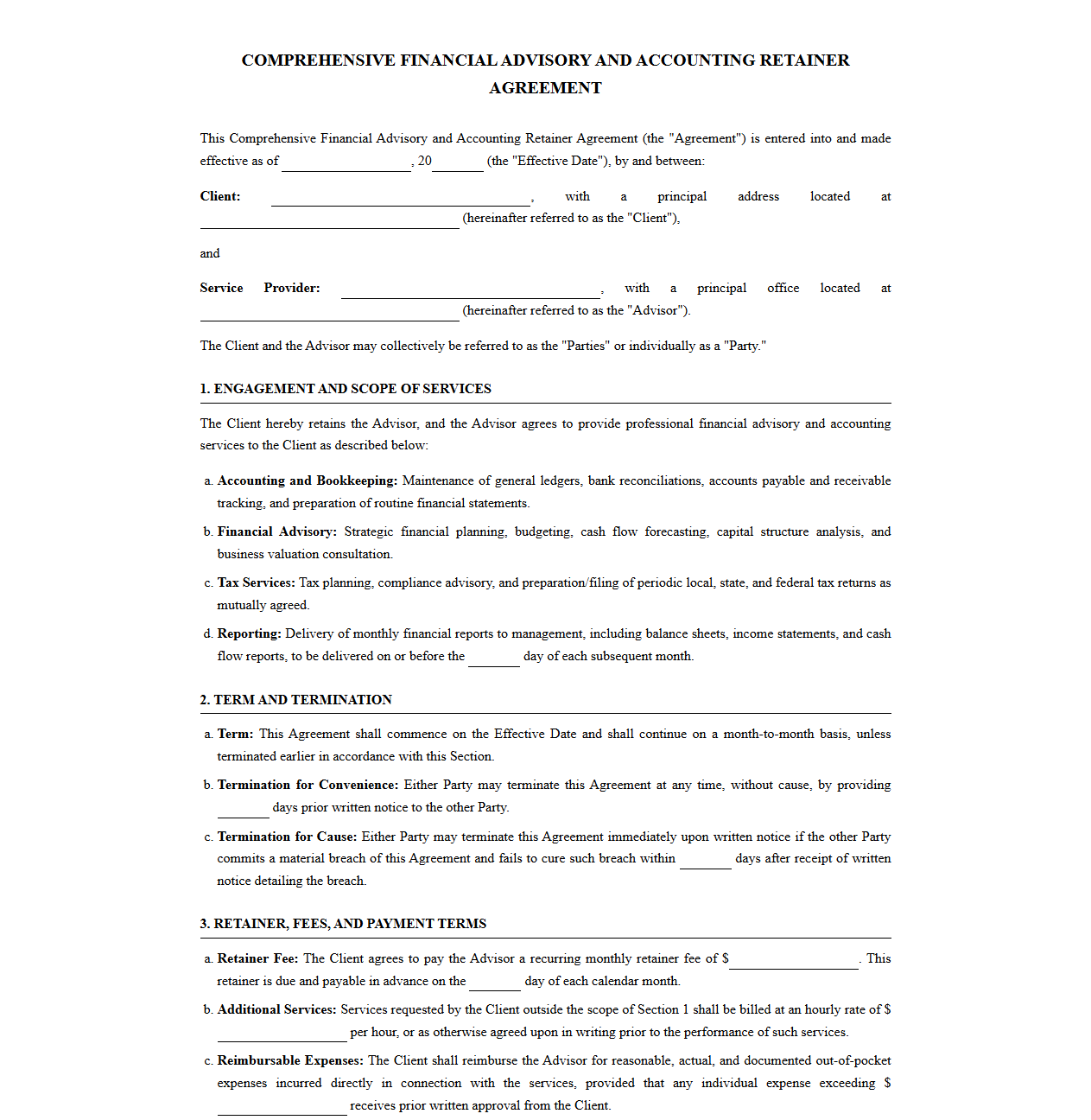 Download: .PDF
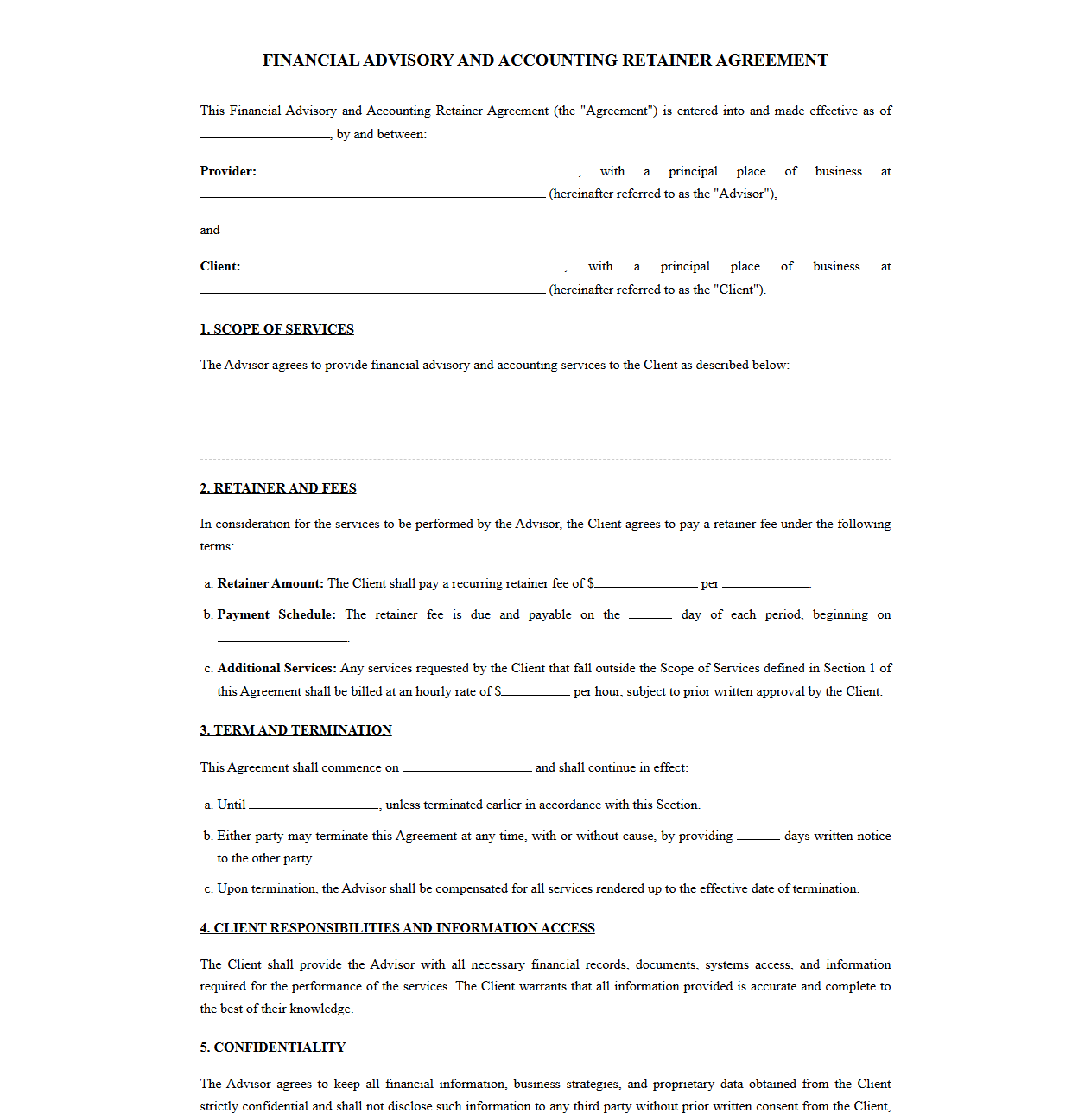
Retainer Contract for Financial Advisory and Accounting Services
 Download: .PDF
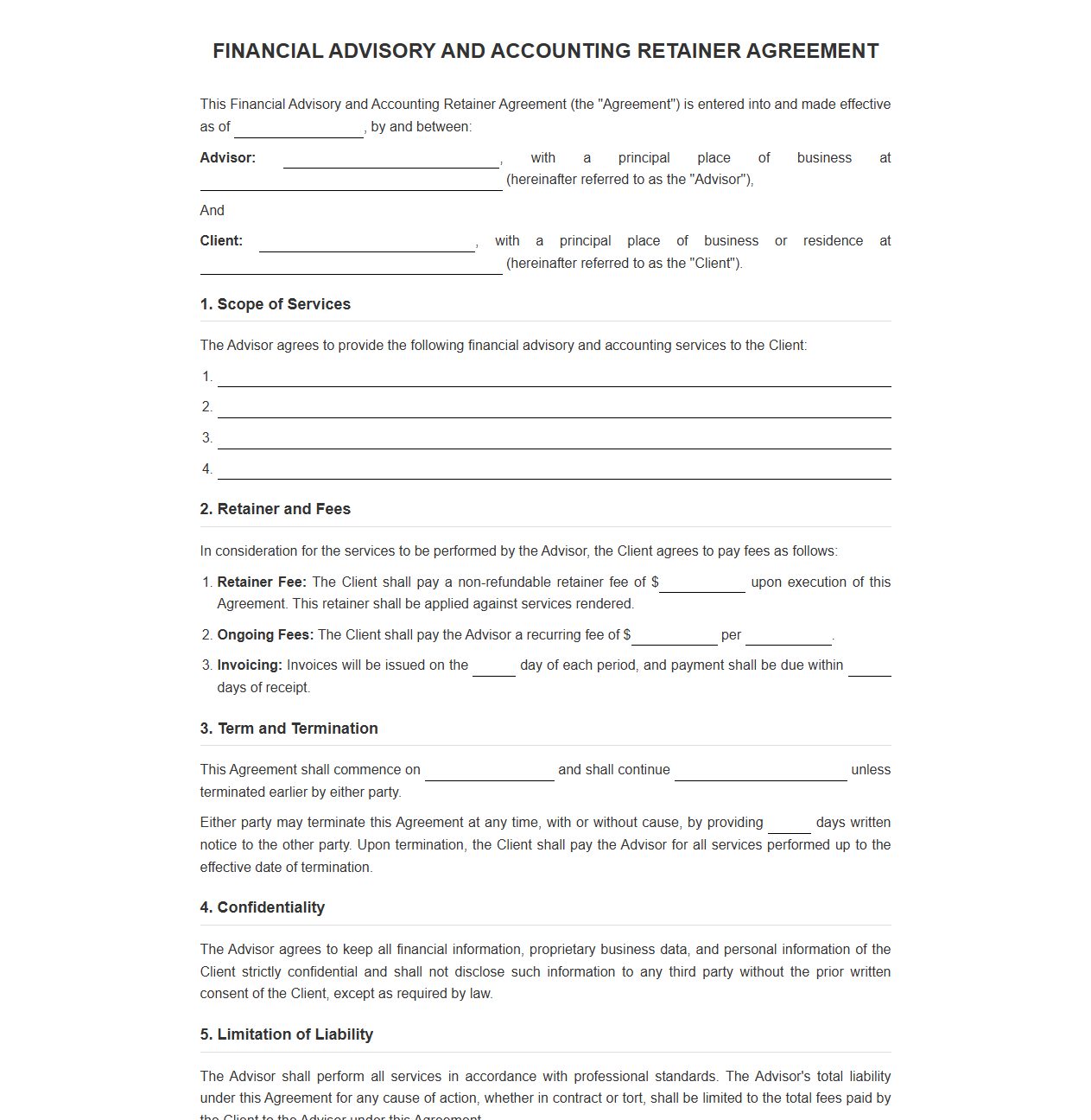
Standard Financial Advisory and Accounting Retainer Agreement
 Download: .PDF
Introduction: The Power of Retainer Agreements for Financial Professionals
For financial advisors, accountants, and bookkeepers, the traditional hourly billing model often leads to unpredictable income fluctuations and administrative headaches. Transitioning to a retainer-based model shifts the dynamic from transactional consultations to continuous, high-value partnerships. By securing professional retainer agreements, financial practitioners can count on a steady, predictable cash flow while clients enjoy ongoing, proactive financial guidance without the fear of unexpected hourly bills.
This fee structure does more than stabilize your firm's revenue; it fundamentally strengthens client relationships. When clients pay a recurring retainer, they view their financial professional as a strategic partner deeply invested in their long-term growth. This continuous engagement fosters unparalleled client trust, as advisors can proactively address financial opportunities and risks rather than reacting only when a crisis occurs.
Key Benefits of Retainer-Based Engagements
Adopting a retainer model transforms the operational efficiency of a financial practice and clarifies the value proposition for the client. Here are the primary advantages of utilizing structured retainer engagements:
- Predictable Recurring Revenue: Establishes a dependable baseline of monthly or quarterly income, allowing firms to forecast growth, hire staff, and invest in technology with confidence.
- Structured Onboarding Processes: Enables a smoother transition for new clients by setting clear expectations and aligning administrative workflows from day one.
- Clear Scope Definition: Minimizes "scope creep" by explicitly outlining which services are covered under the recurring fee and which require additional, project-based billing.
- Enhanced Client Accessibility: Promotes open communication, as clients feel comfortable reaching out for advice without worrying about the billable clock ticking.
Core Elements of a Professional Retainer Agreement
A legally sound and mutually beneficial retainer agreement relies on clarity. To ensure both parties are aligned, your contract must contain several essential clauses.
1. Detailed Scope of Services
This section outlines exactly what tasks, reports, and advisory services are covered under the recurring fee. Clearly delineating these tasks prevents misunderstandings regarding what is included in the monthly rate and what constitutes extra work.
2. Payment Terms and Schedule
Specify the retainer amount, the billing frequency (such as monthly or quarterly), and the payment due date. It is also wise to outline accepted payment methods, such as ACH or credit card, and any late payment fees.
3. Termination and Out-of-Scope Provisions
A well-drafted termination clause defines how either party can end the agreement, including the required notice period (typically 30 days). Additionally, define the hourly rate or flat fees that apply if the client requests out-of-scope work.
Customizable Retainer Agreement Template for Financial Advisors
Below is a customizable professional retainer template designed for financial advisors. This template focuses on ongoing wealth management, financial planning, and portfolio reviews. Copy and paste this text, filling in the bracketed placeholders to match your specific terms.
RETAINER AGREEMENT: FINANCIAL ADVISORY SERVICES
This Agreement is made effective as of [Date], by and between:
Advisor: [Advisor Name/Firm], located at [Advisor Address]
Client: [Client Name], located at [Client Address]
1. Scope of Services
The Advisor agrees to provide the Client with ongoing financial planning and advisory services, which include:
- [e.g., Quarterly portfolio review and rebalancing]
- [e.g., Annual comprehensive financial plan updates]
- [e.g., Unlimited email and telephone consultation regarding investment strategies]
2. Retainer Fee and Payment Terms
In consideration for the services outlined above, the Client agrees to pay a recurring retainer fee of $[Amount] per [Month/Quarter]. This fee is due in advance on the [Day, e.g., 1st] of each billing cycle. Payments shall be made via [ACH/Credit Card/Bank Transfer].
3. Out-of-Scope Work
Any services requested by the Client not expressly listed in Section 1 will be billed separately at the Advisor's standard hourly rate of $[Hourly Rate]/hour, or subject to a separate written project agreement.
4. Term and Termination
This agreement shall remain in effect on a month-to-month basis. Either party may terminate this agreement at any time by providing at least [Number, e.g., 30] days written notice to the other party.
Client Signature: ___________________________ Date: ___________
Advisor Signature: __________________________ Date: ___________
Customizable Retainer Agreement Template for Accountants and Bookkeepers
Accountants and bookkeepers have different operational cycles, often focused on monthly reconciliation, payroll, and tax deadlines. Use the following template to establish clear monthly accounting retainers.
RETAINER AGREEMENT: ACCOUNTING & BOOKKEEPING SERVICES
This Agreement is entered into on [Date], by and between:
Practitioner: [Firm/Accountant Name], located at [Firm Address]
Client: [Client/Business Name], located at [Client Address]
1. Scope of Services
The Practitioner will perform the following recurring professional accounting services:
- [e.g., Monthly bank and credit card reconciliation for up to [X] accounts]
- [e.g., Monthly preparation of Profit & Loss and Balance Sheet statements]
- [e.g., Quarterly sales tax filing and payroll processing assistance]
- [e.g., Annual business tax preparation and filing]
2. Retainer Fee and Payment Terms
The Client agrees to pay a monthly retainer fee of $[Amount]. This fee is due on the [Day, e.g., 5th] day of each calendar month. Work will commence only upon receipt of the monthly payment.
3. Client Responsibilities
The Client must provide all bank statements, invoices, and financial records necessary to complete the work by the [Day, e.g., 10th] of each month. Delayed documentation may result in delayed deliverables.
4. Termination Clause
Either party may terminate this agreement with [Number, e.g., 30] days written notice. In the event of termination, the Client shall pay for all services rendered up to the termination effective date.
Client Signature: ___________________________ Date: ___________
Practitioner Signature: ______________________ Date: ___________
Best Practices for Implementing and Negotiating Retainers
Transitioning clients from hourly billing to a recurring retainer requires clear communication and a firm value proposition. Follow these steps to execute the transition successfully:
- Quantify the Value of Peace of Mind: Explain to clients that a retainer gives them predictable expenses and unlimited access to your expertise without fear of a surprise bill.
- Review Historic Billable Hours: When transitioning an existing client, review their past 12 months of invoices to calculate a fair monthly average that reflects their historical usage.
- Overcome the "Paying for Idle Time" Objection: Address worries about paying for unused services by highlighting the continuous monitoring, background software maintenance, and proactive planning your firm provides even during quiet months.
- Set Clear Boundaries Early: Be strict about what constitutes "out-of-scope" work from the very beginning to establish healthy boundaries and protect your profit margins.
Legal Considerations and Final Steps
While utilizing pre-drafted templates can save significant administrative time, these documents must be tailored to your local jurisdictions and specific practice styles. Every financial firm operates under distinct regulatory bodies, which may dictate specific disclosure rules for upfront fees.
Disclaimer: The templates and guidelines provided in this article are intended strictly for educational and informational purposes. They do not constitute formal legal advice. You should always have your customized retainer agreements reviewed by qualified legal counsel to ensure compliance with all federal, state, and local regulations.

Leave a comment