
Managing outstanding invoices and persistent payment friction can paralyze subcontractor relations, stalling project momentum and draining vital administrative resources. Navigating these highly charged disputes requires balancing complex prompt payment statutes with the preservation of critical commercial partnerships. Utilizing standardized invoice settlement agreement templates grants project managers the power to bypass costly litigation, securing immediate, legally binding resolutions that protect cash flow.
However, while these frameworks streamline negotiations, they must be treated as structured baseline agreements tailored to local regulations rather than universal legal cure-alls. For instance, incorporating specific mechanisms like conditional lien waivers and structured partial payment releases ensures both parties remain contractually protected during reconciliation. In this guide, we will explore how to effectively deploy these essential templates, customize them for your specific operational needs, and restore financial harmony to your project pipeline.
Subcontractor Invoice Dispute Settlement Agreement Template
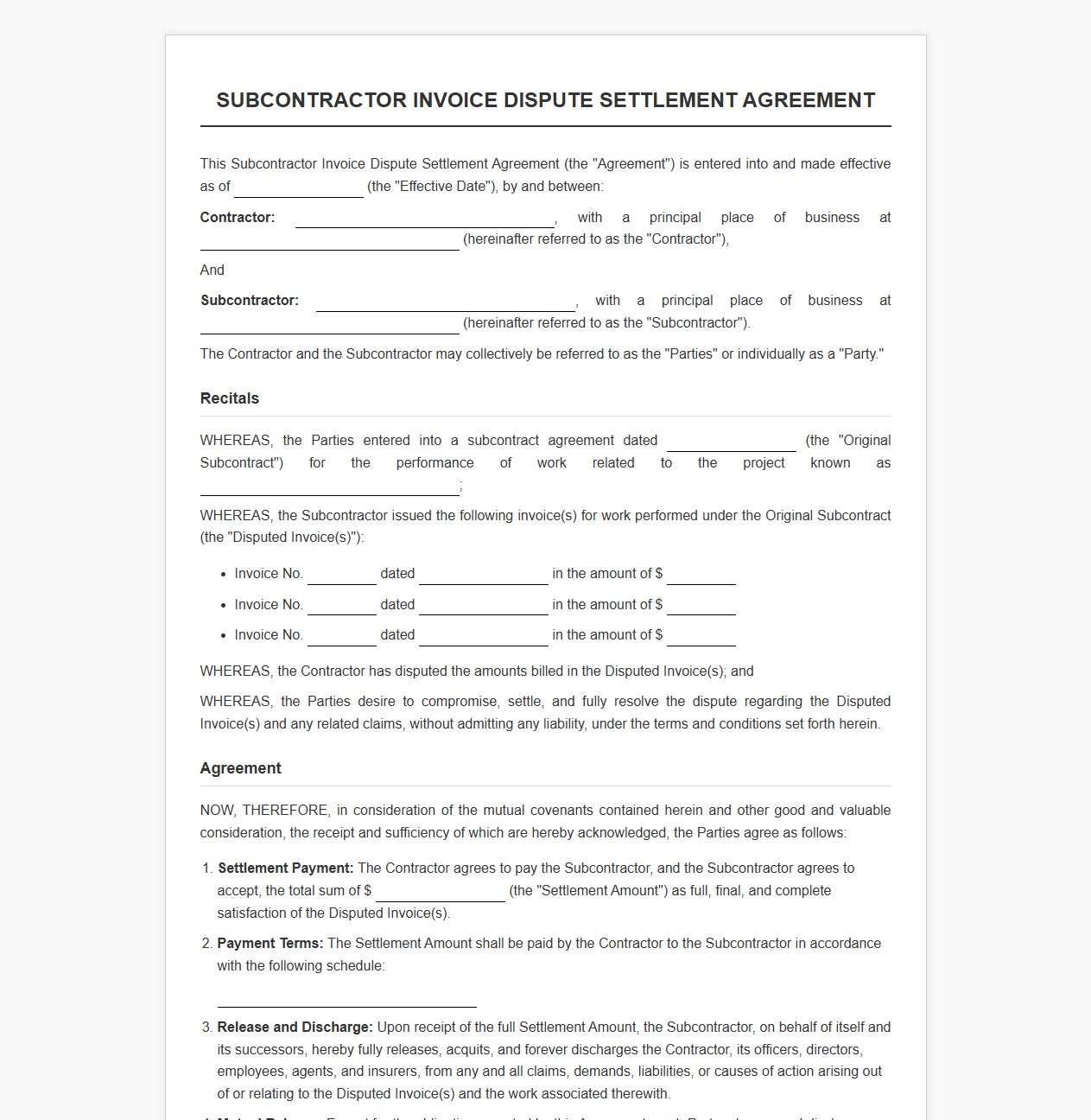 Download: .PDF
Disputed Invoice Resolution Agreement for Subcontractors
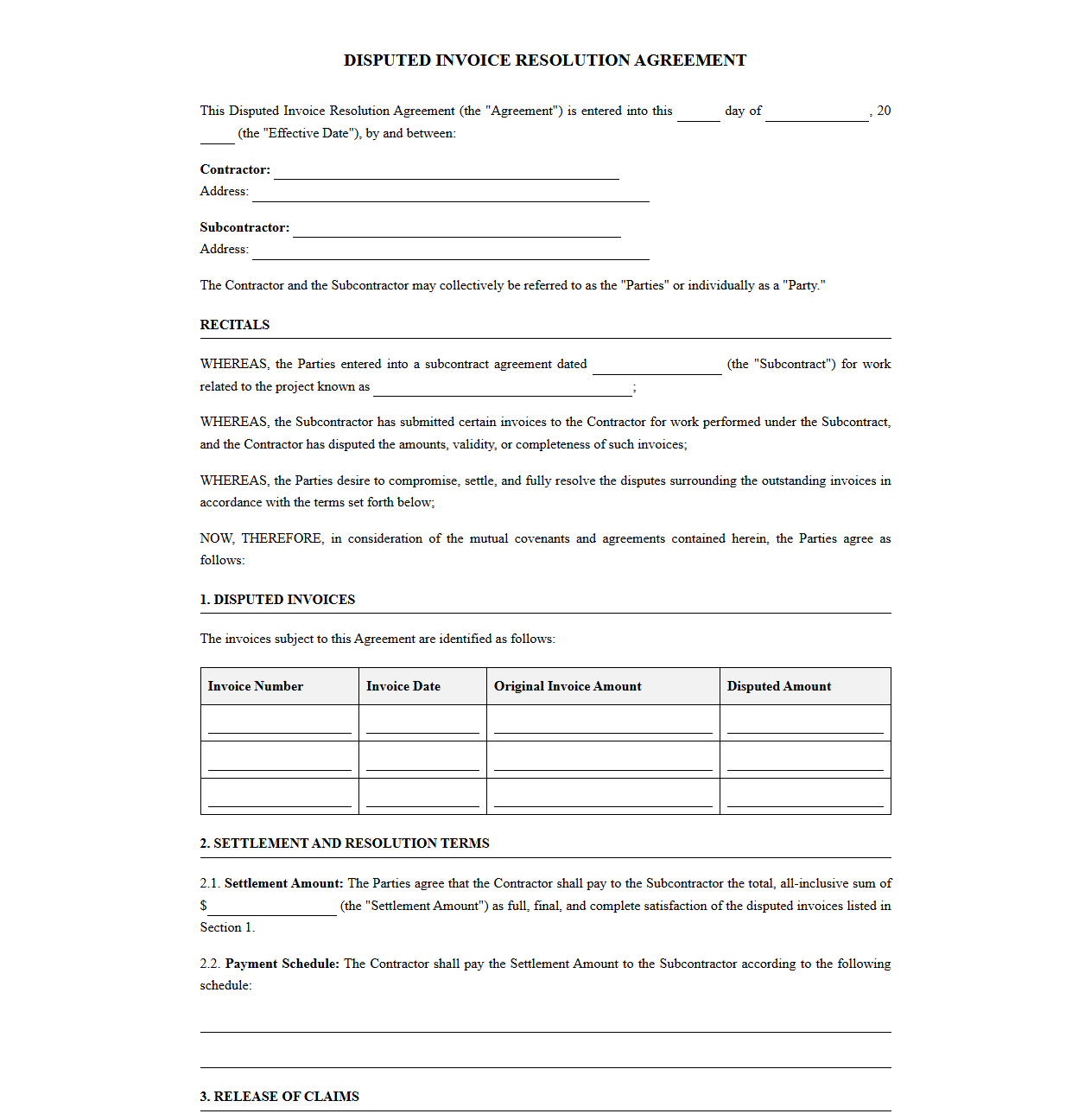 Download: .PDF
Subcontractor Billing Dispute Settlement Template
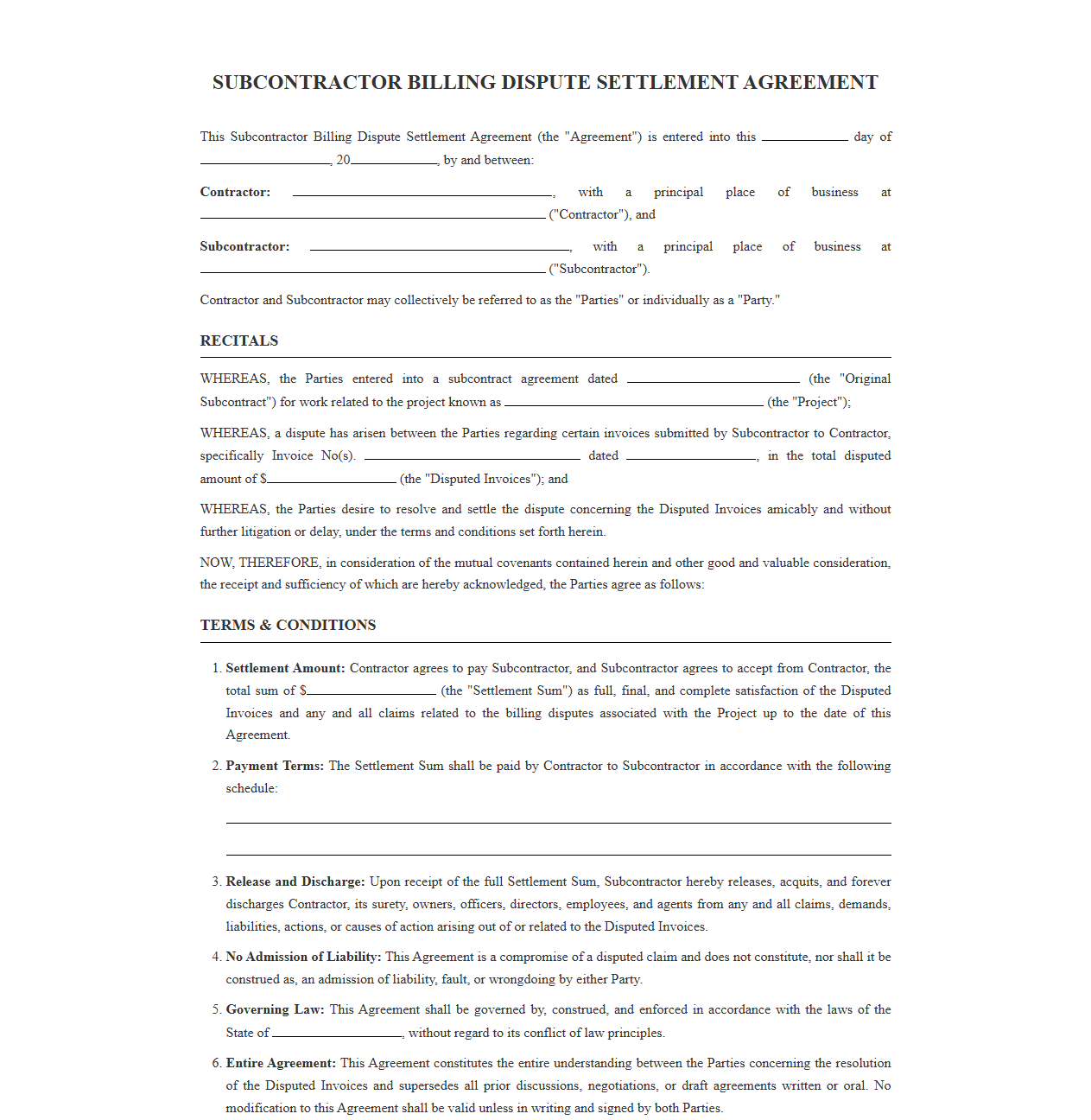 Download: .PDF
Subcontractor Disputed Invoice Reconciliation Agreement
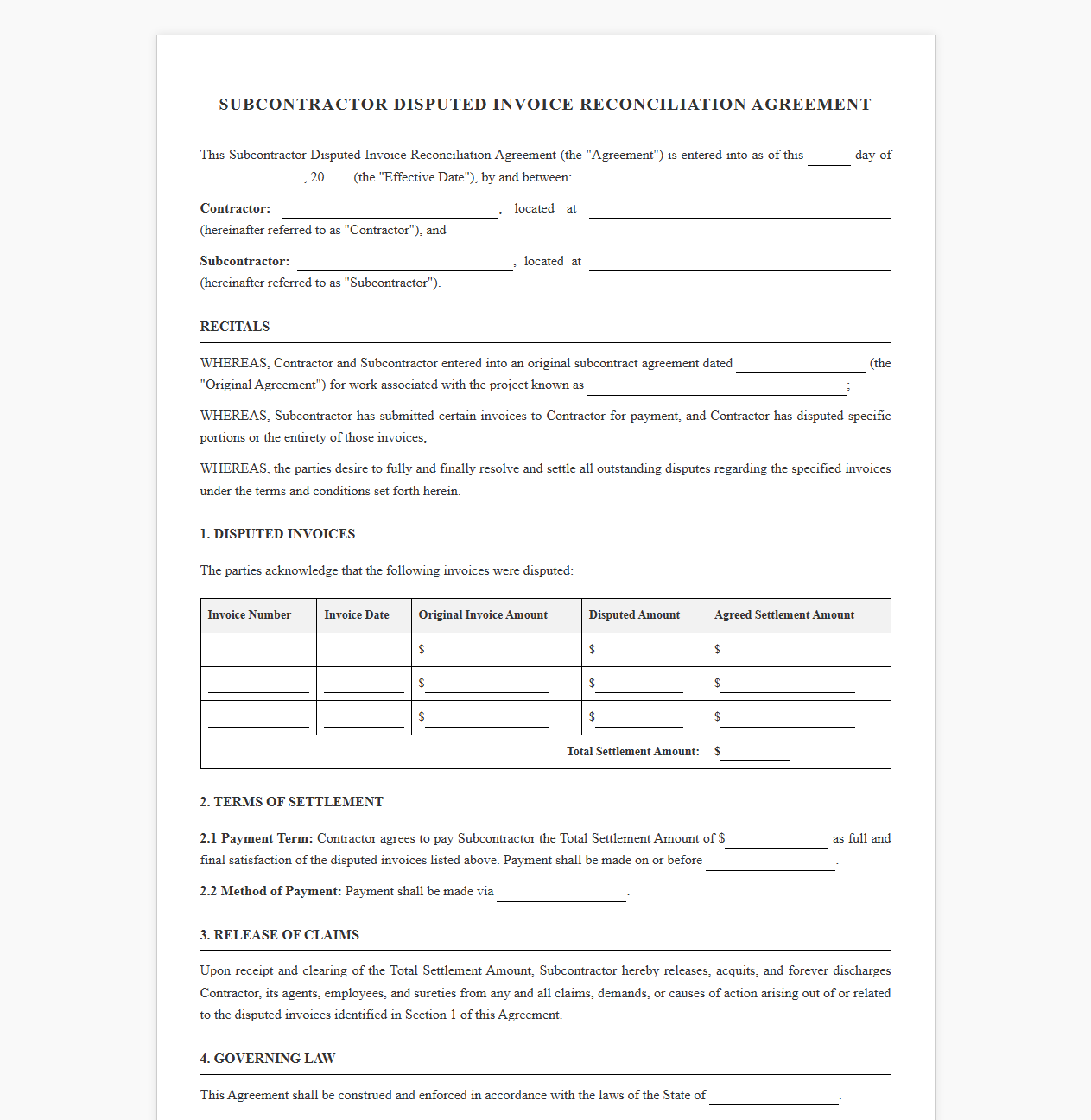 Download: .PDF
Agreement for Resolving Subcontractor Invoice Disputes
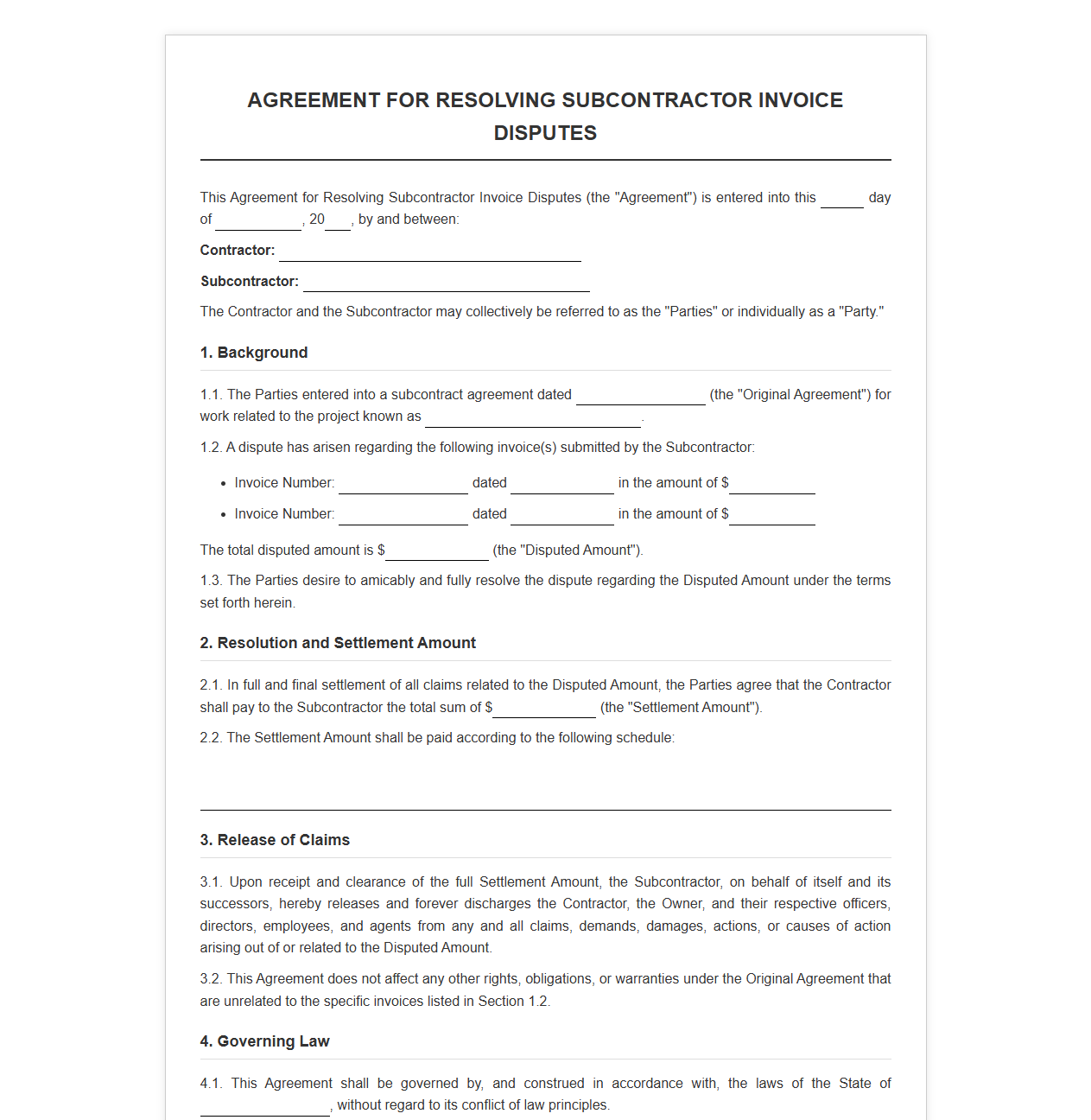 Download: .PDF
Subcontractor Payment Dispute Resolution Agreement Template
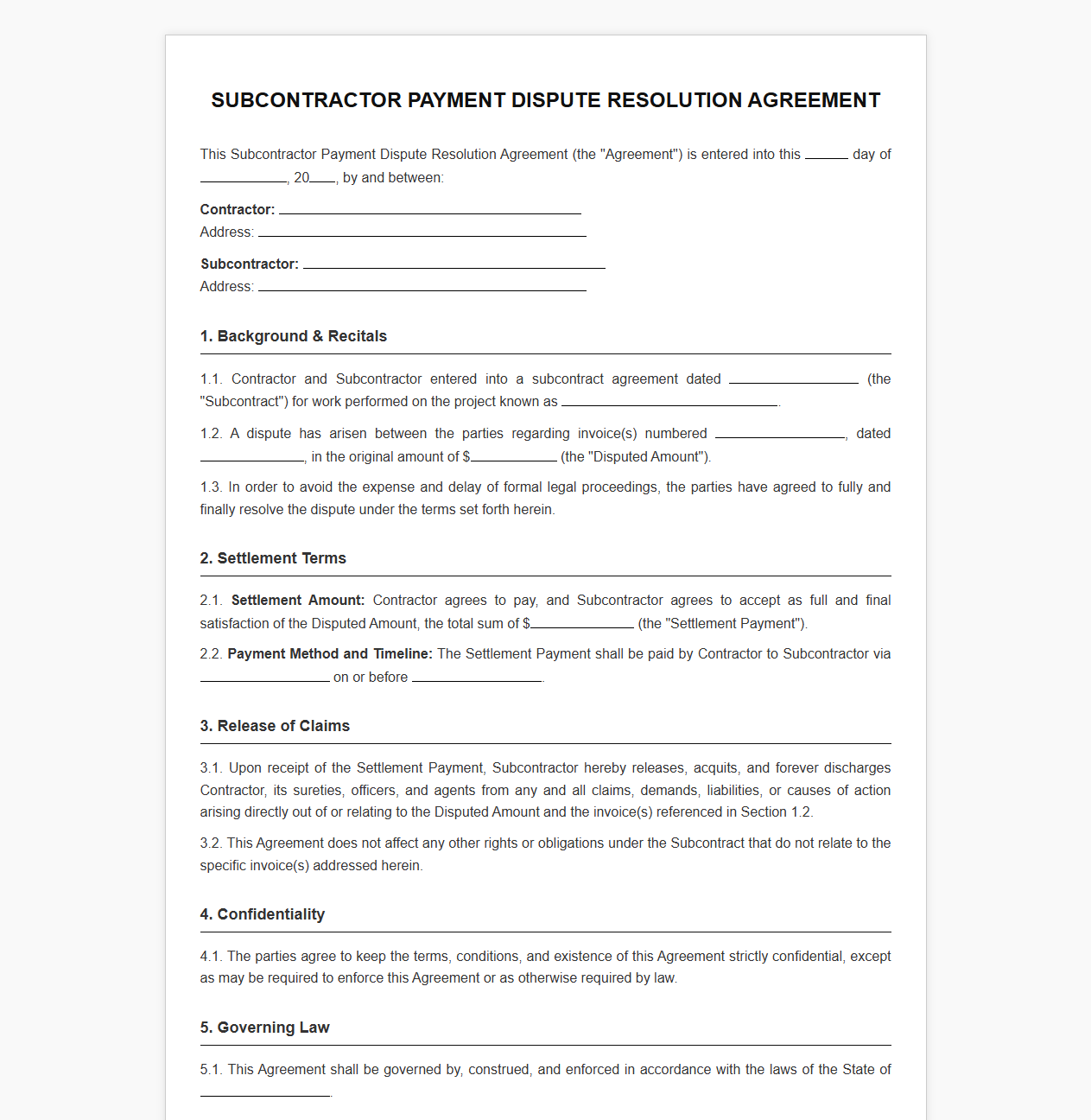 Download: .PDF
Disputed Billing Settlement Agreement for Subcontractors
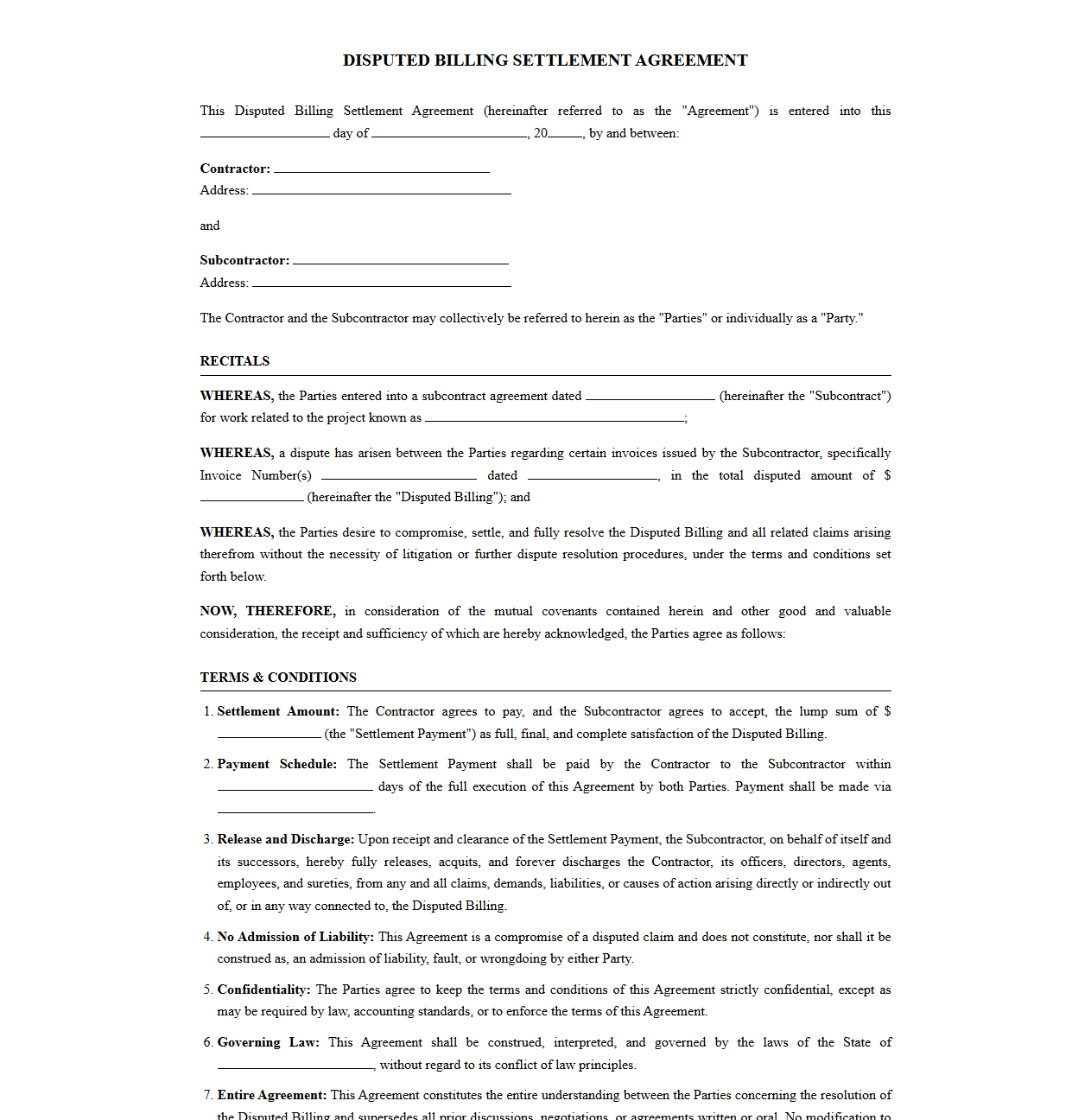 Download: .PDF
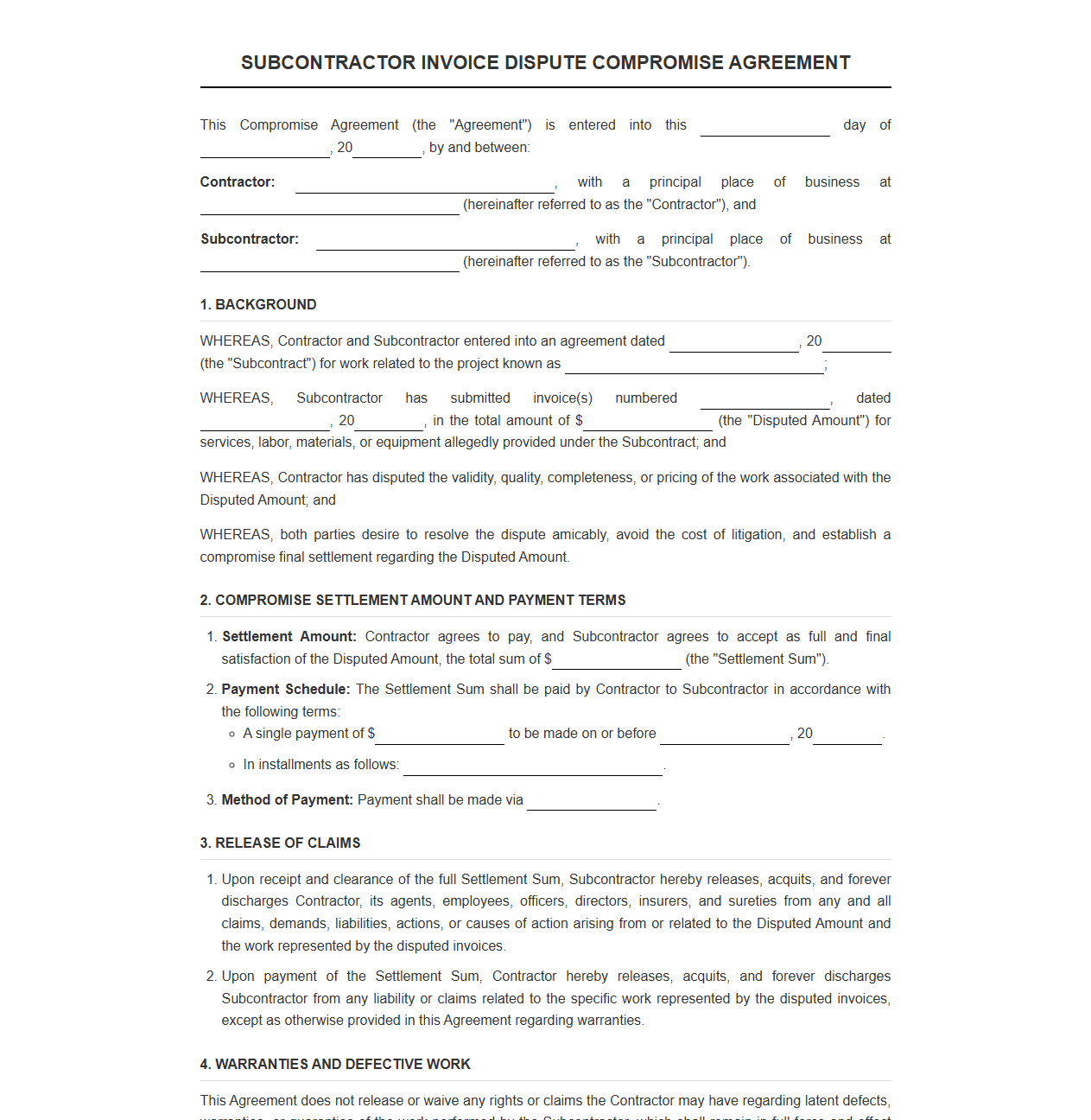
Subcontractor Invoice Dispute Compromise Agreement Template
 Download: .PDF
Understanding Subcontractor Payment Disputes in Construction
Payment disputes between contractors and subcontractors often arise due to communication gaps, scope-of-work misalignments, or cash flow challenges. Unresolved invoices can halt project momentum entirely, causing delays that affect the entire supply chain. Industry data shows that more than 30% of construction projects experience significant payment delays, which can threaten the financial survival of smaller subcontractors. Utilizing formal settlement agreements helps restore project momentum by establishing clear expectations and legally binding resolutions.
The Role of Written Settlement Agreements
Using written settlement templates provides critical legal and operational benefits. By formalizing agreements in writing, both parties mitigate litigation risks and establish explicit payment terms. Rather than relying on verbal promises, a written record guarantees that both contractors and subcontractors are aligned on outstanding balances and project deliverables.
These documents serve as enforceable contracts that protect business relationships. They allow projects to move forward without the looming threat of costly court battles, ensuring operational continuity.
Essential Clauses in a Subcontractor Settlement Template
- Release of Liens: The subcontractor agrees to waive or release mechanics' lien rights upon receiving the agreed-upon payment.
- Final Payment Amount: Clearly states the exact sum to be paid, leaving no room for interpretation.
- Dispute Waivers: Prevents either party from pursuing future legal action regarding the specific invoices in question.
- Confidentiality Clause: Keeps the terms and existence of the settlement private between the signing parties.
Template 1: Partial Payment and Lien Waiver Agreement
This agreement outlines the terms for a partial, progressive payment. The subcontractor waives lien rights incrementally as payments are successfully processed.
PARTIAL PAYMENT AND RELEASE OF LIEN
This agreement is entered into on this [Date], by and between [Contractor Name] ("Contractor") and [Subcontractor Name] ("Subcontractor").
In consideration of the partial payment of [$ Amount], Subcontractor hereby waives and releases its lien rights for work performed up to [Cut-off Date].
Signed: __________________ (Contractor)  Date: ___________
Signed: __________________ (Subcontractor)  Date: ___________
Template 2: Full and Final Settlement Agreement
For disputes that require a complete, lump-sum resolution, a final settlement agreement ensures that all past, present, and future claims regarding the disputed project scope are fully released.
"By signing this Full and Final Settlement Agreement, the Subcontractor acknowledges receipt of the final sum of [Amount] as complete satisfaction of all outstanding invoices. Both parties agree to release, acquit, and forever discharge each other from any and all claims, liabilities, or demands arising from Project [Project Name]."
Steps to Negotiate and Execute the Settlement
Navigating an invoice dispute requires structured communication to avoid costly legal escalations. Following a clear, sequential path helps both parties find common ground swiftly.
- Identify and Document the Dispute: Gather all relevant contracts, daily logs, and invoice records to pinpoint the discrepancy.
- Initiate an Open Dialogue: Schedule a face-to-face meeting or call to discuss the issue without immediate legal threats.
- Propose a Structured Settlement: Offer a compromise, such as a reduced lump-sum payment or a structured installment plan.
- Draft and Execute the Written Agreement: Formalize the mutually agreed terms using a legally binding template signed by both parties.
Proactive Strategies to Prevent Future Invoice Disputes
Preventing payment disputes starts long before work begins on the construction site. By establishing strong operational habits, contractors and subcontractors can maintain positive working relationships and steady cash flow.
Draft clear initial contracts that outline specific payment terms, deadlines, and dispute-resolution pathways. Implementing automated invoicing systems reduces administrative errors and ensures timely submission of payment applications. Finally, maintaining transparent communication throughout the project lifecycle ensures that potential delays or scope changes are addressed and documented immediately, protecting both parties' financial interests.
Leave a comment