

Finance teams constantly struggle with the volatile task of bad debt provisioning, where overestimating stifles operational cash flow and underestimating risks severe balance sheet distortion. To resolve this balancing act, we must first examine the increasingly stringent compliance standards under IFRS 9 and ASC 326. Navigating these shifting regulatory landscapes requires structured, repeatable systems.
Standardizing your approach with dedicated templates grants your organization immediate reporting precision and defensible audit trails. Please note, however, that while these templates serve as robust structural frameworks, they must be calibrated to your specific industry's historical loss rates. For instance, implementing a dynamic aging-of-receivables template provides the concrete mathematical proof required to justify your allowances to stakeholders.
Below, we explore essential provisioning templates, break down key estimation methodologies, and outline best practices for integrating these tools into your financial close workflow.
Bad Debt Provision Statement Template
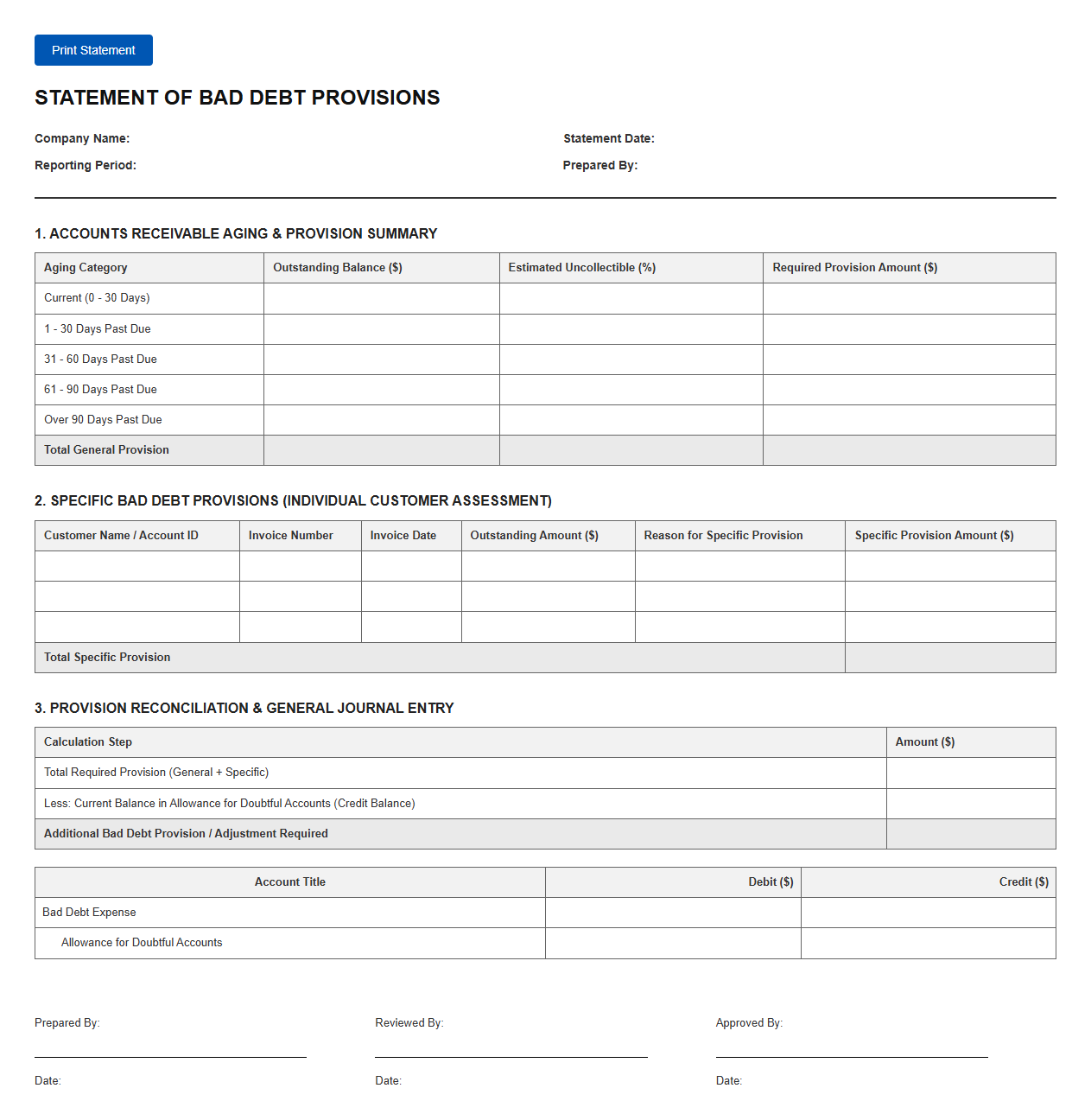 Download: .PDF
Allowance for Doubtful Accounts Statement Sheet
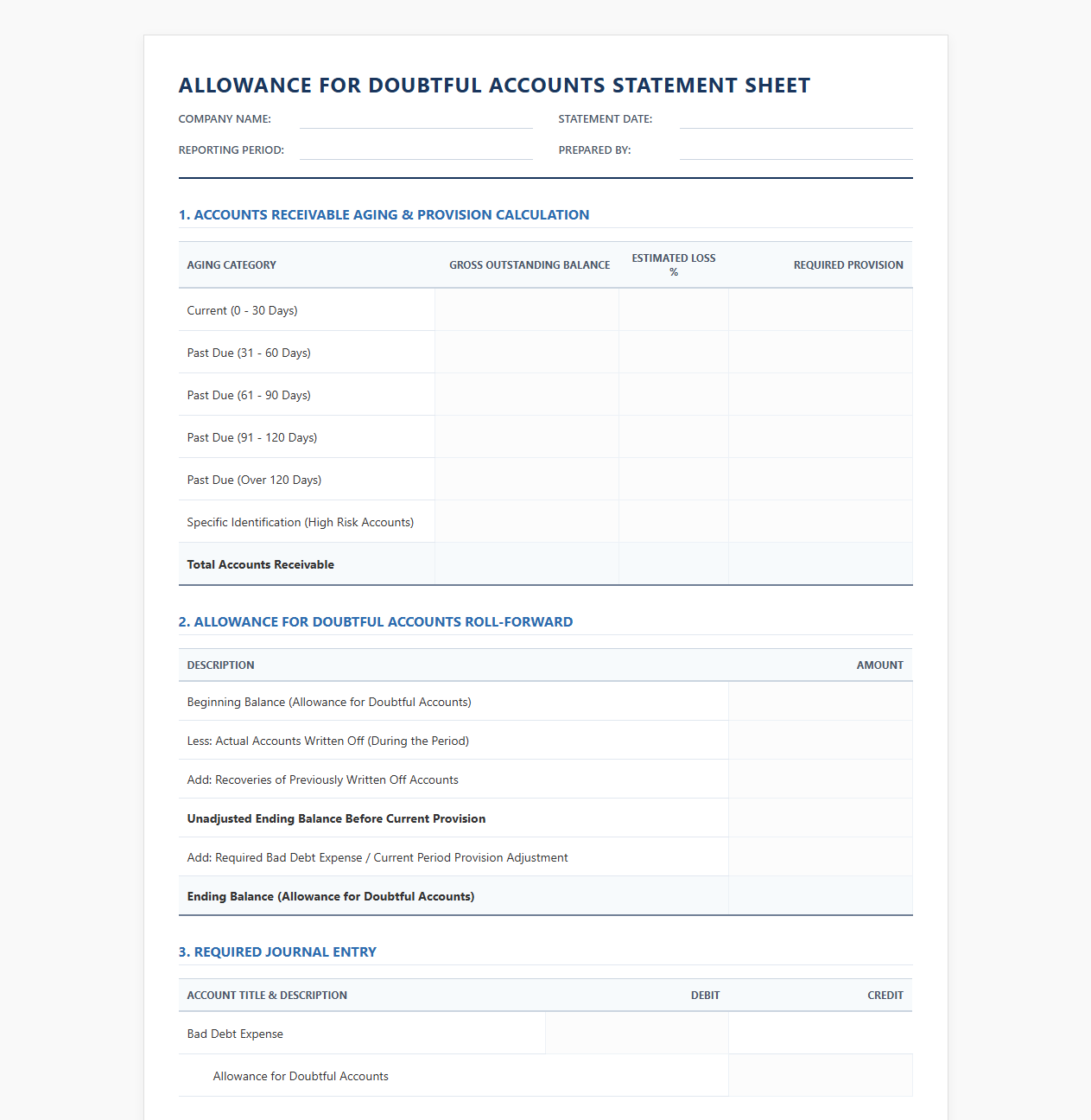 Download: .PDF
Uncollectible Accounts Provision Statement Form
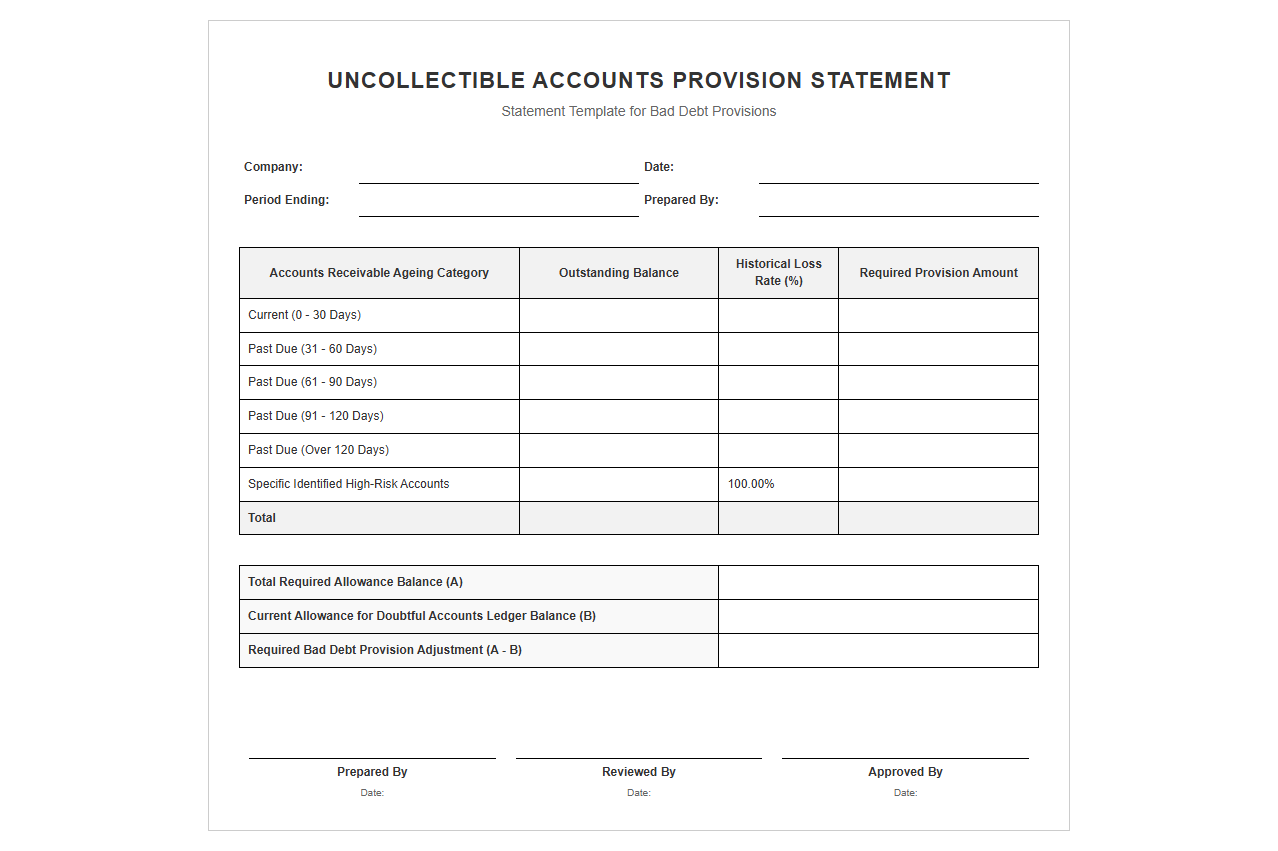 Download: .PDF
Bad Debt Reserve Estimation Statement
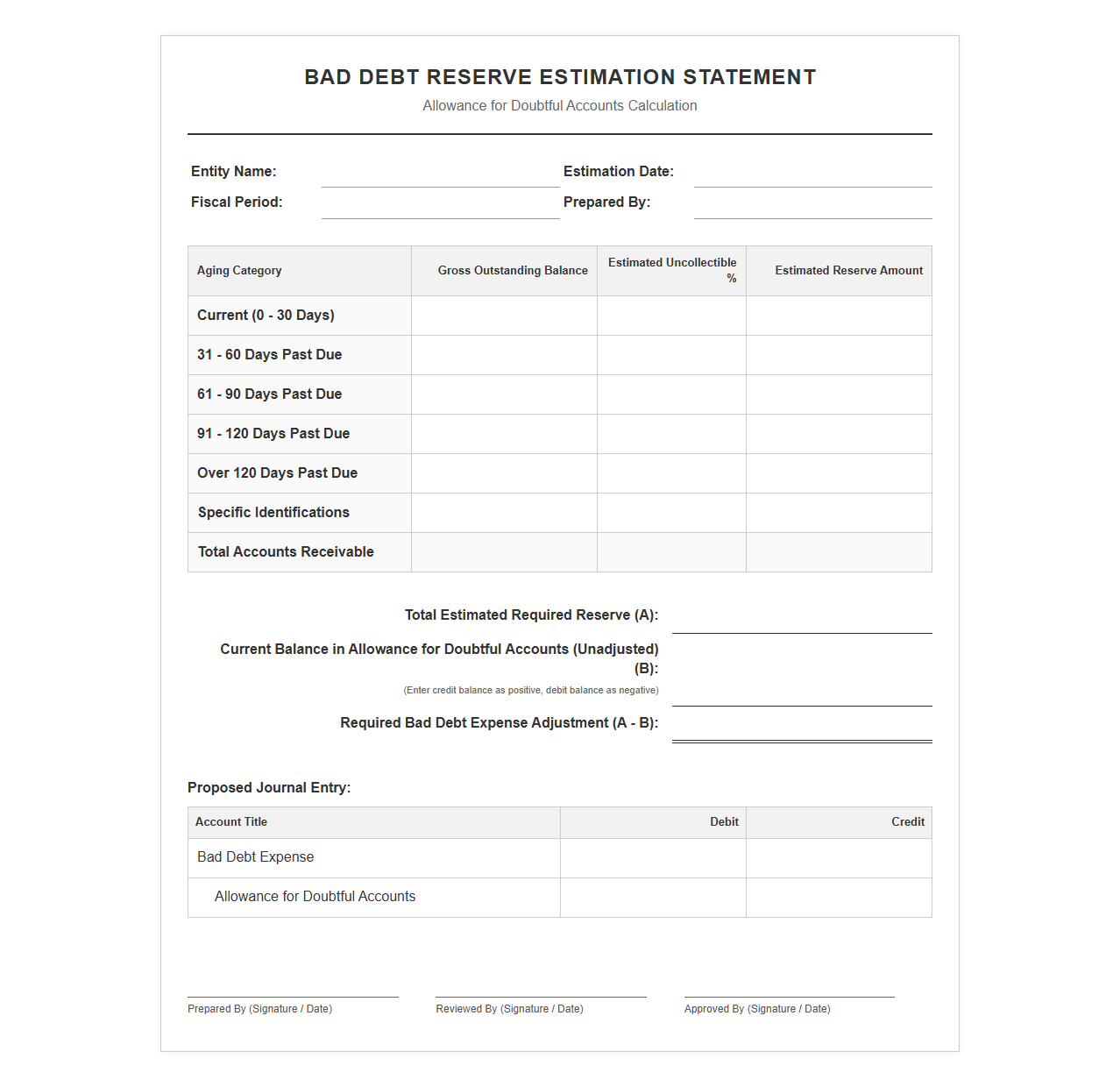 Download: .PDF
Provision for Bad Debts Calculation Statement
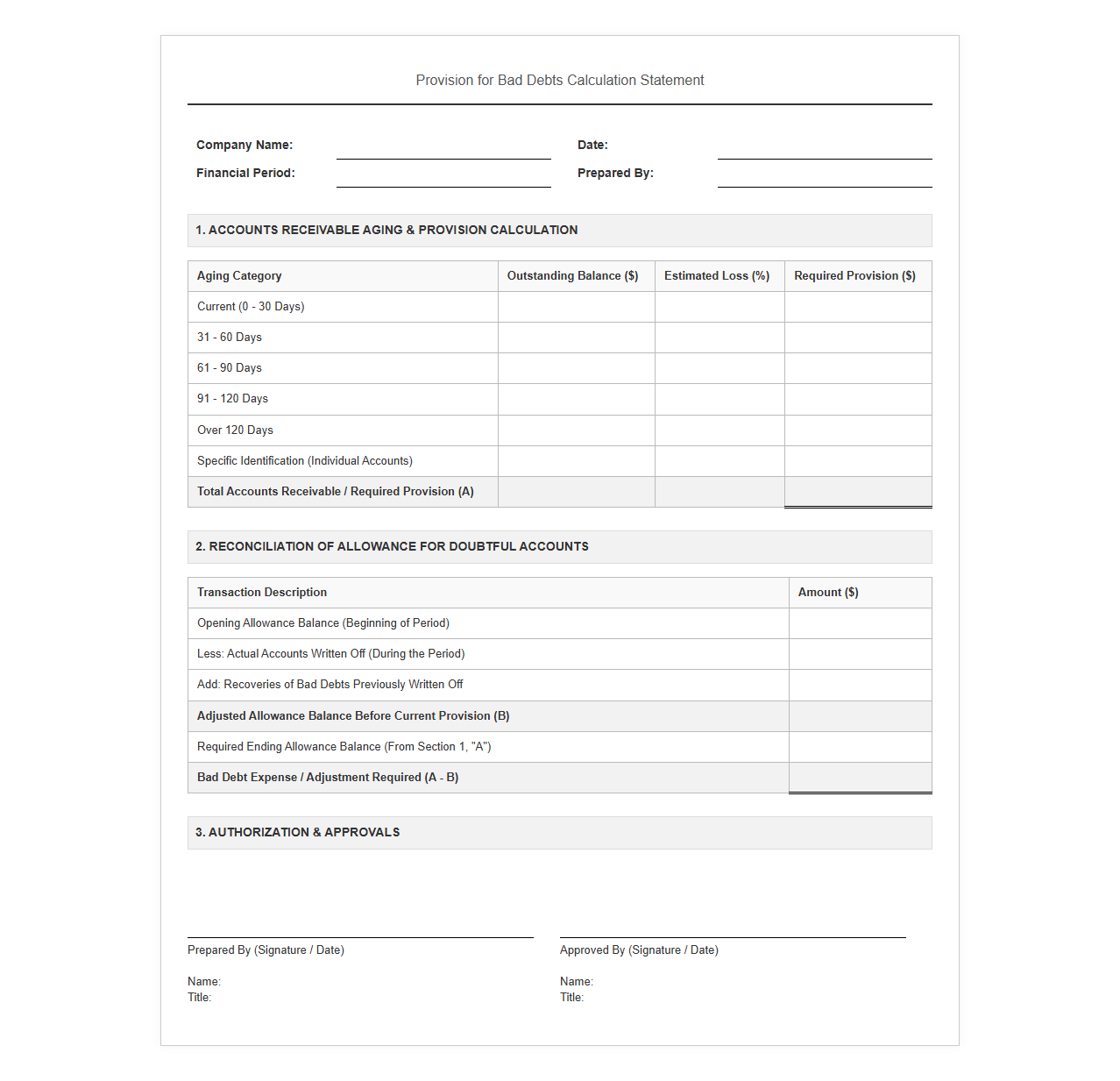 Download: .PDF
Expected Credit Loss Provision Statement Template
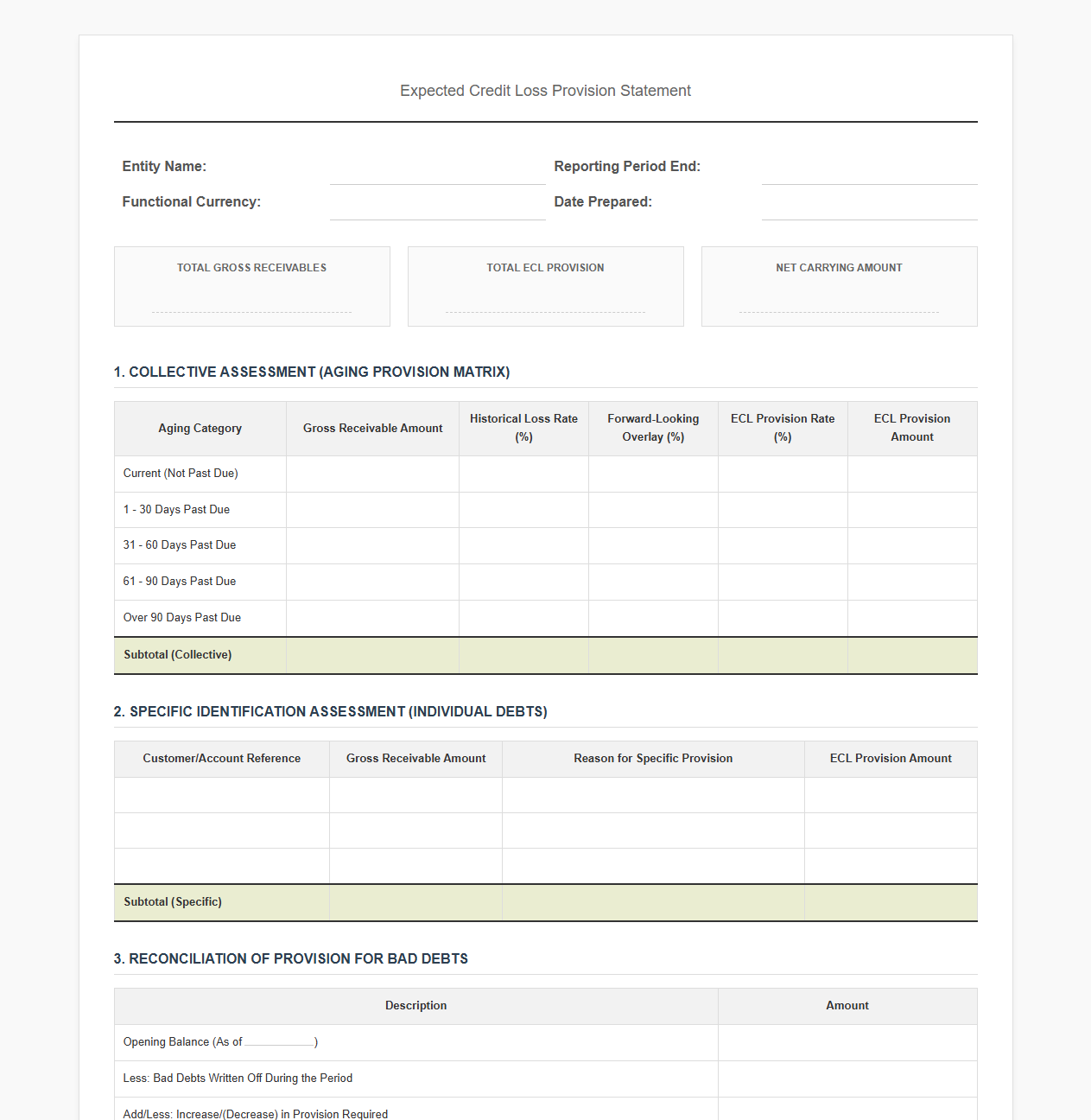 Download: .PDF
Doubtful Debts Provision Statement Ledger
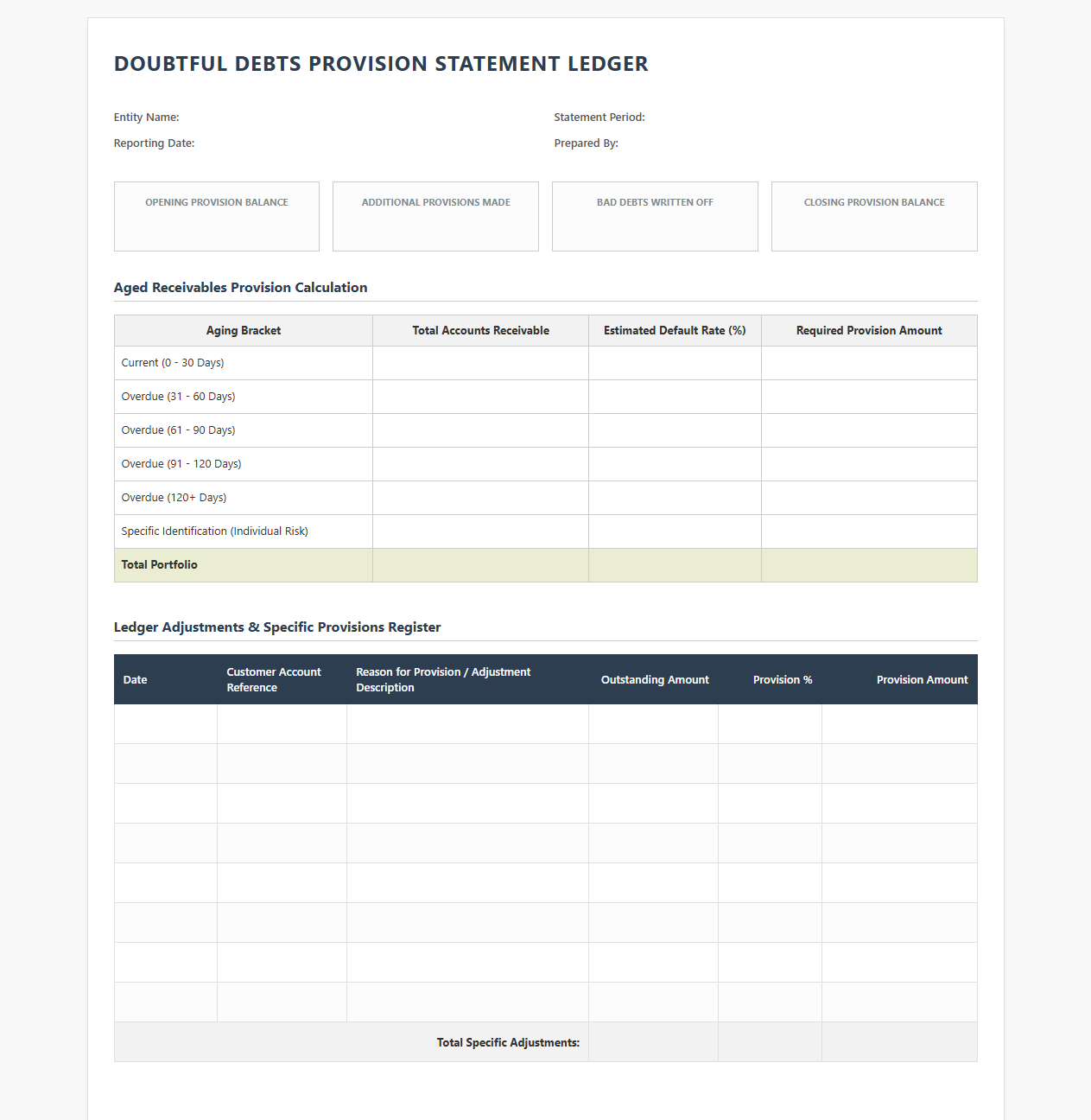 Download: .PDF
Financial Statement Template for Bad Debt Reserves
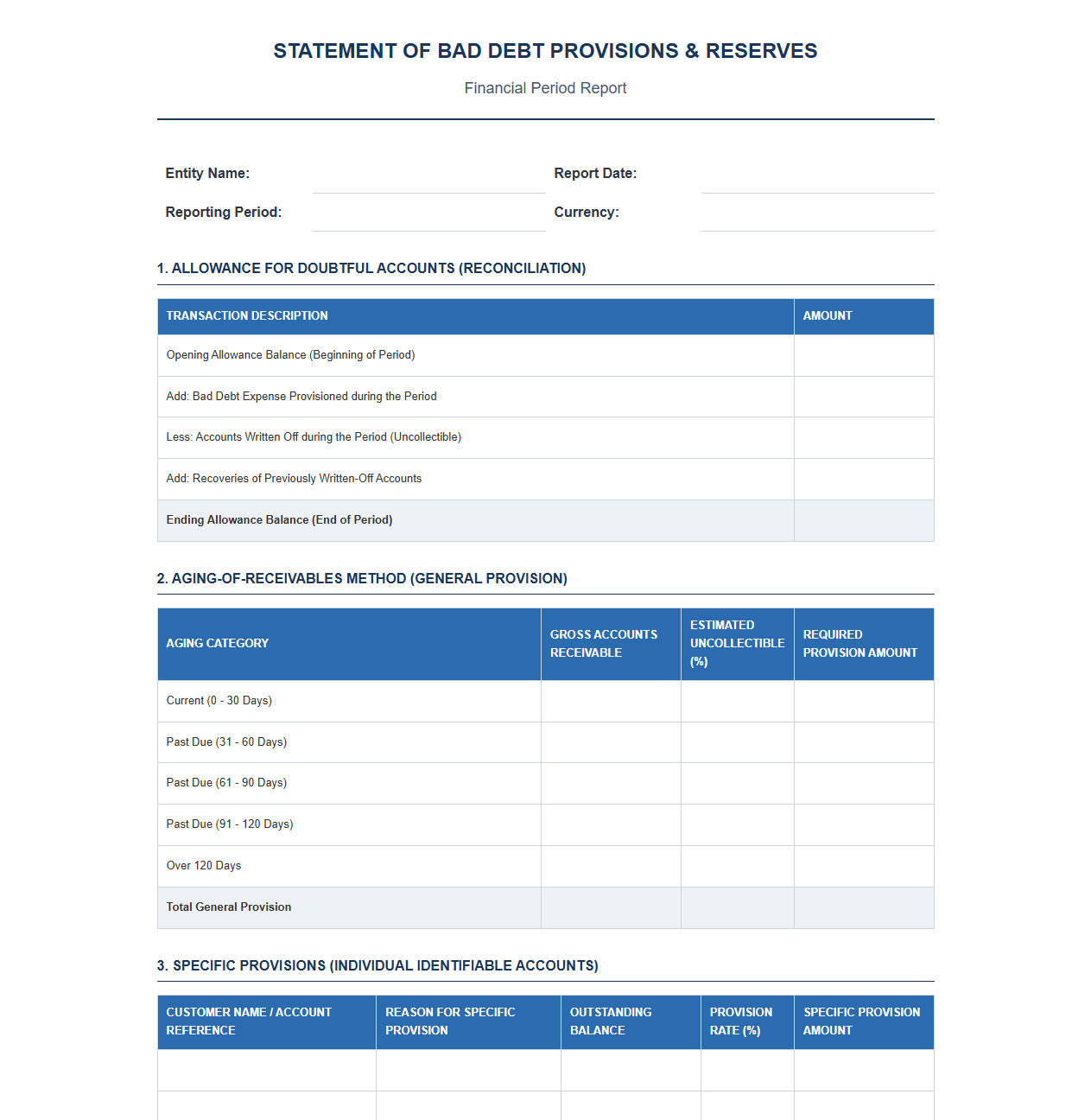 Download: .PDF
Section 1: Introduction to Bad Debt Provisioning and Financial Accuracy
In the world of corporate finance, maintaining an accurate representation of an organization's financial health is paramount. Bad debt provisioning is a critical accounting practice that estimates the portion of accounts receivable that a company expects will remain uncollectible. By proactively recognizing these potential losses, businesses ensure that their assets are not overstated, conforming to the fundamental accounting principle of prudence.
Accurate financial reporting relies heavily on these estimates to present a true and fair view of profitability and liquidity. Without a systematic approach to estimating uncollectible accounts, sudden customer defaults can lead to severe shocks on the income statement. Implementing standardized templates for bad debt provisioning establishes a disciplined, repeatable framework. This systematic approach enhances the reliability of the balance sheet, builds investor confidence, and ensures consistency across reporting periods.
Section 2: Establishing the Foundation with Historical Data Analysis
Before implementing any predictive model, a business must ground its assumptions in empirical evidence. Analyzing historical accounts receivable data serves as the foundation for setting realistic bad debt allowances. By looking back at past customer payment behaviors, collection cycle times, and the correlation between macroeconomic factors and late payments, financial analysts can identify clear patterns of default risk.
Reviewing historical write-offs over a multi-year period allows a company to calculate its average loss rate. For instance, evaluating the ratio of actual write-offs to total outstanding credit sales over the past three to five years provides a baseline percentage. This historical write-off ratio must be adjusted for current economic conditions, but it remains the most reliable anchor for initial estimations. Without this historical baseline, any provision for doubtful accounts risks being either overly conservative, which unnecessarily depresses net income, or too aggressive, which leaves the company vulnerable to sudden balance sheet write-downs.
Section 3: Statement Template for the Percentage of Credit Sales Method
Overview and Calculation Guide
The Percentage of Credit Sales method estimates bad debt expense by applying a fixed historical default percentage directly to the current period's total credit sales. This method focuses on the income statement, matching bad debt expenses directly with the revenues generated in the same accounting period.
Step-by-Step Calculation Guidelines
1. Determine the total volume of credit sales for the current accounting period (excluding cash transactions).
2. Calculate the historical bad debt rate by dividing total historical write-offs by total historical credit sales over a chosen period (e.g., 3 years).
3. Multiply the current period's credit sales by the historical bad debt percentage to determine the bad debt expense.
Standard Statement Template
====================================================================
BAD DEBT PROVISIONING STATEMENT: PERCENTAGE OF CREDIT SALES METHOD
Reporting Period: [Specify Period, e.g., Q1 202X]
====================================================================
1. Total Credit Sales for Period:            $ [Insert Credit Sales]
2. Historical Bad Debt Rate:                 [Insert %] %
3. Estimated Bad Debt Expense:               $ [Line 1 * Line 2]
Formula Applied:
Bad Debt Expense = Total Credit Sales * Historical Bad Debt Rate
====================================================================
Section 4: Statement Template for the Accounts Receivable Aging Method
Understanding the Aging Schedule
The Accounts Receivable Aging method shifts the analytical focus to the balance sheet. This approach groups outstanding invoices by age and applies progressively higher default probabilities to older balance categories. The rationale is simple: the longer a debt remains unpaid, the less likely it is to be recovered.
Accounts Receivable Aging Template
| Aging Category (Days Outstanding) | Outstanding Balance ($) | Estimated Default Probability (%) | Required Allowance Contribution ($) |
|---|---|---|---|
| Current (0-30 Days) | 150,000 | 1.0% | 1,500 |
| 1-60 Days Overdue | 50,000 | 3.0% | 1,500 |
| 61-90 Days Overdue | 20,000 | 10.0% | 2,000 |
| Over 90 Days Overdue | 10,000 | 50.0% | 5,000 |
| Total Portfolio | 230,000 | N/A | 10,000 |
Section 5: Statement Template for Specific Identification of High-Risk Accounts
Bypassing General Estimation Formulas
While statistical models like the aging schedule are effective for large portfolios, they fail to account for unique, material credit events. When a specific debtor shows clear signs of severe financial distress-such as filing for bankruptcy protection, entering liquidation, or experiencing extreme delinquency-accounting standards require a direct evaluation. This specific identification method bypasses general estimation formulas for those targeted accounts to prevent distorting general pool metrics.
Specific Risk Statement Template
High-Risk Account Assessment Memo
Debtor Name: [Debtor Company Name]
Outstanding Invoice Reference: [Invoice Numbers / Dates]
Total Outstanding Balance: $ [Balance Amount]
Risk Event Identified: [e.g., Chapter 11 Bankruptcy Filing / Severe Payment Delinquency exceeding 180 days]
Recovery Assessment: Legal and collections counsel estimate a maximum recovery rate of [Recovery %].
Specific Provision Required: $ [Outstanding Balance * (100% - Recovery %)]
Authorization Signature: _______________________ Date: _________
Section 6: Journal Entry and Balance Sheet Disclosure Templates
Once the required bad debt provision is calculated, it must be recorded in the general ledger. This is achieved through a adjusting journal entry. The entry debits the Bad Debt Expense account (which impacts the income statement) and credits the Allowance for Doubtful Accounts (a contra-asset account that reduces accounts receivable on the balance sheet).
====================================================================
JOURNAL ENTRY TEMPLATE: RECORDING PROVISION ADJUSTMENT
====================================================================
Date: [End of Accounting Period]
General Ledger Entry:
Debit:  Bad Debt Expense                      $ [Adjustment Amount]
Credit: Allowance for Doubtful Accounts       $ [Adjustment Amount]
Description: To adjust the Allowance for Doubtful Accounts to the
estimated required balance based on the periodic receivable analysis.
====================================================================
To ensure transparent financial reporting, corporations must include clarifying footnotes in their annual and quarterly financial statements. The disclosure statement below illustrates how this information should be presented to stakeholders:
====================================================================
BALANCE SHEET DISCLOSURE NOTE (FOOTNOTE TEMPLATE)
====================================================================
Note X: Accounts Receivable and Allowance for Doubtful Accounts
Accounts receivable are recorded net of an allowance for doubtful
accounts. The balance of the allowance is determined by management's
evaluation of the collectibility of outstanding receivables, based
on historical write-off experience, current economic conditions,
and specific reviews of high-risk debtor accounts.
Allowance Activity Summary:
Beginning Balance (Period Start):            $ [Beginning Balance]
Plus: Provisions Charged to Expense:         $ [Provisions Added]
Less: Actual Write-offs Net of Recoveries:   $ [Write-offs Processed]
Ending Balance (Period End):                 $ [Ending Balance]
====================================================================
Section 7: Best Practices for Regular Provision Review and Audit Compliance
Financial landscapes change rapidly, and static provisioning figures can quickly become obsolete. Implementing a systematic, ongoing review process is essential to maintaining compliance with modern financial regulations and satisfying external auditors.
To achieve this, accounting teams should establish a structured workflow focused on key regulatory standards, specifically IFRS 9 (Expected Credit Losses) and CECL (Current Expected Credit Losses). These forward-looking frameworks require institutions to estimate credit losses over the lifetime of a receivable based on reasonable, supportable forecasts rather than relying solely on historical losses.
The following checklist outlines the essential steps for quarterly reviews and preparation for external audit processes:
- Quarterly Recalculation: Perform a comprehensive update of the accounts receivable aging schedule and historical default rates every quarter to reflect recent payment trends.
- Macroeconomic Adjustments: Review and document forward-looking economic indicators, such as industry growth forecasts, unemployment rates, or inflation factors, adjusting allowance percentages in compliance with CECL and IFRS 9.
- Write-off Reconciliation: Ensure that all accounts formally written off during the period have been correctly authorized by management and properly matched against the existing allowance balance.
- Audit Trail Documentation: Maintain a clear, step-by-step paper trail detailing the methodologies, assumptions, and data sources utilized to calculate the provision figures.
- Segregation of Duties: Ensure that the team member calculating the bad debt estimation is distinct from the personnel authorizing specific high-risk write-offs.

Leave a comment