

Financial advisors expanding into high-value FP&A consulting often face a frustrating reality: scope creep and unforeseen liabilities that quickly erode project profitability. As the advisory landscape shifts from retrospective reporting to forward-looking strategic partnership, standard, one-size-fits-all engagement letters are no longer sufficient to protect your firm's bottom line.
Implementing specialized FP&A service agreement templates grants you the operational security and professional confidence needed to scale your consulting practice safely. While these frameworks serve as educational starting points rather than absolute substitutes for localized legal counsel, they establish vital boundaries. Specifically, integrating concrete clauses-such as precise data-sharing protocols, clear liability limitations, and explicit service-level agreements (SLAs)-ensures client alignment from day one.
This article examines the critical risk-mitigation clauses every financial consultant needs and provides downloadable, customizable templates to safeguard your next engagement.
Financial Planning and Analysis Services Agreement Template
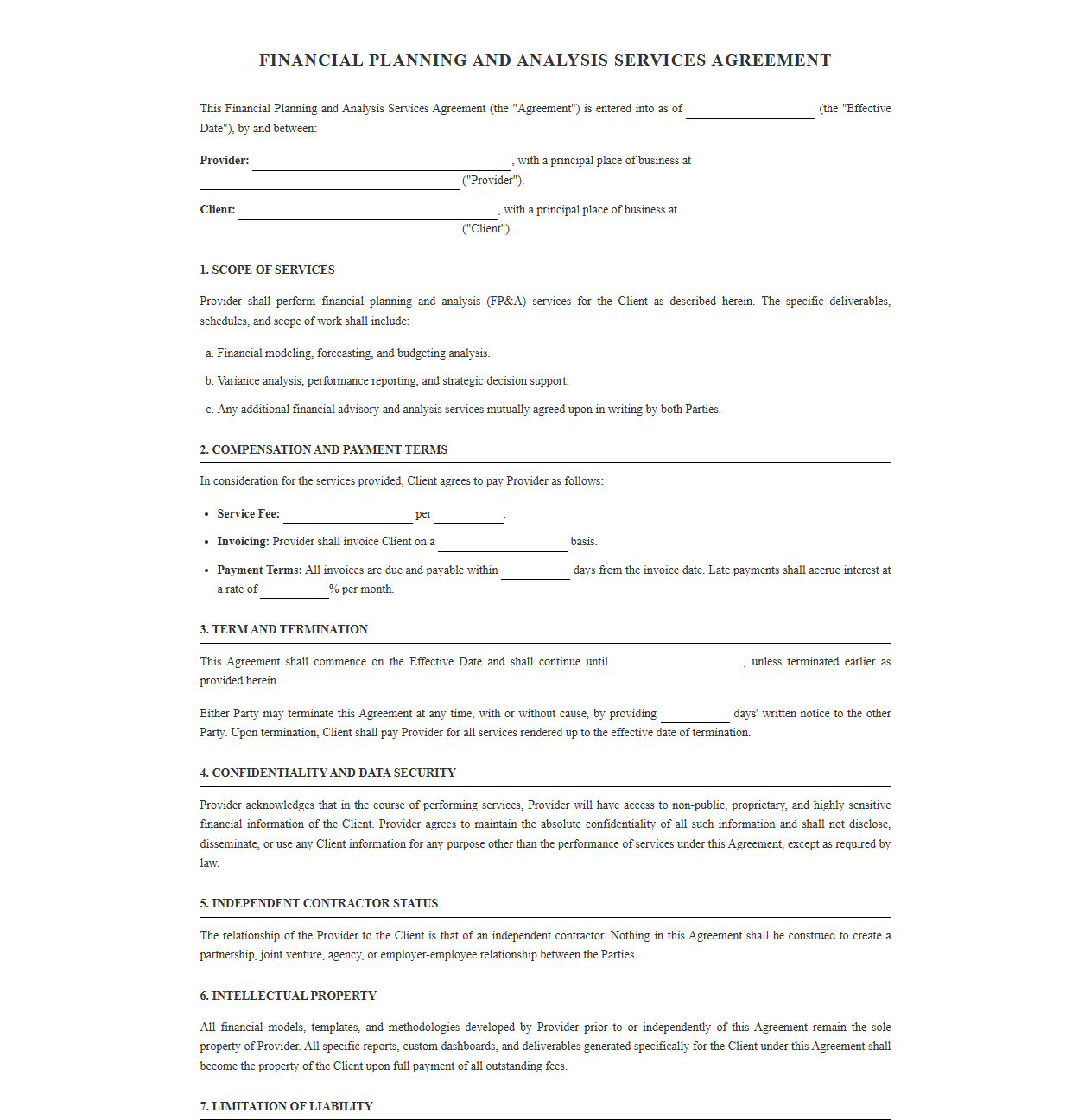 Download: .PDF
FP&A Consulting Services Contract Template
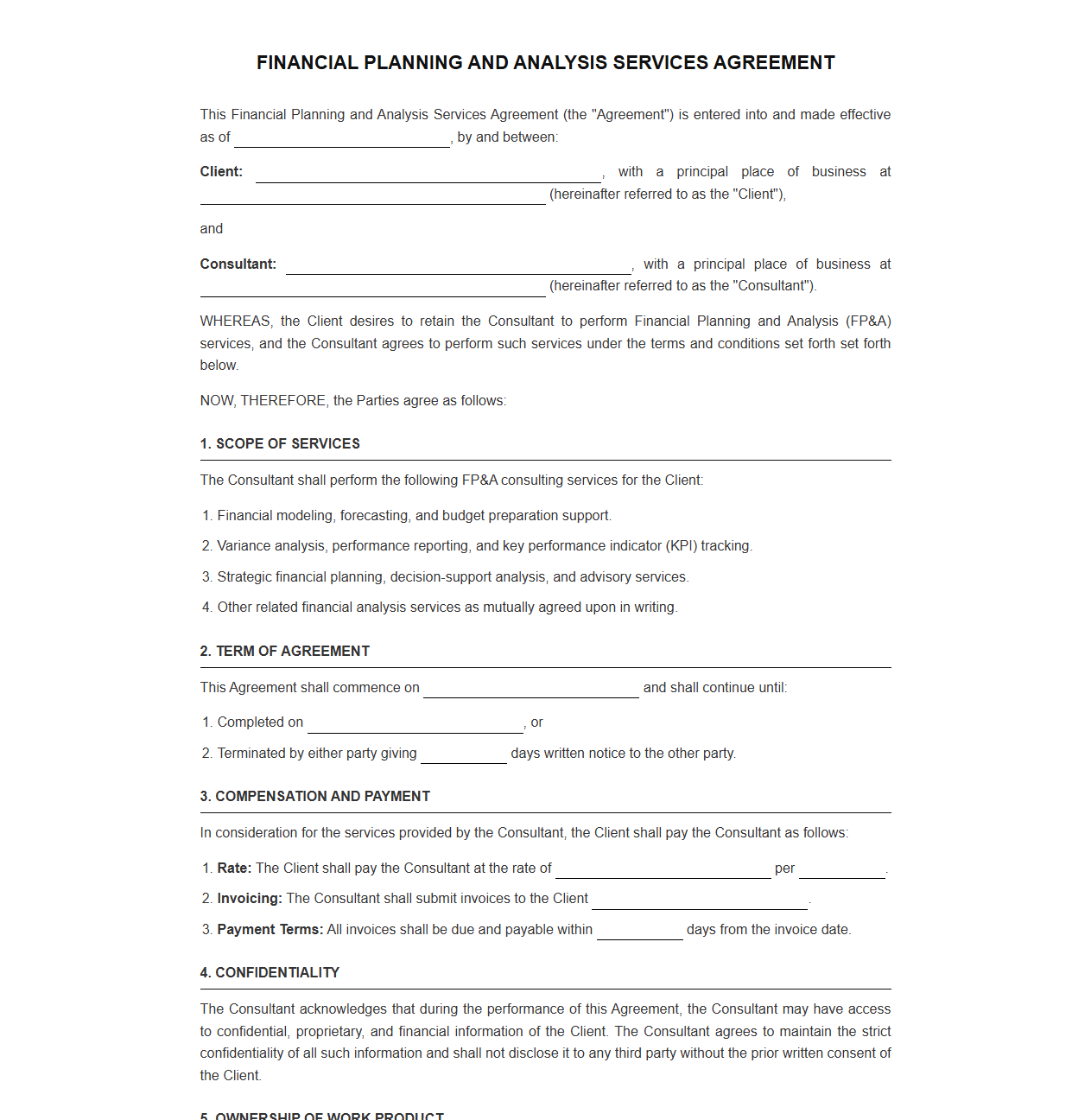 Download: .PDF
Strategic Financial Planning Services Agreement Form
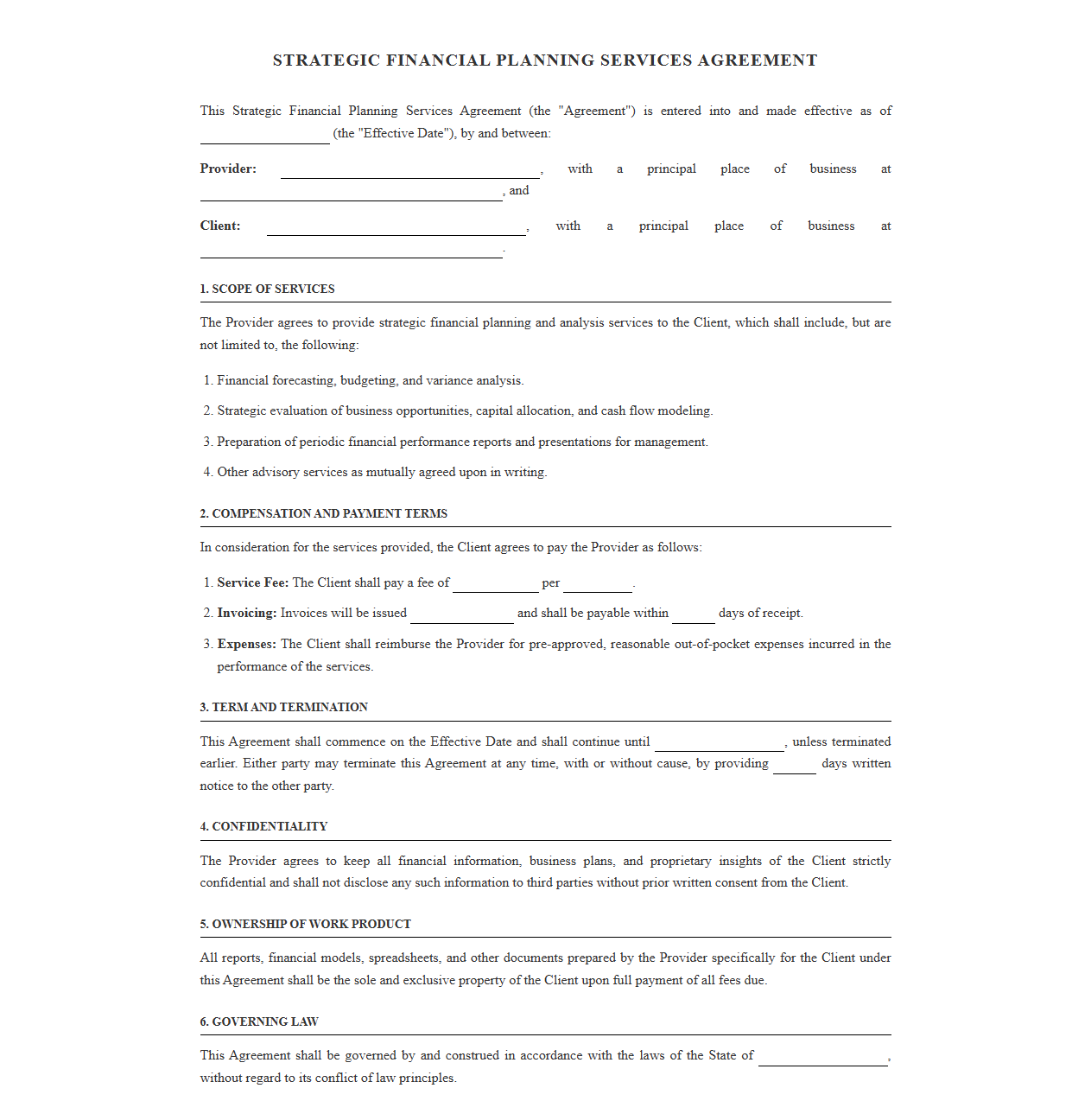 Download: .PDF
Corporate Financial Analysis and Planning Agreement
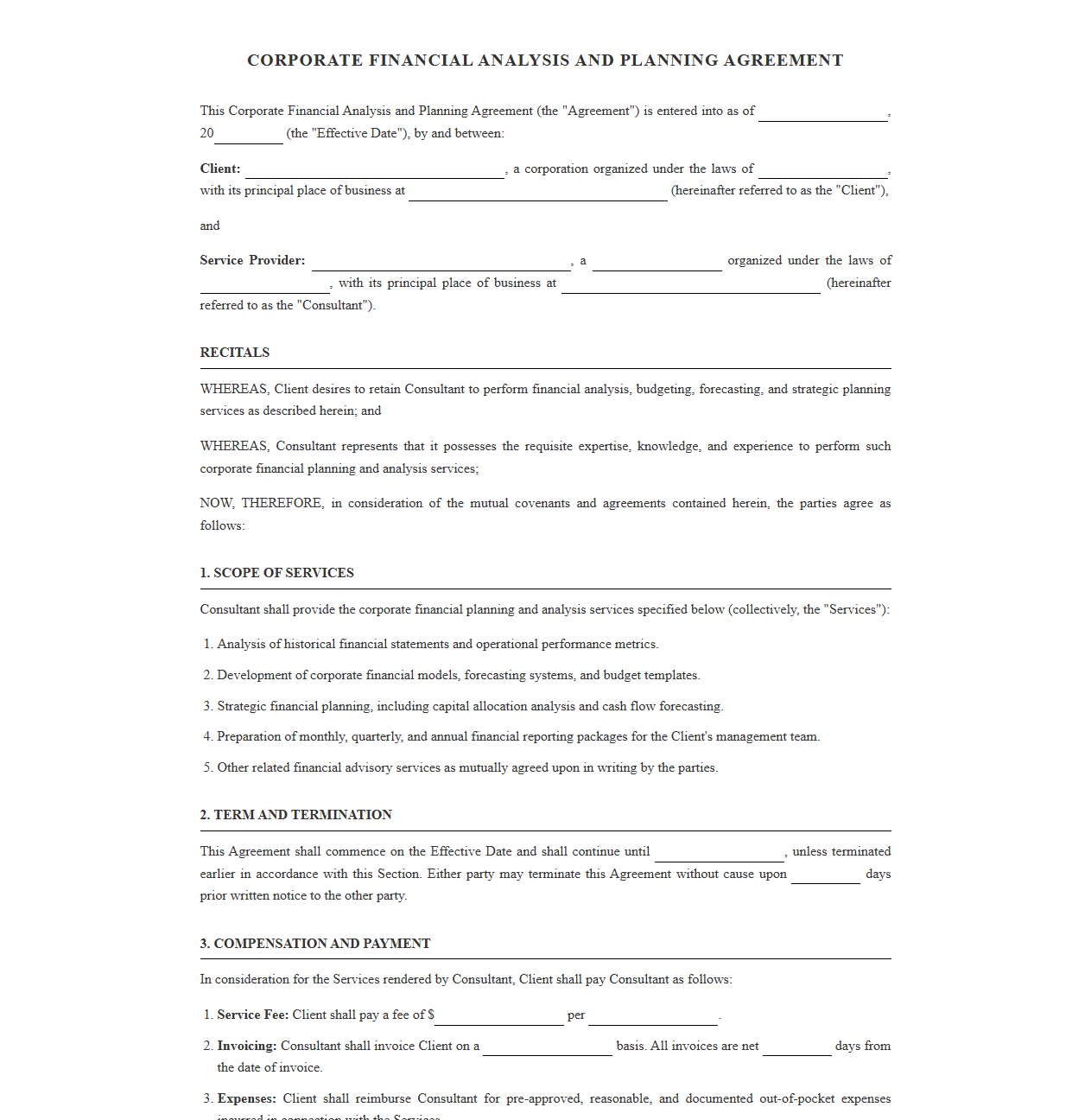 Download: .PDF
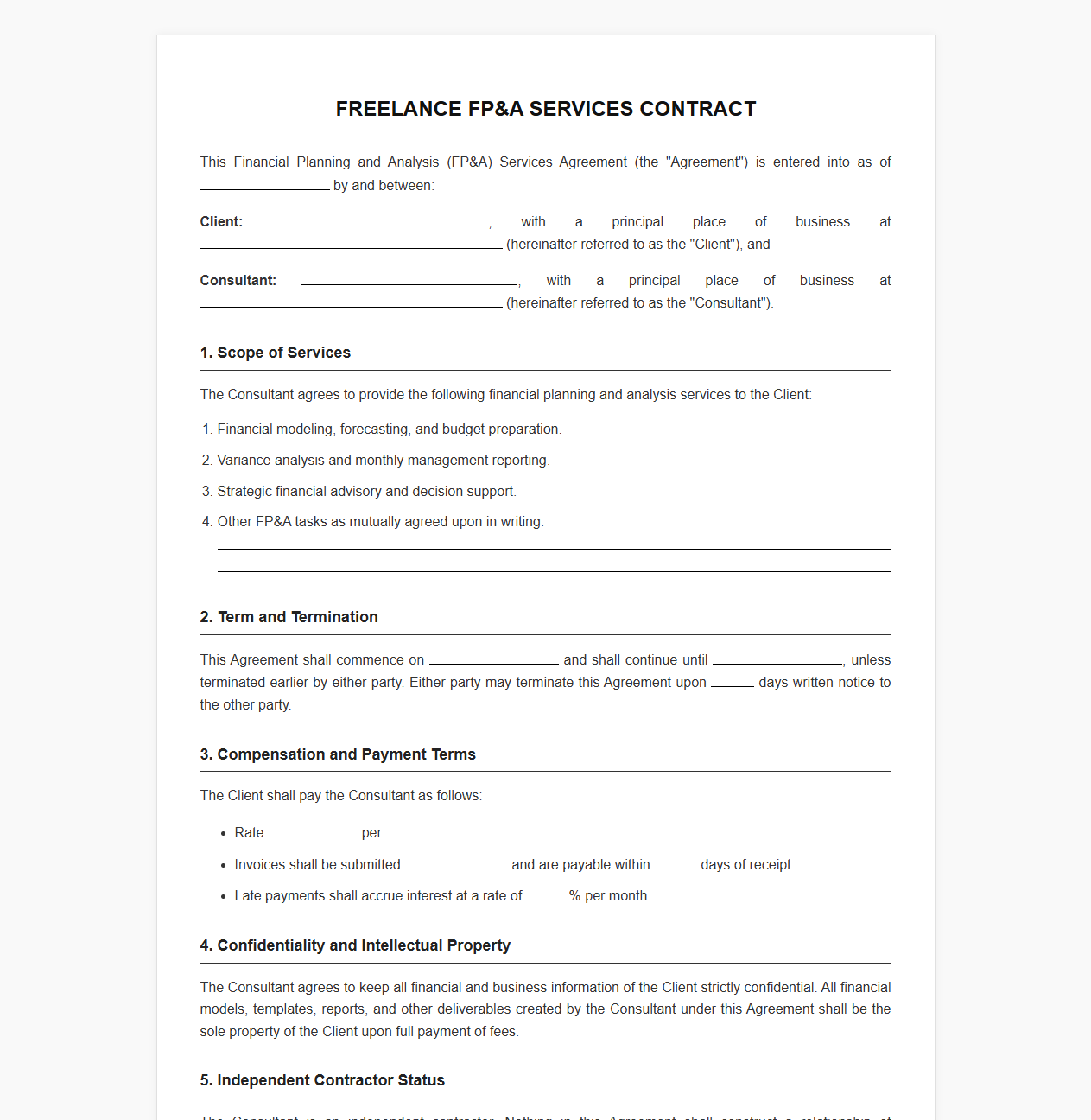
Freelance FP&A Services Contract Template
 Download: .PDF
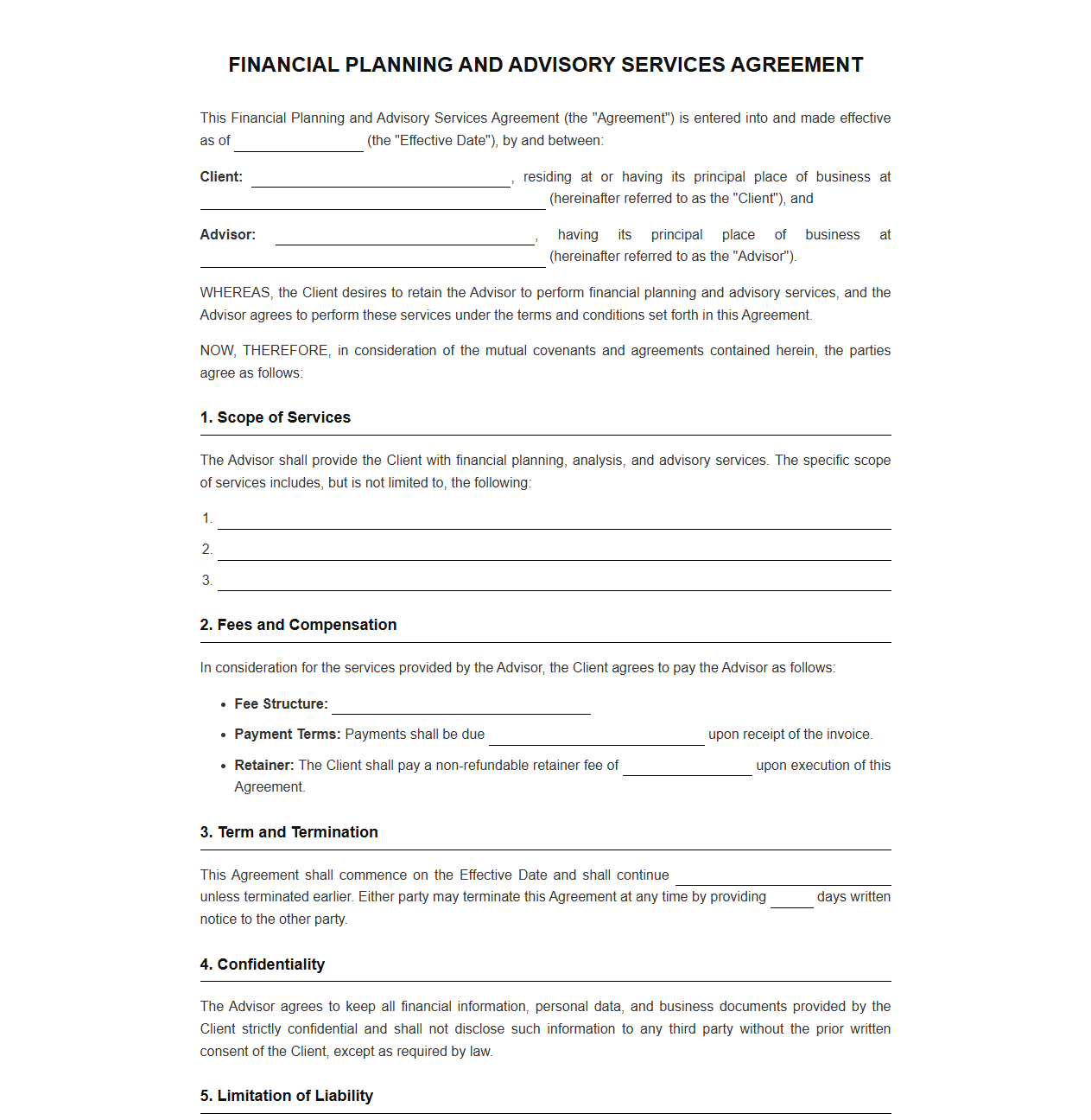
Financial Planning and Advisory Services Agreement
 Download: .PDF
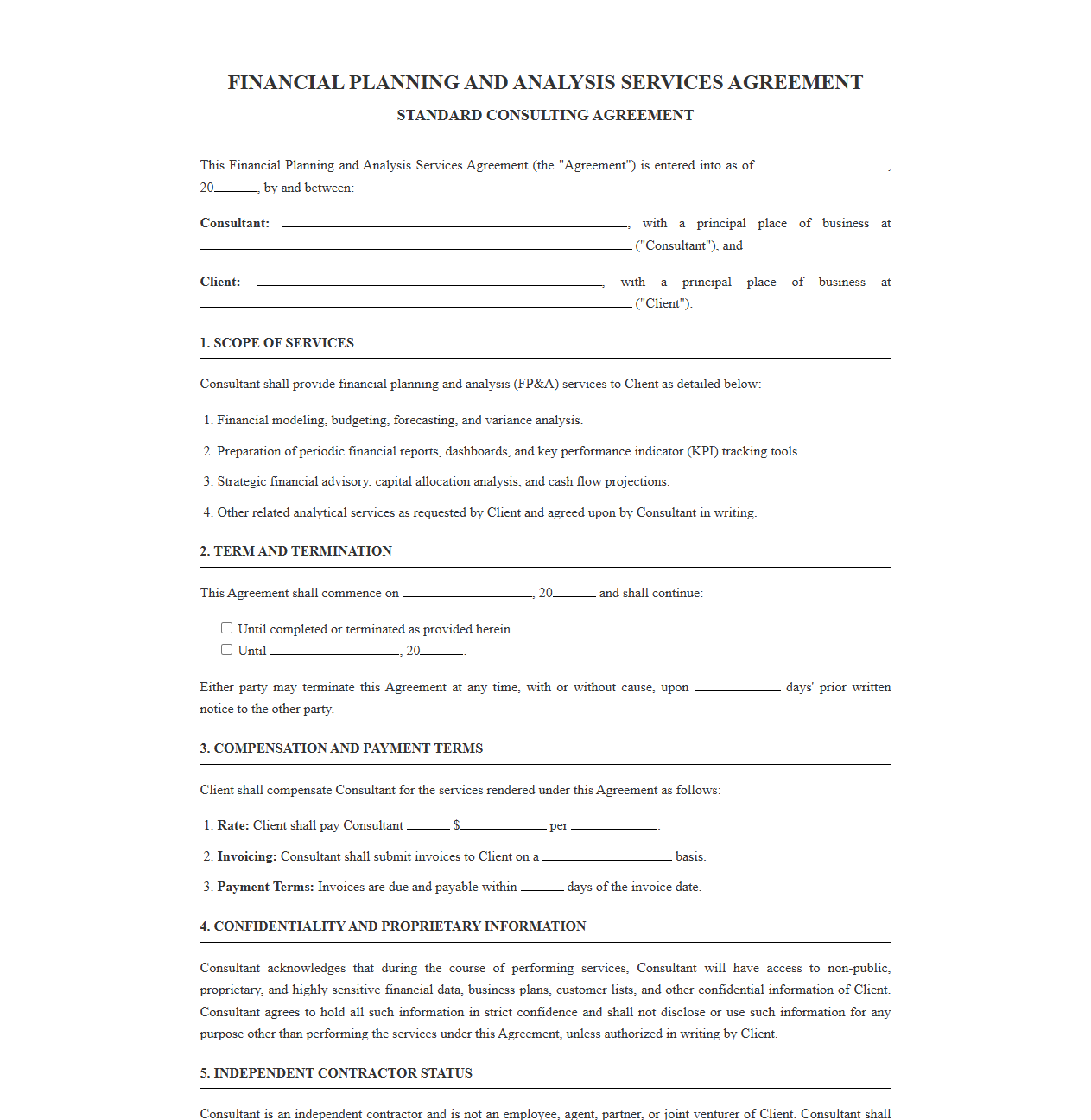
Standard FP&A Consulting Agreement Template
 Download: .PDF
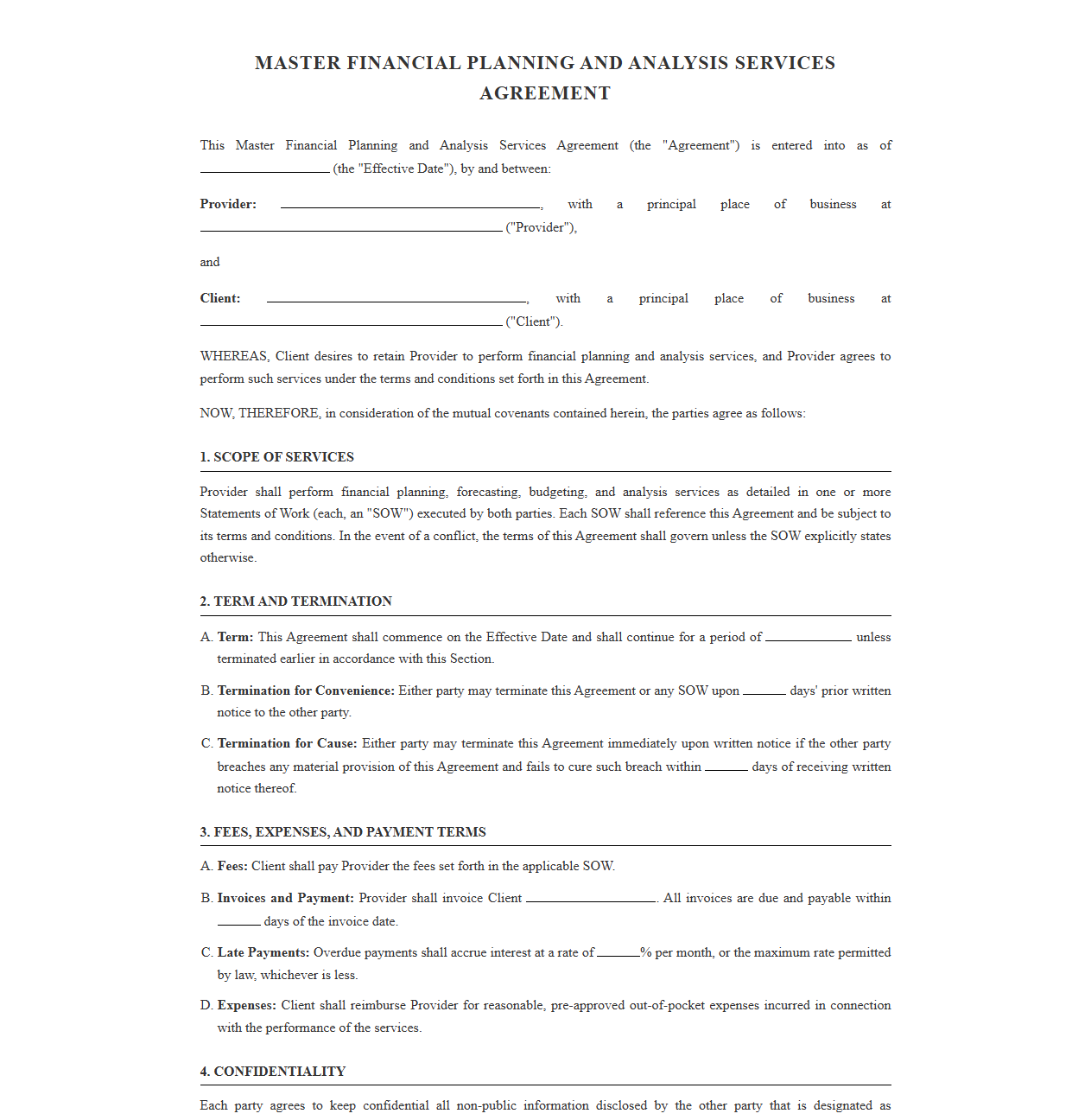
Master Financial Planning and Analysis Agreement
 Download: .PDF
Outsourced FP&A Services Contract Template
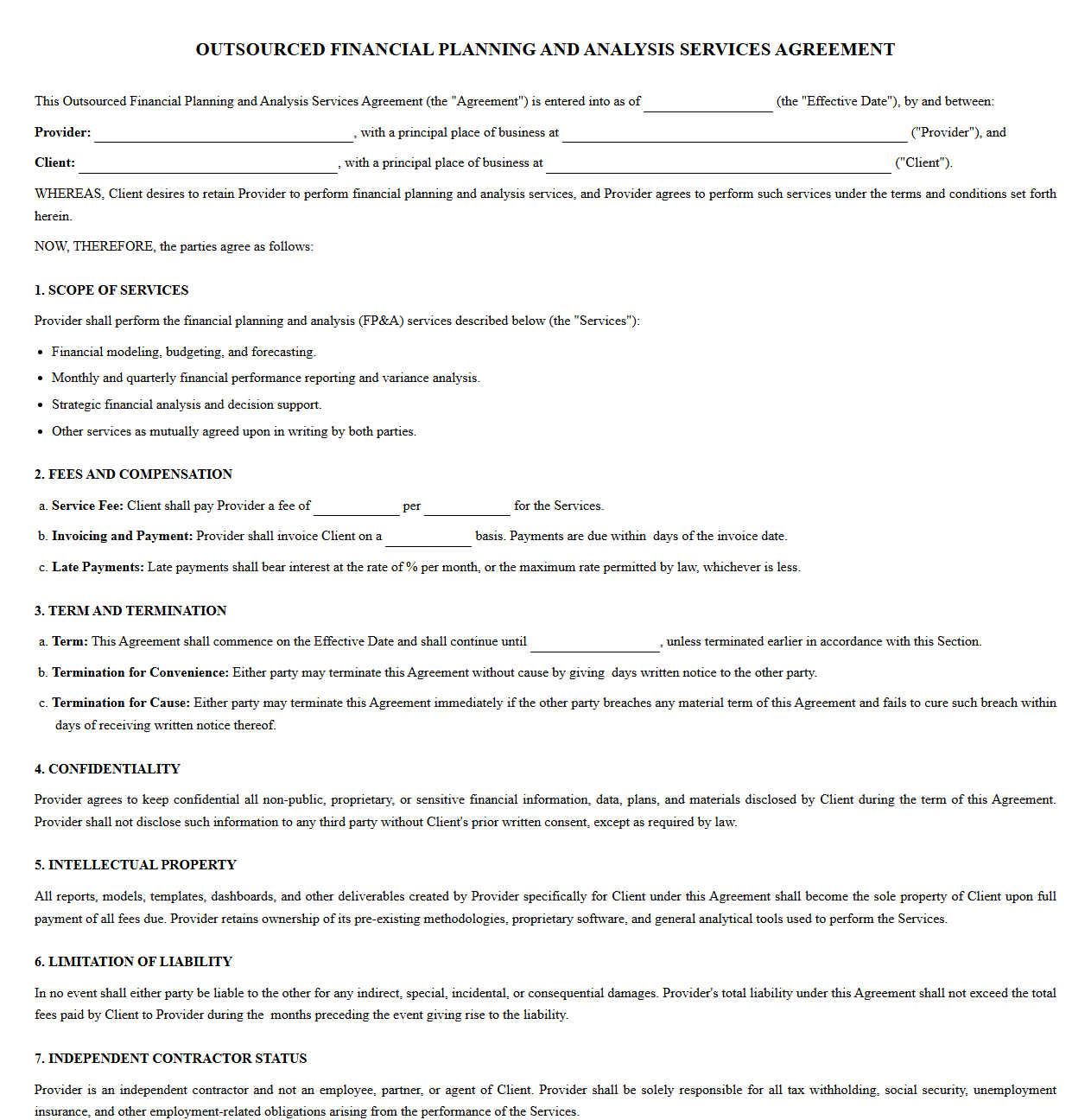 Download: .PDF
Introduction: Why FP&A Service Agreements are Essential for Financial Advisors
For financial advisors, offering Financial Planning and Analysis (FP&A) services is an excellent way to provide high-value strategic guidance to clients. However, without a formal contract in place, advisors expose themselves to significant professional hazards. A robust FP&A service agreement serves as the foundational shield protecting your advisory business from consulting risks, unauthorized scope creep, and unexpected legal liabilities.
By clearly defining the boundaries of the advisory relationship, a well-drafted agreement ensures both parties share identical expectations. This proactive legal alignment prevents misunderstandings, secures your revenue stream, and establishes a professional framework that allows your advisory practice to scale safely.
Defining the Scope of Work to Prevent Scope Creep
One of the most common challenges in financial consulting is the gradual expansion of duties without a corresponding increase in compensation. Drafting a precise Scope of Work (SOW) section within your FP&A agreement is the most effective defense against this issue. The SOW must explicitly outline what is included in your service package-and just as importantly, what is excluded.
To ensure absolute clarity, your SOW should always document the following essential components:
- Specific Deliverables: Define the exact outputs, such as monthly cash flow models, quarterly budget vs. actual variance reports, or five-year pro forma projections.
- Timelines and Milestones: Establish clear deadlines for client data submission and subsequent advisor delivery dates.
- Boundaries of Service: Explicitly state that services do not include tax preparation, legal auditing, or formal valuation opinions unless specifically contracted.
- Out-of-Scope Rates: Define an hourly rate or a change-order process for any requests that fall outside the initial agreement.
Payment Terms, Fee Structures, and Retainers
A transparent billing structure eliminates friction and ensures consistent cash flow. Your consulting agreement must clearly outline how you will be compensated, when invoices are issued, the penalties for late payments, and whether a retainer is required upfront to secure your advisory capacity.
Depending on the nature of the FP&A engagement, advisors typically utilize one of several common billing structures:
| Billing Model | Description | Best Used For |
|---|---|---|
| Monthly Retainer | A fixed recurring fee billed at the start of each month for ongoing strategic support. | Continuous FP&A advisory and monthly fractional CFO services. |
| Fixed Project Fee | A single flat fee, often paid 50% upfront and 50% upon final delivery. | One-time projects like building a custom financial model or fundraising preparation. |
| Hourly Billing | An agreed-upon hourly rate billed weekly or bi-weekly based on tracked hours. | Ad-hoc consulting, troubleshooting, or highly variable consulting engagements. |
Confidentiality, Data Security, and IP Protection
FP&A consultants regularly handle sensitive corporate financial data, intellectual property, and proprietary strategic plans. Protecting this information is critical for maintaining client trust and adhering to regulatory compliance standards. Your service agreement must outline strict data security protocols and establish clear ownership of intellectual property, ensuring that your proprietary forecasting models and templates remain your exclusive property.
A mutual non-disclosure agreement (NDA) clause should be embedded directly into the contract. A standard, enforceable confidentiality clause often reads as follows:
"The Consultant agrees to hold all non-public financial information, business plans, and proprietary client data in strict confidence. The Consultant shall not disclose, distribute, or utilize such Confidential Information for any purpose outside the scope of this Agreement without the prior written consent of the Client."
Limiting Liability and Defining Indemnification
No financial forecast is perfect, and future business performance depends on numerous external variables. If a client suffers financial losses after relying on your models, they may attempt to hold your advisory firm accountable. To mitigate this risk, you must include a limitation of liability clause that establishes a reasonable financial ceiling on your potential exposure.
The agreement must clarify that FP&A deliverables are strategic projections rather than guaranteed performance outcomes. Under this framework, you should state that the advisor's maximum aggregate liability for any claims arising under this agreement shall be strictly limited to the total fees actually paid by the client to the advisor during the preceding twelve-month period. Additionally, include an indemnification clause requiring the client to defend you against third-party claims arising from inaccurate financial data they provided to you.
Termination Clauses and Dispute Resolution
Even the best business relationships can come to an end. A structured termination clause protects both parties by detailing how to wind down the engagement cleanly, including the required notice period (such as 30 days' written notice) and the compensation due for work completed up to the termination date. Furthermore, establishing a clear dispute resolution framework prevents minor disagreements from escalating into expensive court battles.
When a conflict arises, the agreement should mandate a structured, multi-step resolution process:
- Good Faith Negotiation: Both parties agree to meet informally to discuss and resolve the issue directly.
- Structured Mediation: If negotiation fails, the parties must submit the dispute to a neutral, third-party mediator before filing lawsuits.
- Binding Arbitration: If mediation is unsuccessful, the dispute will be resolved through confidential, binding arbitration in accordance with local state laws.
Conclusion and Essential Checklist for Your FP&A Template
A comprehensive FP&A service agreement is not merely a bureaucratic hurdle; it is a vital business asset that establishes professional boundaries, secures your compensation, and minimizes legal risks. Taking the time to build a robust template ensures that your strategic advisory firm can focus on delivering high-impact financial insights with confidence and peace of mind.
FP&A Agreement Review Checklist
- Does the Scope of Work clearly state what is included and what is explicitly excluded?
- Are the billing schedules, late fees, and retainer rules clearly defined in a table or structured clause?
- Is your proprietary intellectual property (models, formulas, templates) legally protected?
- Does the agreement contain a standard, robust confidentiality and NDA clause?
- Have you established a maximum liability cap equal to or less than the fees collected?
- Is there a clear termination notice period and a structured, step-by-step dispute resolution framework?

Leave a comment