

Managing executive compensation is a persistent and high-stakes struggle for finance and HR leaders. The sheer volume of bespoke agreements, intricate vesting schedules, and stringent tax regulations frequently leads to costly administrative errors and compliance risks.
Before addressing these operational bottlenecks, organizations must recognize that modern executive pay is a multi-layered ecosystem of equity, deferred benefits, and performance incentives. Successfully organizing this landscape grants payroll departments the ultimate value: absolute processing accuracy and heightened stakeholder trust. However, a key stipulation remains: structured templates serve as operational guardrails to streamline workflow, not as a replacement for specialized legal counsel.
By utilizing templates that pre-structure concrete variables-such as clawback clauses, Section 409A valuation alignments, and performance-based stock unit (PSU) vesting schedules-companies can systematically mitigate risk.
In this article, we will examine the core architecture of structured executive payroll documents, highlight essential regulatory benchmarks to integrate, and outline a step-by-step approach to simplifying your executive pay workflows.
Executive Salary and Compensation Agreement Template
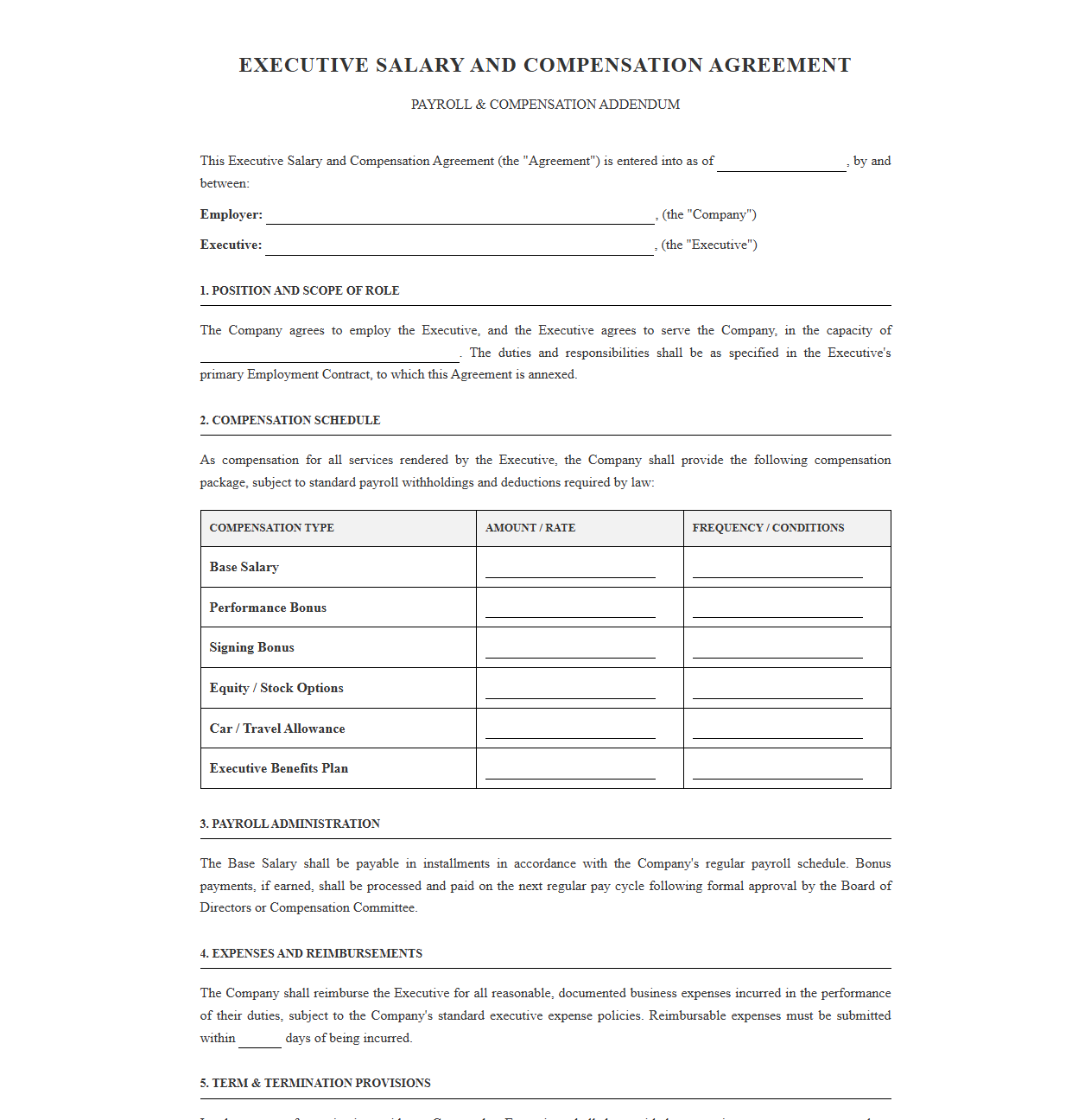 Download: .PDF
C-Suite Executive Payroll and Benefits Calculator
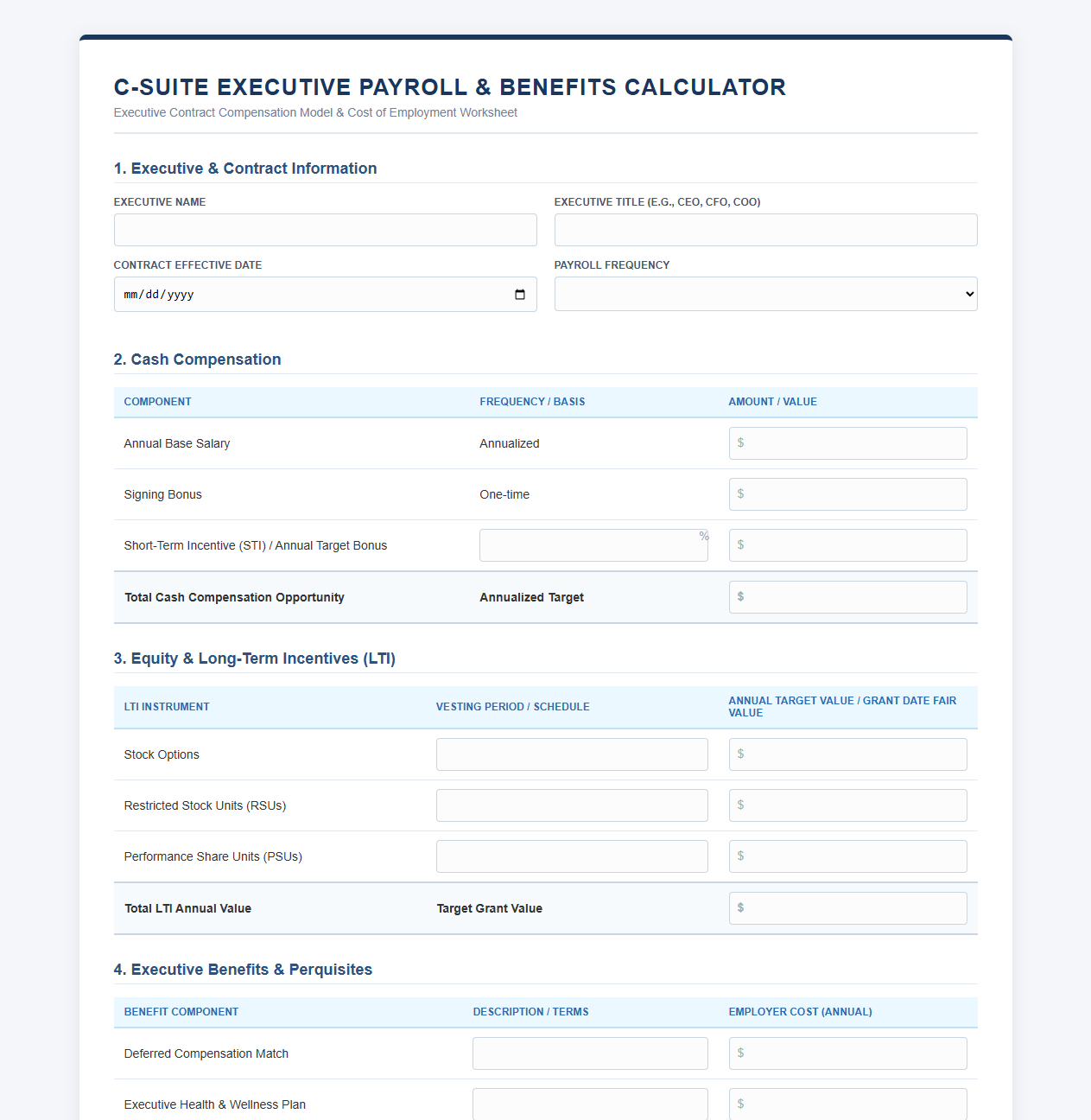 Download: .PDF
Executive Employment Contract Compensation Schedule
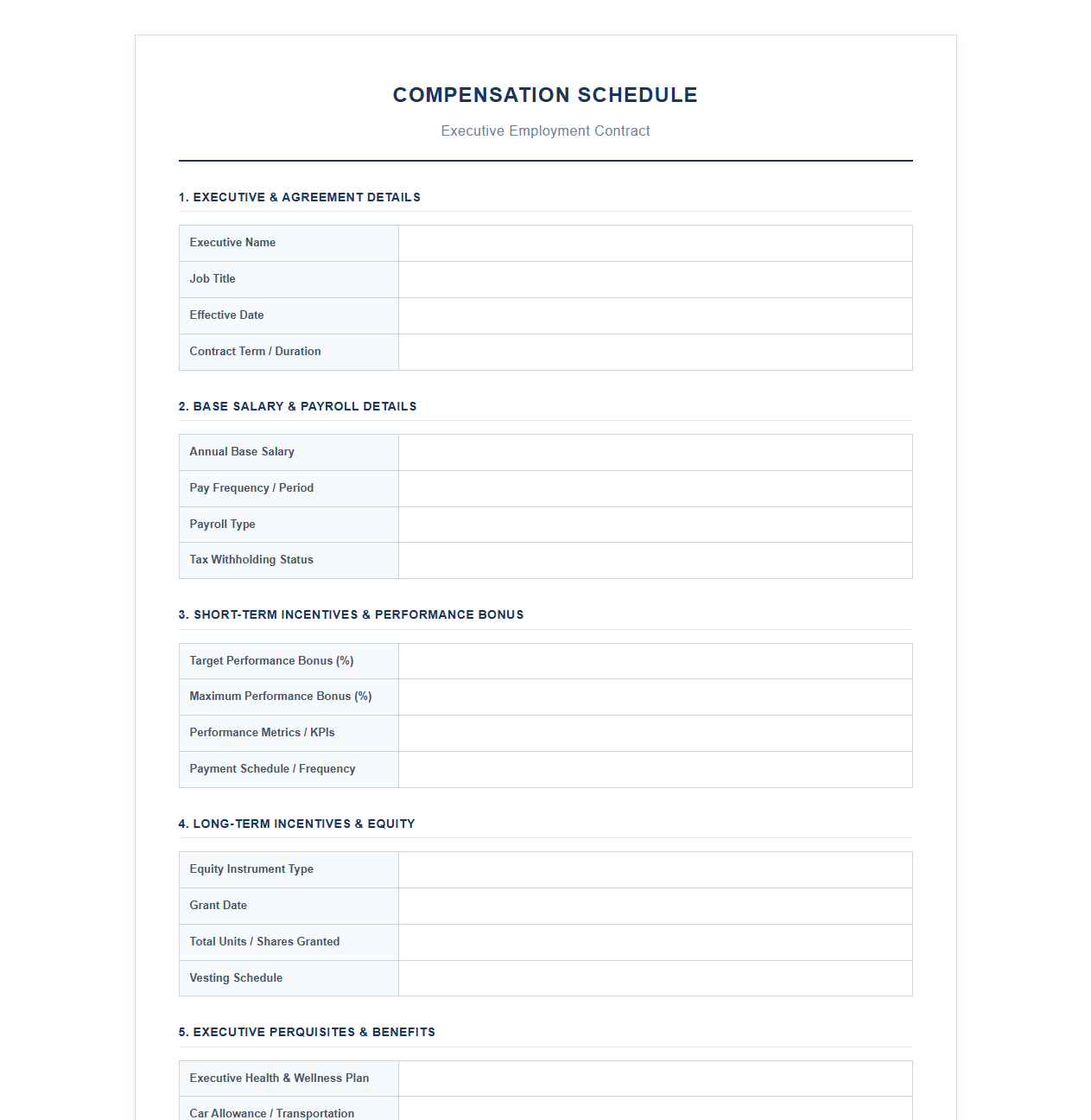 Download: .PDF
Executive Compensation Plan and Payroll Structure
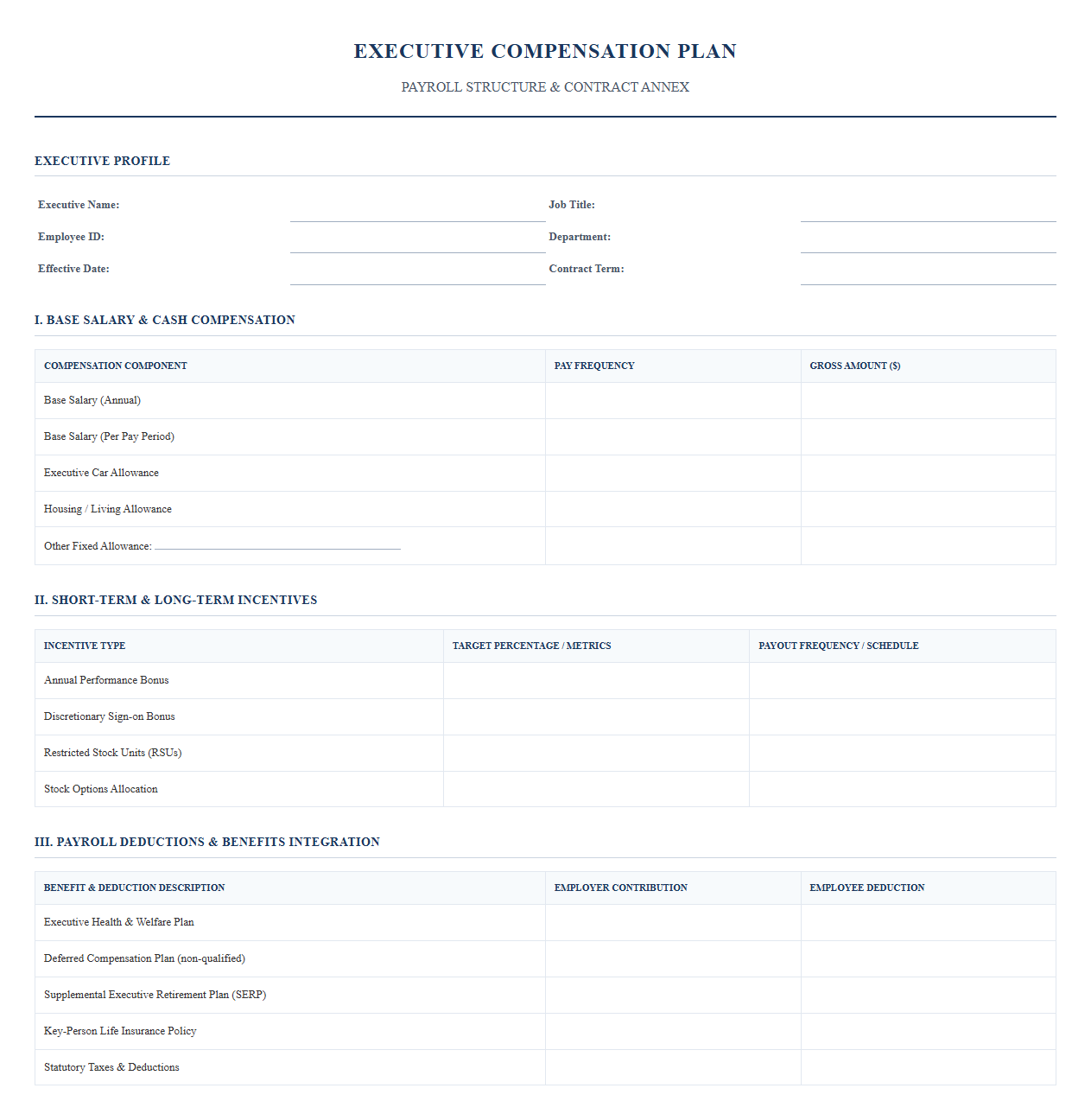 Download: .PDF
Payroll Sheet for Key Executive Employment Agreements
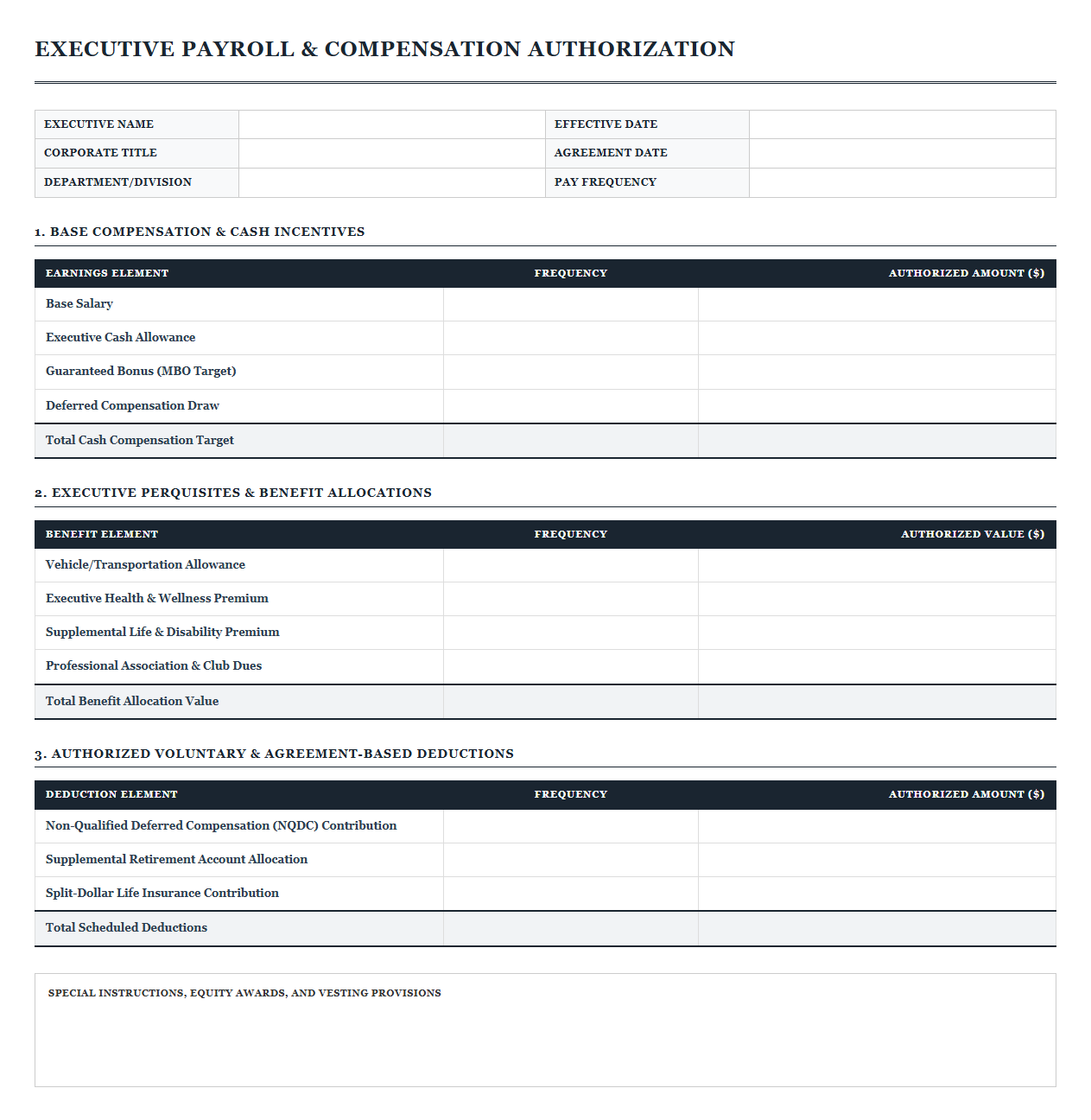 Download: .PDF
Senior Executive Payroll and Bonus Structure Template
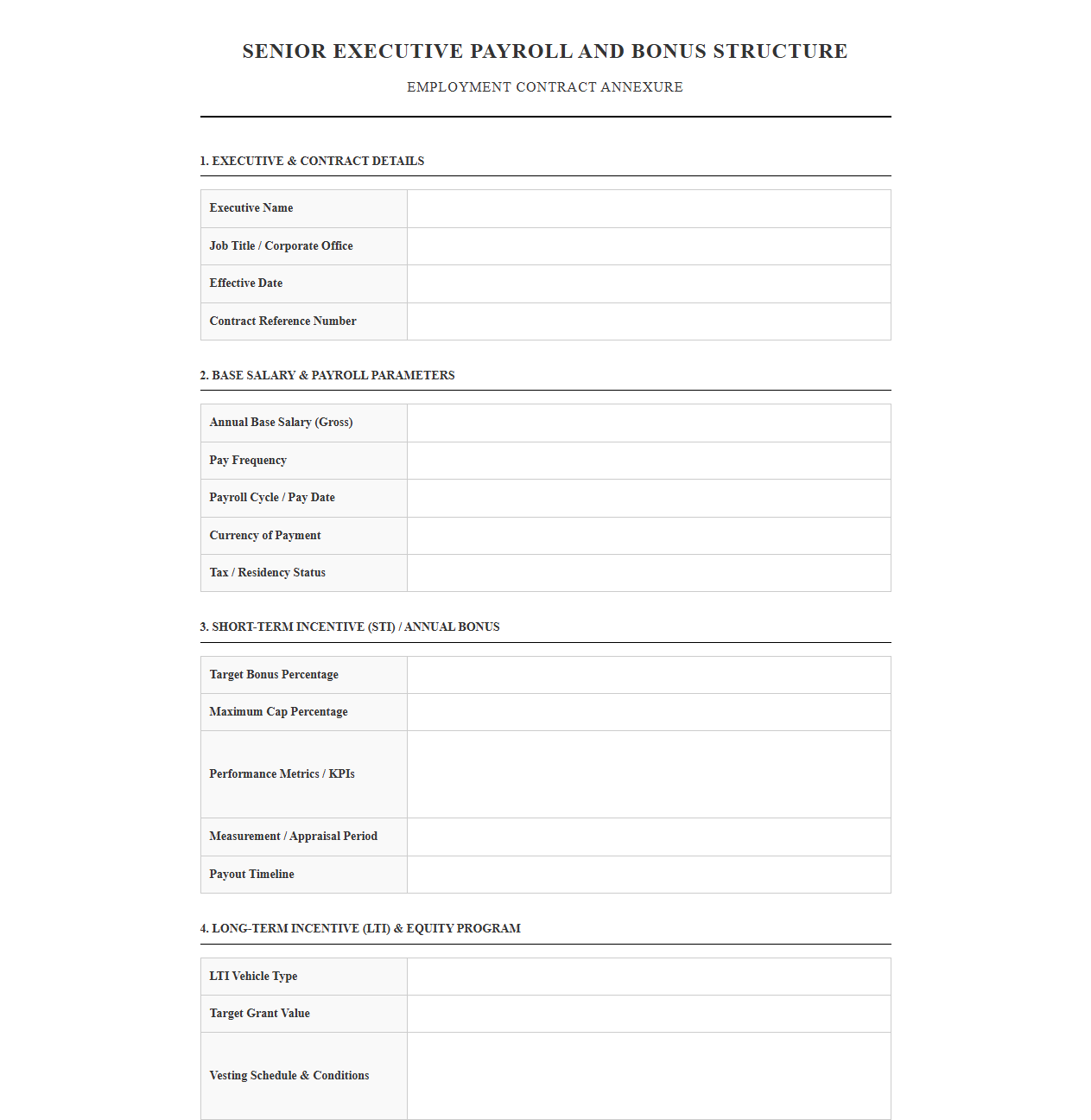 Download: .PDF
Executive Employment Agreement Payroll Ledger
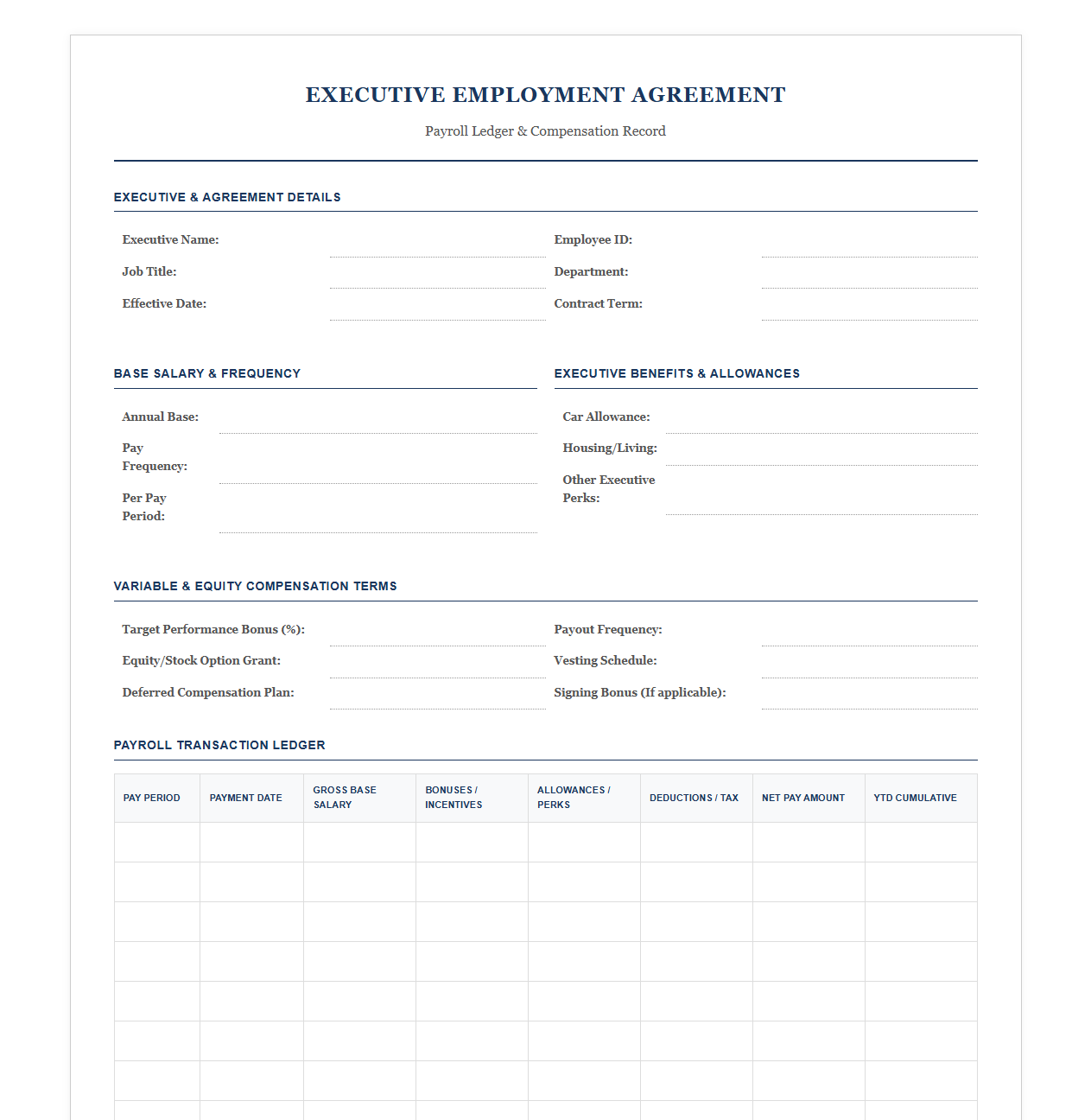 Download: .PDF
C-Level Officer Payroll and Equity Compensation Template
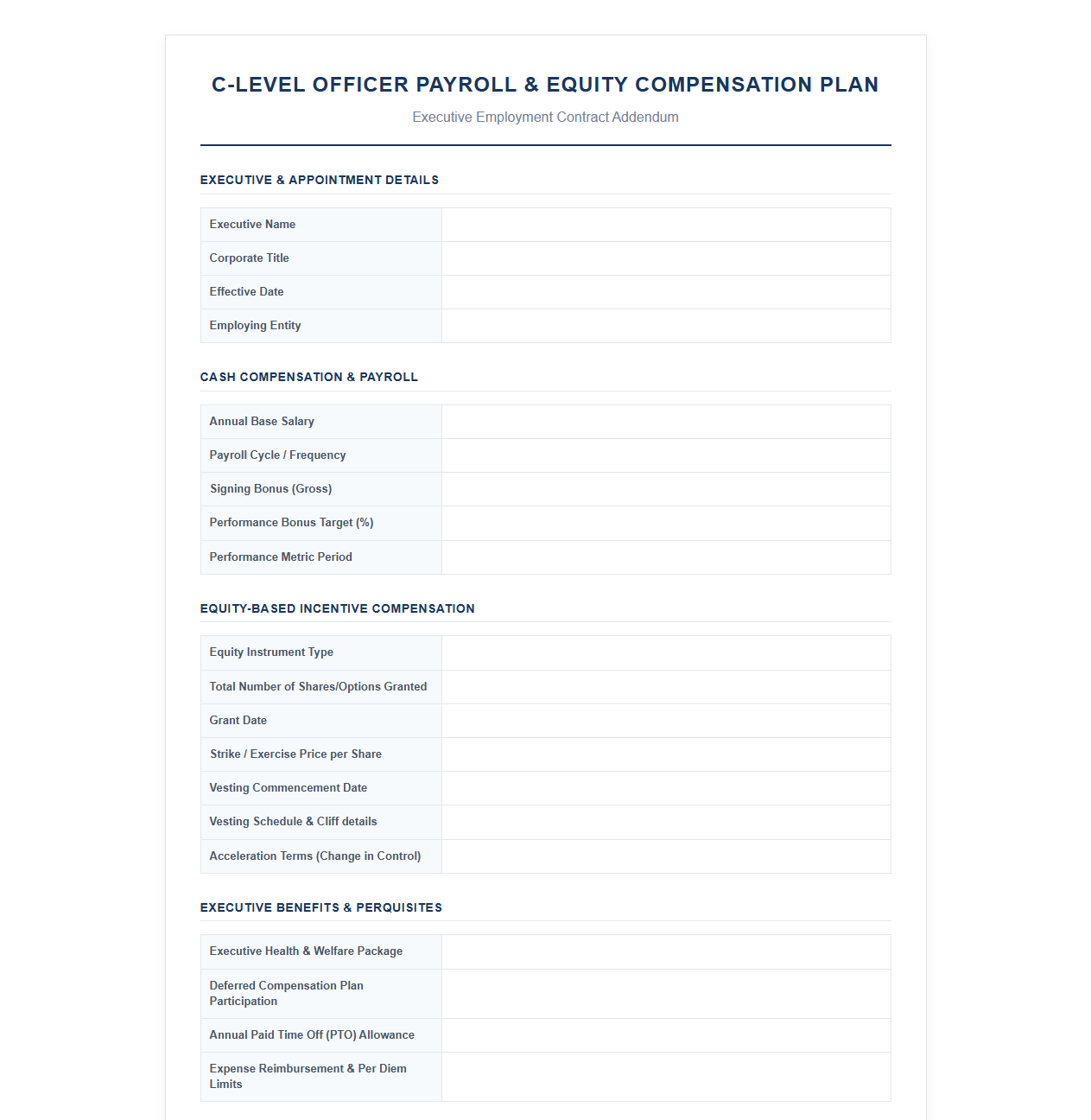 Download: .PDF
Executive Payroll Contract Amendment Template
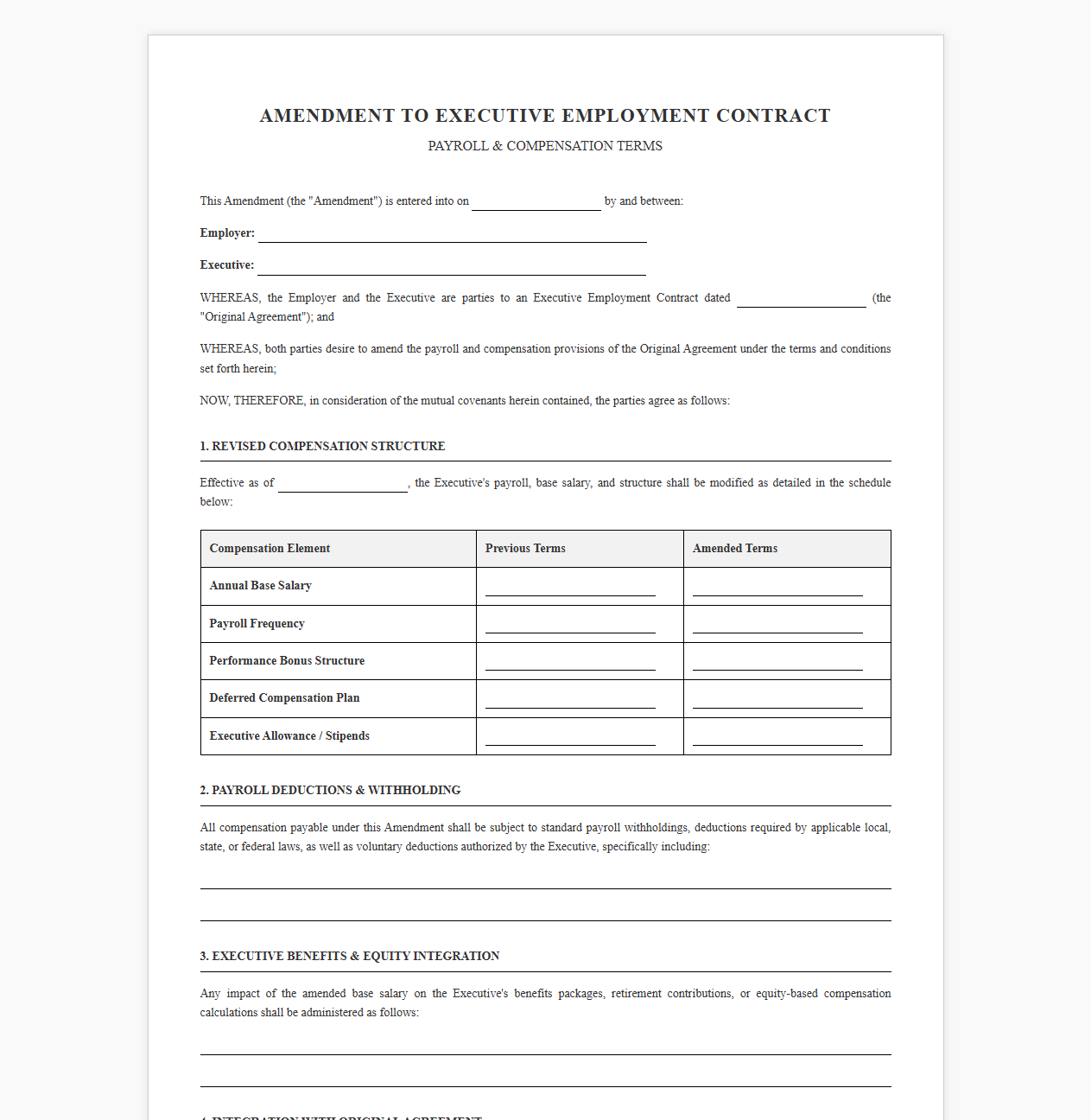 Download: .PDF
Demystifying the Complexity of Executive Compensation
Executive compensation packages are far more intricate than standard salaried wages. They routinely incorporate a diverse mix of base pay, performance-based bonuses, deferred compensation plans, and equity-based incentives like stock options or restricted stock units (RSUs). This multi-layered structure is designed to align leadership incentives with shareholder value, but it introduces significant administrative complexity.
Managing these highly individualized contracts often leads to severe administrative bottlenecks. Finance and HR teams must manually track vesting schedules, performance hurdles, and clawback provisions. Without a cohesive system, processing leadership pay becomes a high-risk operational burden prone to calculation discrepancies.
The Strategic Role of Structured Payroll Templates
Standardized, structured payroll templates serve as the vital blueprint for managing executive pay. By establishing a unified framework, organizations can systematically organize the distinct pay elements of every executive. This consistency is essential to transition away from chaotic, manual spreadsheets that invite human error.
Using a structured template guarantees that every calculation rule is pre-defined, keeping the payroll process repeatable and predictable. By locking down the mathematical logic for complex pay components, companies can dramatically reduce calculation mistakes, ensure internal equity, and save dozens of administrative hours during every payment cycle.
Essential Components of an Executive Payroll Template
To capture the full scope of executive remuneration, a robust payroll template must contain highly specific, dedicated tracking fields. This ensures no compensation component is overlooked during processing cycles.
An effective executive payroll template should always include the following core elements:
- Base Salary Details: The fixed cash compensation, including pro-rated adjustments for partial-period calculations.
- Short-Term Incentives (STI): Performance bonuses, commission structures, and discretionary cash awards.
- Long-Term Incentives (LTI) & Equity: Tracking columns for stock options, RSUs, and performance shares alongside their specific vesting dates.
- Deferred Compensation Programs: Postponed earnings accounts, employer matching metrics, and deferred tax allocations.
- Executive Benefits & Perquisites: Car allowances, specialized health coverages, club memberships, and personal security allocations.
Navigating Tax Compliance and Regulatory Requirements
Executive compensation is heavily scrutinized by external regulatory bodies, making strict compliance a non-negotiable priority. Mistakes in reporting deferred assets or vesting equity can lead to severe IRS penalties, SEC audit failures, and lasting reputational damage to the organization.
Structured payroll templates act as a critical compliance safeguard, ensuring that all deductions, withholdings, and reporting timelines align perfectly with current laws. Implementing these templates guarantees that internal governance standards are consistently met, offering peace of mind to stakeholders and board members alike.
"Ensuring absolute accuracy in executive pay reporting is not just a matter of financial precision, but a fundamental pillar of corporate governance." - Corporate Governance & Compliance Journal
Optimizing Workflow Efficiency for Payroll and Finance Teams
Transitioning from ad-hoc tracking methods to a template-driven framework introduces a clear, step-by-step workflow that enhances overall department efficiency.
The optimized workflow generally progresses through the following stages:
- Data consolidation, where individual executive agreement details are imported directly into the master payroll template.
- Automated calculation of performance bonuses and equity vesting schedules based on pre-programmed formulas.
- Internal validation and peer review against historical payroll cycles to spot any outliers or deviations.
- Leadership approval routing, sending finalized calculations to board compensation committees for sign-off.
- Execution and distribution of payments, accompanied by the generation of clear, itemized pay statements.
Seamless Integration with Enterprise ERP and HRIS Systems
To maximize the utility of payroll templates, organizations should integrate them directly with broader Enterprise Resource Planning (ERP) and Human Resource Information Systems (HRIS). This allows for a continuous, secure exchange of executive data across departments.
By connecting templates via API endpoints or dedicated database syncs, changes in employment status, performance metrics, or equity vesting are updated in real-time. For example, when a vesting threshold is met, the integrated template can automatically execute the vest_shares() routine to compute the accurate tax withholdings. This high level of system synchronization eliminates duplicate data entry and protects the integrity of sensitive corporate data.
Achieving Operational Excellence and Executive Trust
A structured approach to executive payroll management does more than just simplify administrative tasks. It builds unshakable trust between the organization and its top leadership. When executives receive timely, accurate, and completely transparent pay statements, it reinforces their confidence in the company's financial operations.
Furthermore, maintaining highly organized, template-based records makes future financial auditing a painless process. Internal and external auditors can quickly trace calculations back to their original data points, proving that the organization operates with absolute transparency and operational excellence at every level of its corporate structure.

Leave a comment