
For HR and payroll professionals, tracking where remote employees actually perform their duties to ensure accurate state tax withholding is a constant, high-stakes headache. As state tax authorities aggressively enforce physical nexus rules in our increasingly hybrid economy, relying on outdated withholding practices is no longer an option.
To address this challenge, this guide provides structured payroll document templates that grant your finance team immediate operational clarity and audit-readiness. Please note, however, that while these templates streamline data collection, they must be customized to align with shifting state-specific reciprocity agreements.
By utilizing concrete tools such as standardized remote work location affidavits-essential for navigating complex regulations like New York's "convenience of the employer" rule-you can drastically reduce withholding errors. Below, we outline the essential payroll templates your department needs, how to implement them, and the steps required to maintain multi-state compliance year-round.
Remote Employee Tax Allocation Payroll Template
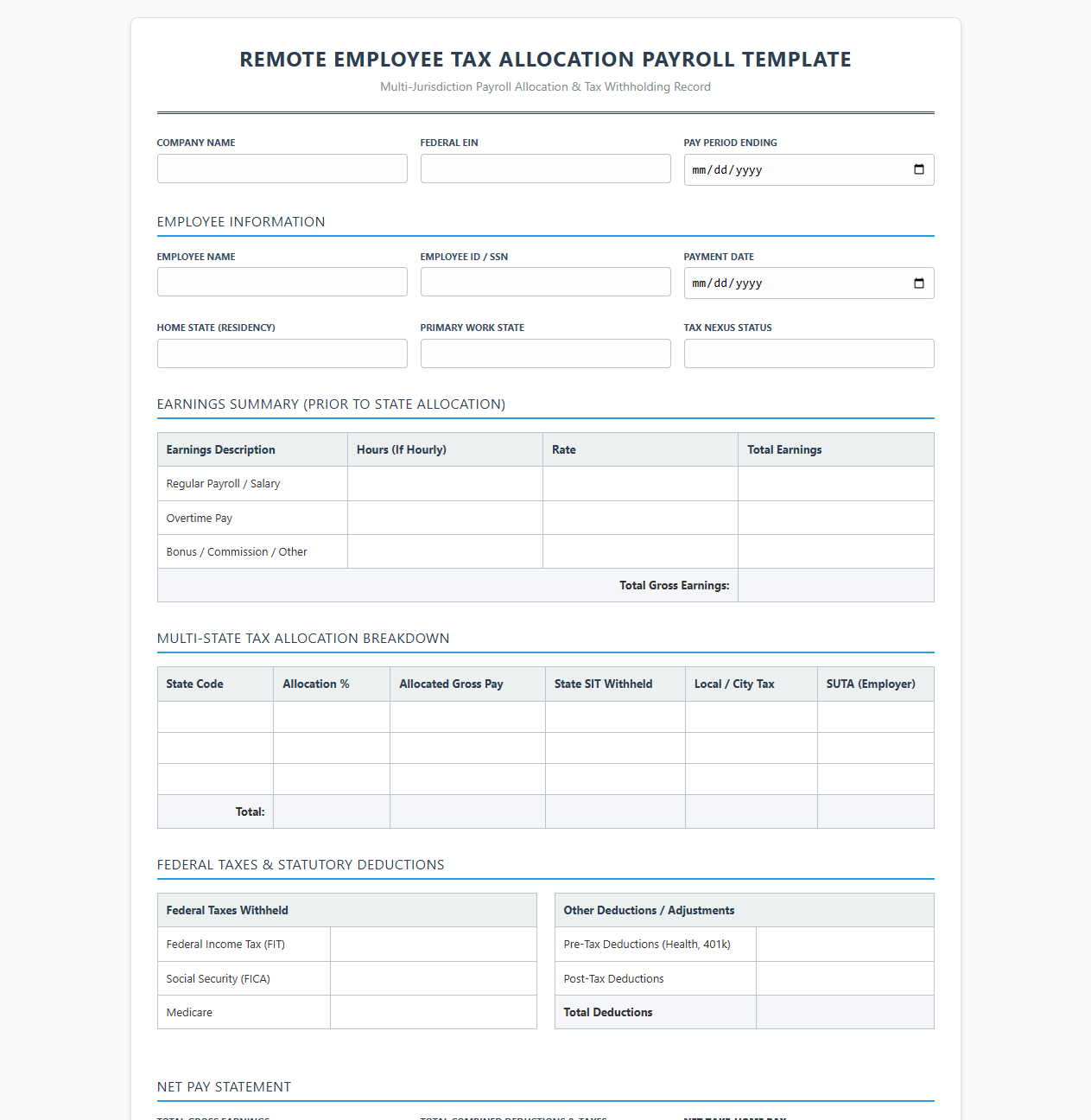 Download: .PDF
Multi-State Remote Worker Payroll Tax Allocation Sheet
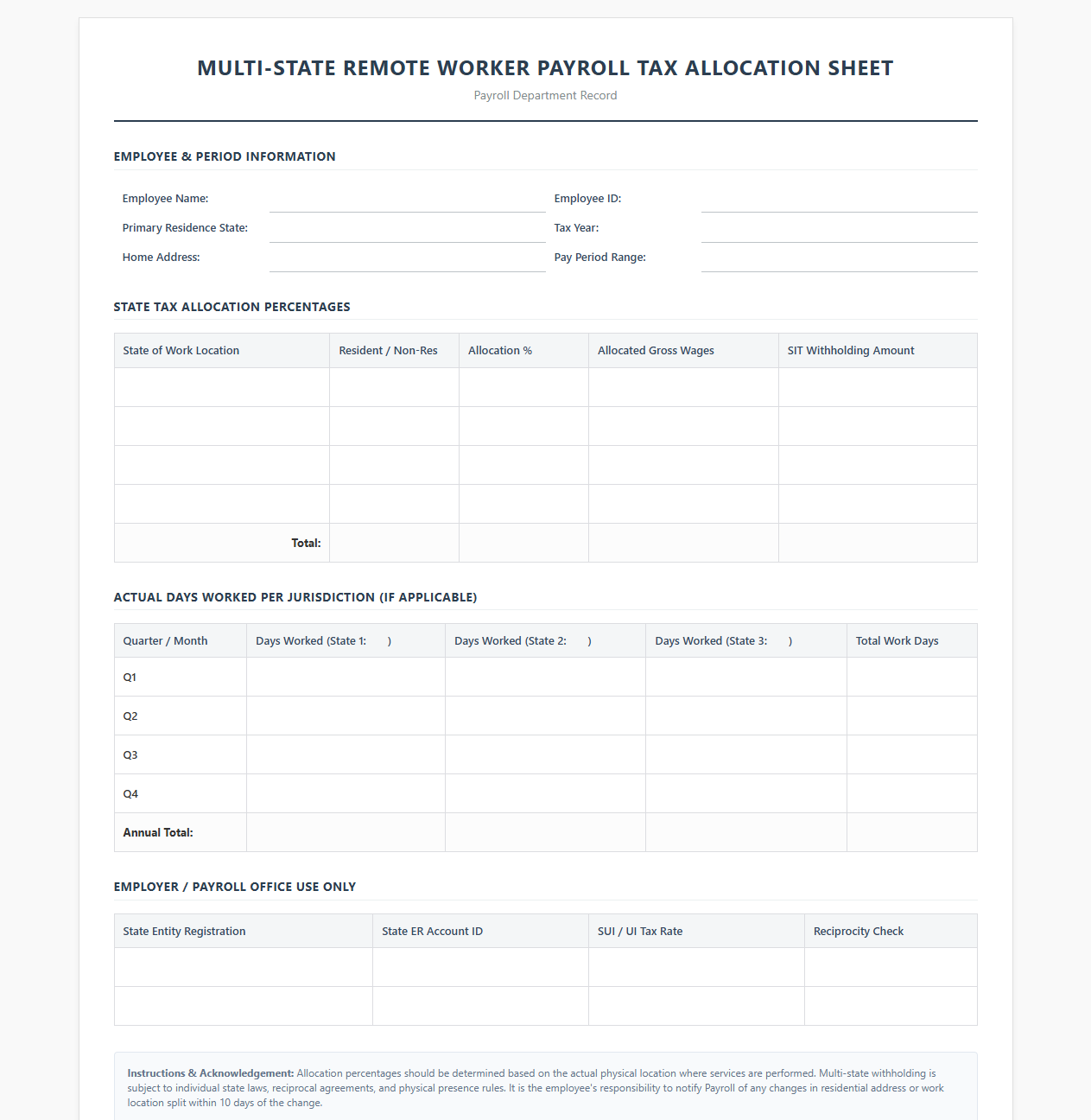 Download: .PDF
Remote Staff Tax Apportionment Payroll Spreadsheet
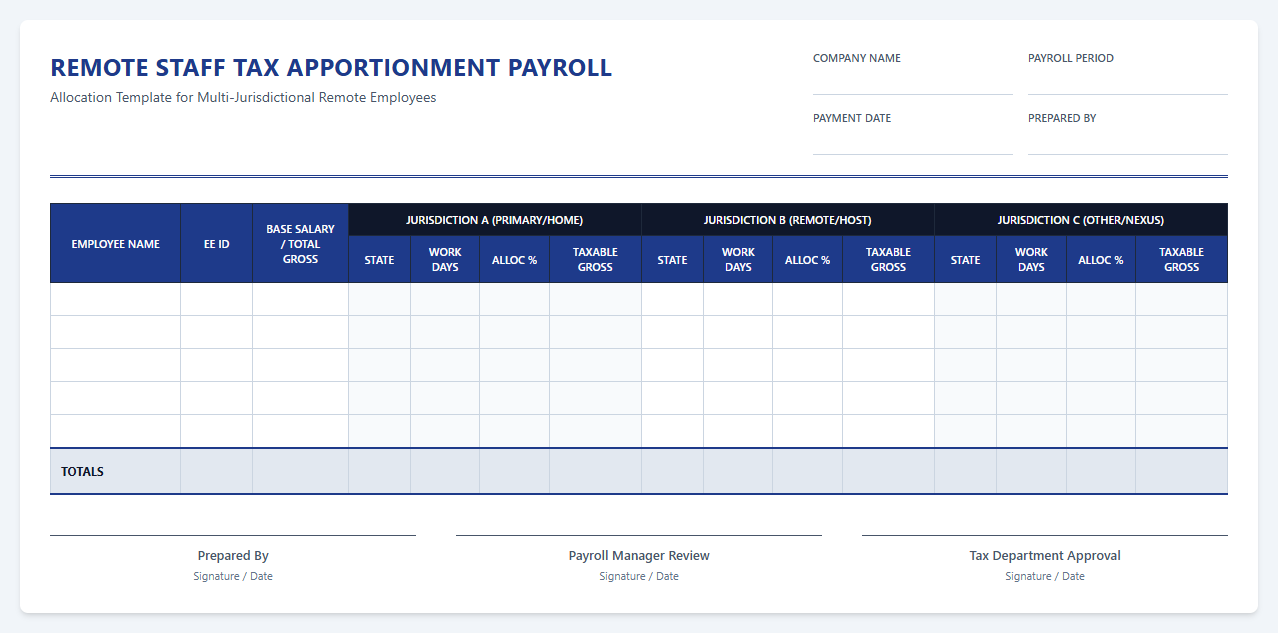 Download: .PDF
Payroll Calculator for Remote Employee Tax Allocation
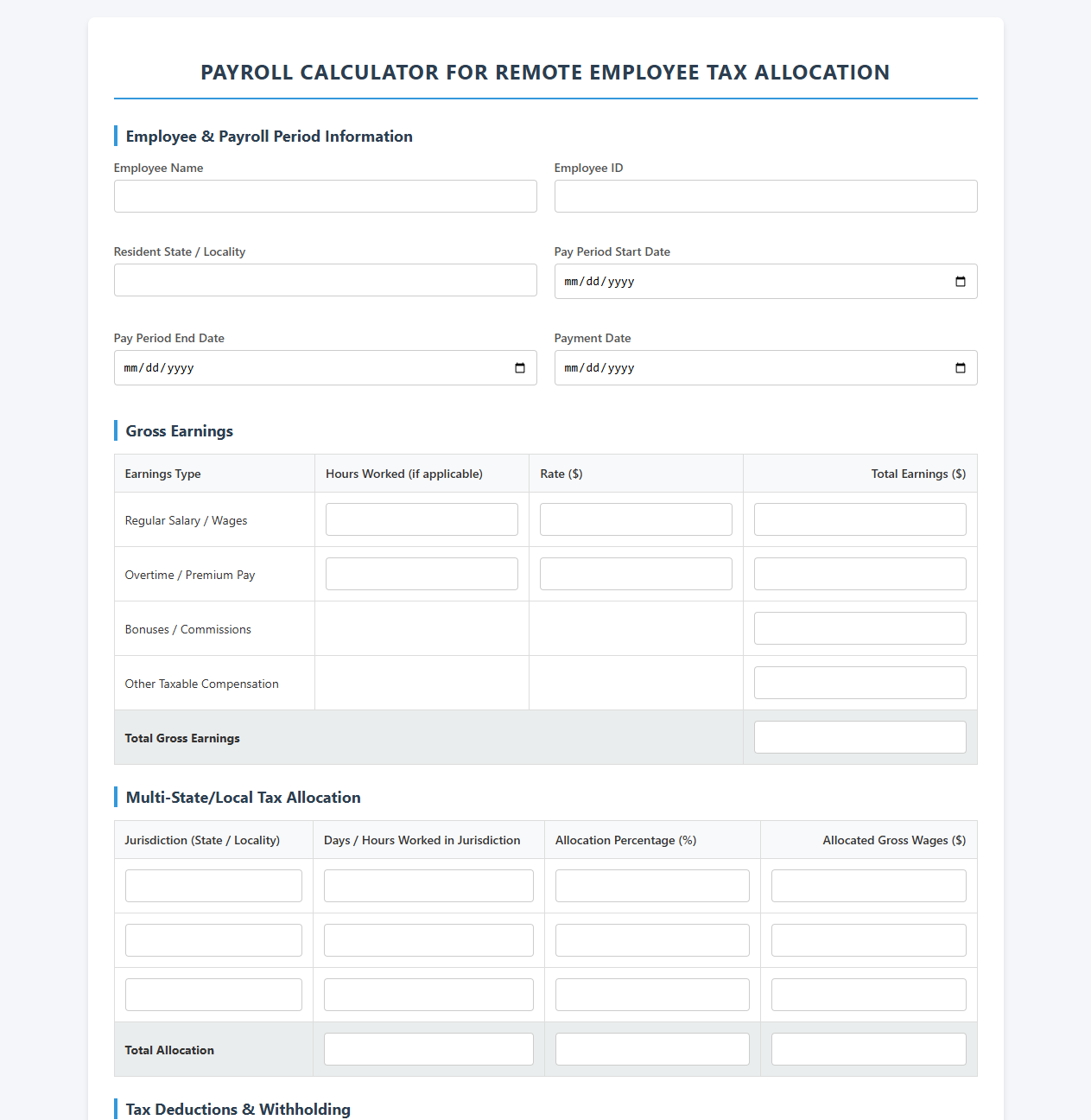 Download: .PDF
Remote Employee State Tax Allocation Payroll Ledger
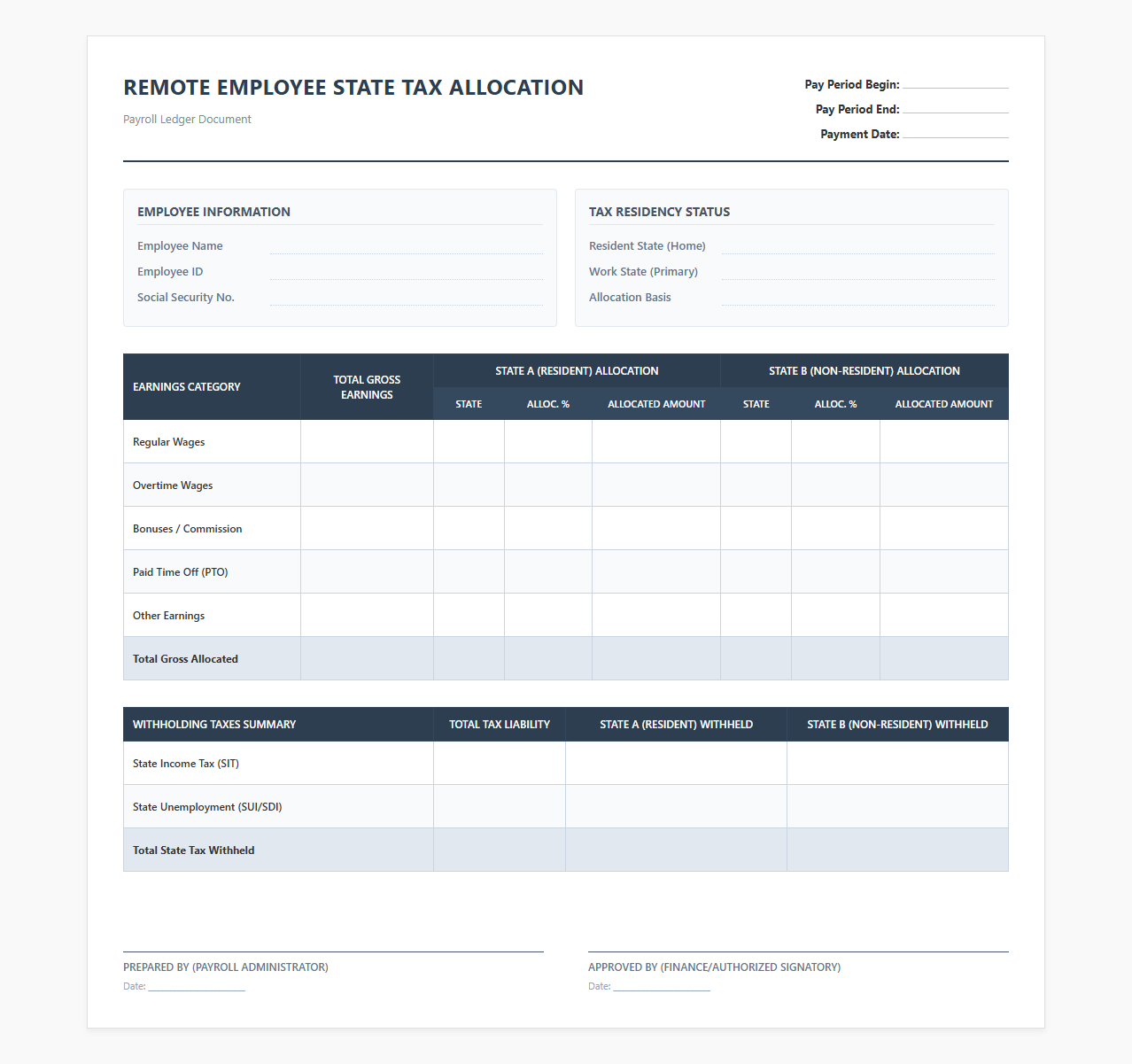 Download: .PDF
Out-of-State Remote Worker Payroll Tax Template
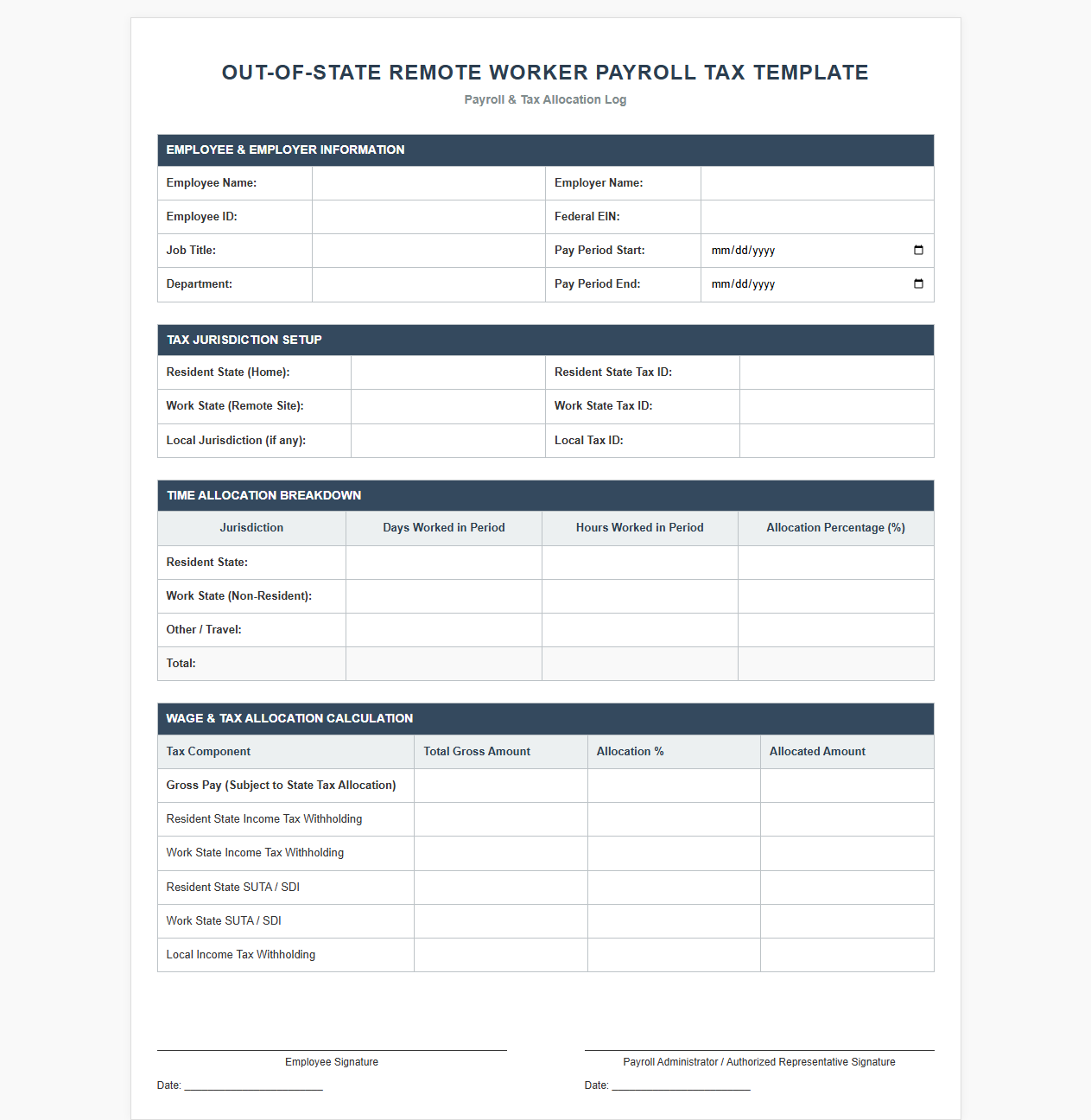 Download: .PDF
Remote Workforce Payroll Tax Allocation Worksheet
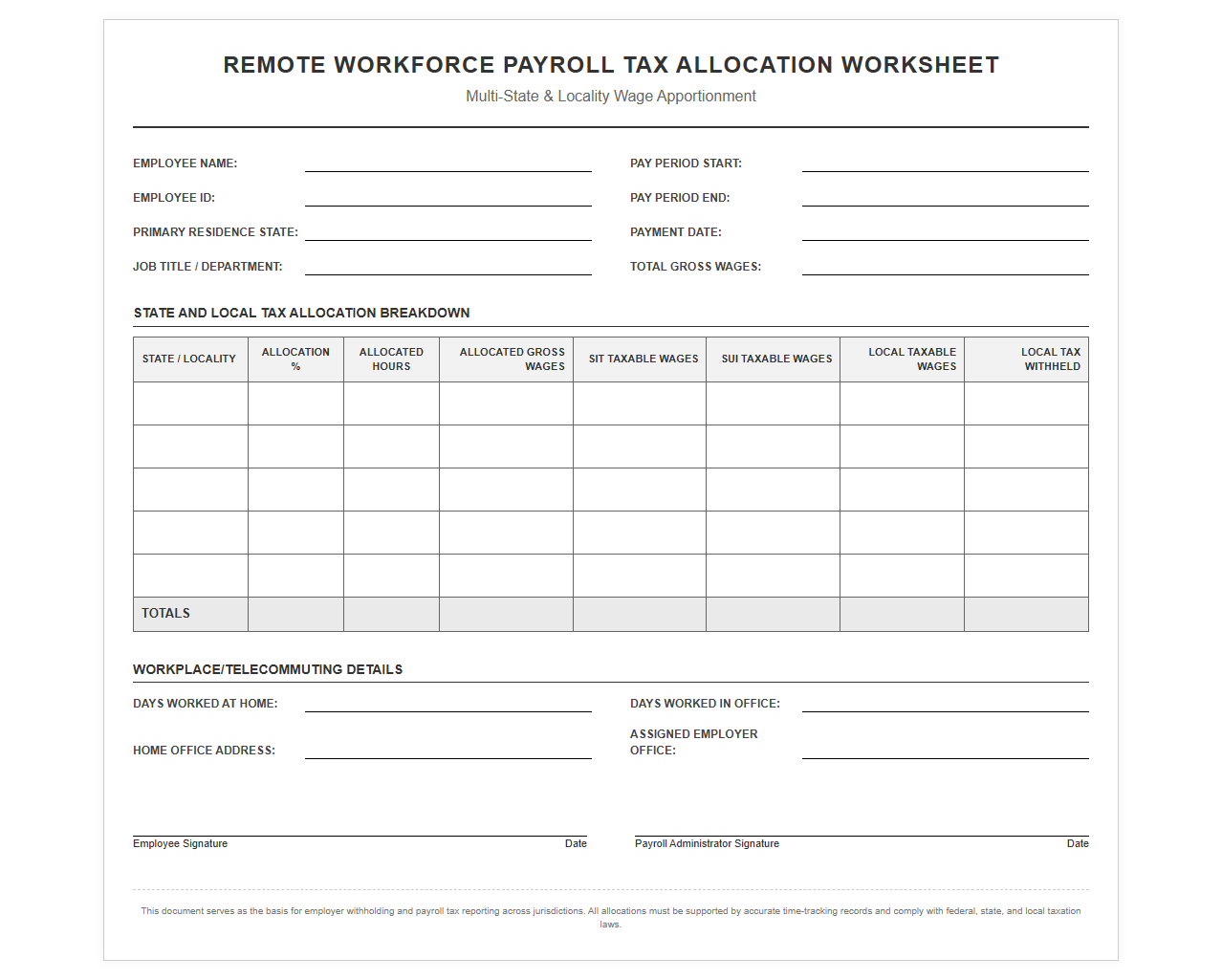 Download: .PDF
Telecommuter Payroll Tax Allocation and Tracking Template
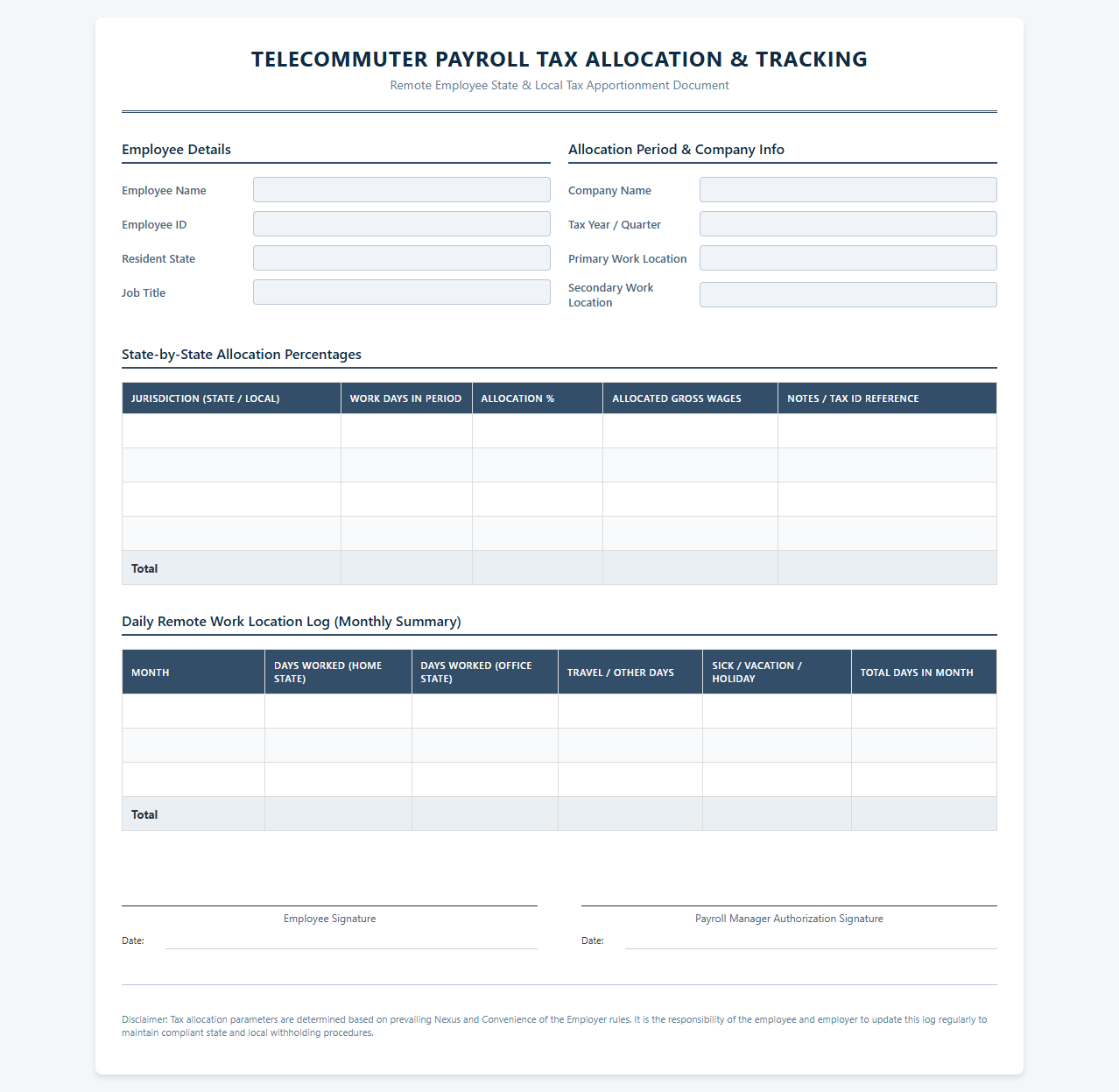 Download: .PDF
Navigating the Complexities of Multi-State Remote Payroll
The rise of the distributed workforce has transformed modern recruitment, but it has also introduced unprecedented compliance challenges for payroll administrators. When employees work across state lines, employers must navigate a labyrinth of conflicting state tax jurisdictions. Accurate remote employee tax allocation requires a granular understanding of where work is physically performed, as failing to correctly assign and withhold local taxes can result in severe financial penalties and retroactive tax assessments for both the business and the individual.
Understanding Tax Nexus and Employee Sourcing Rules
To remain compliant, businesses must first understand the legal triggers of state tax jurisdiction. A corporation establishes a corporate tax nexus-a business connection that subjects the employer to a state's taxing authority-simply by having a remote employee perform services within that state's borders. Under standard physical presence rules, payroll withholding is generally sourced to the state where the employee is physically located while working. However, some jurisdictions enforce the aggressive convenience of the employer rule, which dictates that if an employee works remotely for their own convenience rather than necessity, their income remains sourced to the employer's home state, potentially leading to double-taxation conflicts.
State-Specific Withholding Certificates and Form W-4 Equivalents
Relying solely on the federal Form W-4 is a common compliance pitfall. The federal W-4 is designed exclusively for federal income tax withholding and does not capture the specific allowances, credits, and rules mandated by individual state departments of revenue. To manage state tax allocation correctly, employers must collect state-specific W-4 equivalents from remote workers based on their residency and physical work location. Critical state-specific forms include:
- California DE 4: Used to determine employee withholding allowances specifically for California personal income tax.
- New York IT-2104: Required to calculate New York State, New York City, and Yonkers withholding specifications.
- Illinois IL-W-4: Directs the employer on the correct allowances to apply for Illinois state income tax withholding.
Non-Resident and Certificate of Residency Forms
When employees live in one state but perform work in another, non-resident withholding exemption certificates become vital. These forms allow employees to declare their tax residency status and certify that they are exempt from withholding in a specific jurisdiction. For example, an employee living in Maryland but commuting to or working for an employer in Virginia would utilize Form VA-4 to declare residency and request exemption. Similarly, workers in Maryland use Form MW507 to adjust their exemption status and ensure that tax allocations align precisely with their actual physical presence and residency status.
Leveraging Interstate Reciprocal Tax Agreements
Interstate reciprocity agreements offer a welcome relief for payroll departments managing border-state remote employees. These agreements allow employees who live in one state but work in another to be taxed only by their state of residence, eliminating the need for employers to split withholdings across multiple jurisdictions. To activate this benefit, the employee must submit a reciprocity exemption certificate to their payroll department.
| Employee State of Residence | State of Employment (Nexus) | Required Exemption Certificate |
|---|---|---|
| Pennsylvania | New Jersey | Form NJ-165 |
| Virginia | Maryland | Form MW507 |
| Ohio | Michigan | Form MI-W4 |
Step-by-Step Payroll Allocation Document Workflow
Managing multi-state documentation requires a structured, repeatable onboarding workflow to verify state taxes before the first pay cycle runs.
- Verify Remote Work Location: Confirm the employee's physical home address and exact working address during the job offer stage.
- Determine Tax Nexus: Establish if the employee's state of residence creates a new tax nexus for the employer and register the business with that state's agency if necessary.
- Distribute State-Specific Forms: Provide the employee with the correct state-specific W-4 equivalent or reciprocal exemption form based on physical location rules.
- Validate Completed Documentation: HR checks the completed forms for accuracy, verifying that exemptions and home addresses match current tax laws.
- Configure Payroll Software: Input the specific state withholding allowances and tax codes into the payroll system to automate accurate deductions.
Mitigating Audit Risks with a Multi-State Compliance Checklist
Adopting proactive measures is the most effective way to safeguard an organization against unexpected tax liabilities and state-level audits. Continuous oversight ensures that state tax allocations remain precise even as remote employees relocate or transition between different hybrid working arrangements.
- Conduct quarterly audits of all employee physical work locations to detect unauthorized relocations.
- Reconcile state unemployment insurance (SUI) tax rates with active remote worker jurisdictions on a regular basis.
- Verify that the correct reciprocal agreements are actively applied to eligible border-state employees.
- Ensure the payroll department receives instant notifications when tax laws or state withholding rates change.
- Maintain a secure digital archive of all signed state W-4s and exemption certificates for at least four years.
Leave a comment