
For sole proprietors, tracking every business meal during busy travel schedules is a persistent administrative headache that frequently results in missed tax write-offs. While it is tempting to rely solely on monthly credit card statements, the IRS mandates rigorous substantiation that standard bank logs simply cannot provide. Implementing a structured recording system grants you the dual benefit of absolute audit-proof peace of mind and fully maximized legal deductions.
However, compliance requires adhering to strict IRS stipulations: meals must not be "lavish or extravagant," and most are subject to a 50% deduction limit. To satisfy these regulatory standards, your records must document concrete details for every transaction-specifically the date, location, exact business purpose, and the names of any clients or associates present.
In this article, we will provide essential, customizable expense templates and practical strategies designed to streamline your travel meal logging and ensure seamless IRS compliance.
Sole Proprietor Travel Meal Expense Spreadsheet
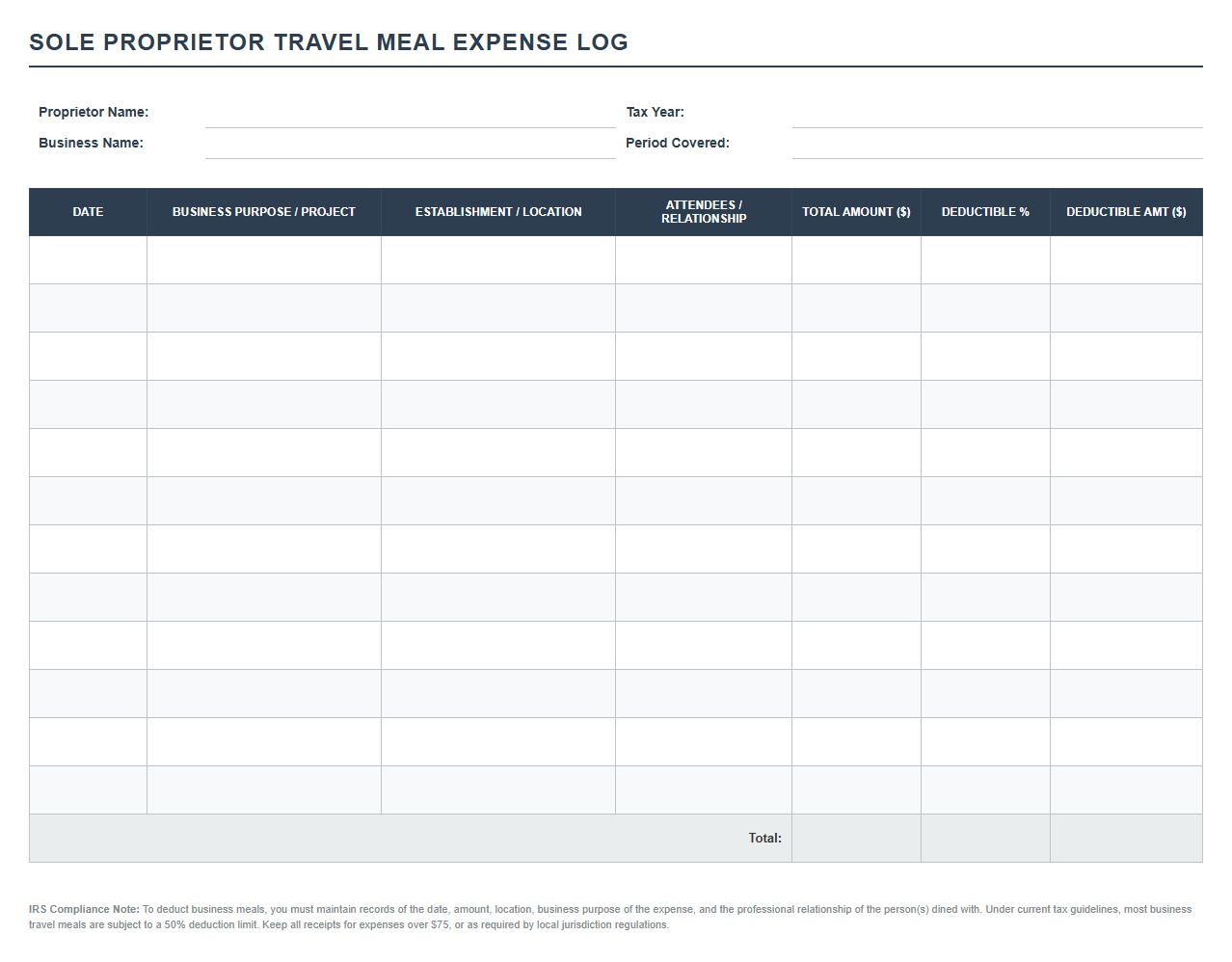 Download: .PDF
Self-Employed Business Travel Dining Expense Log
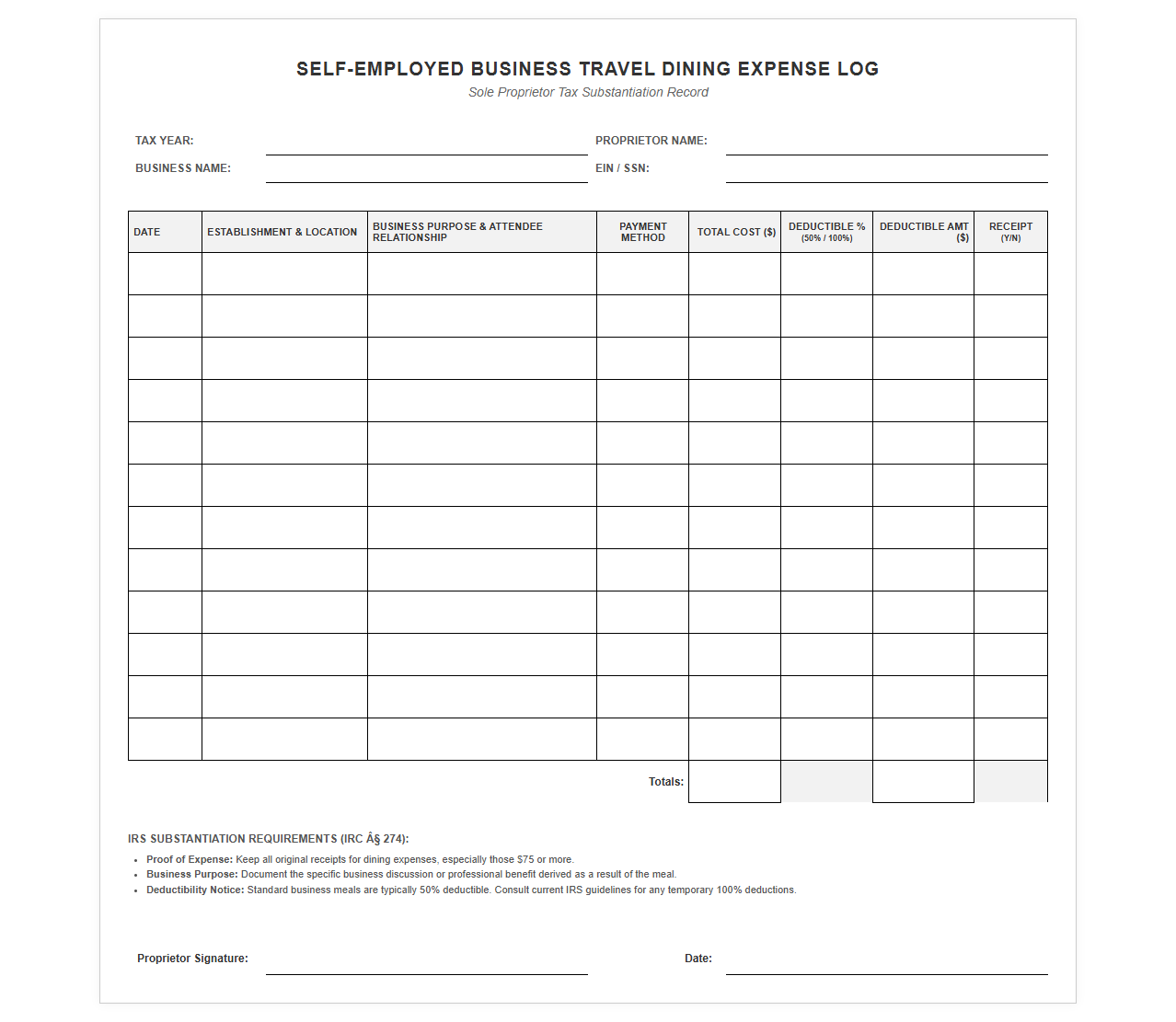 Download: .PDF
Schedule C Travel Meals Deduction Tracker
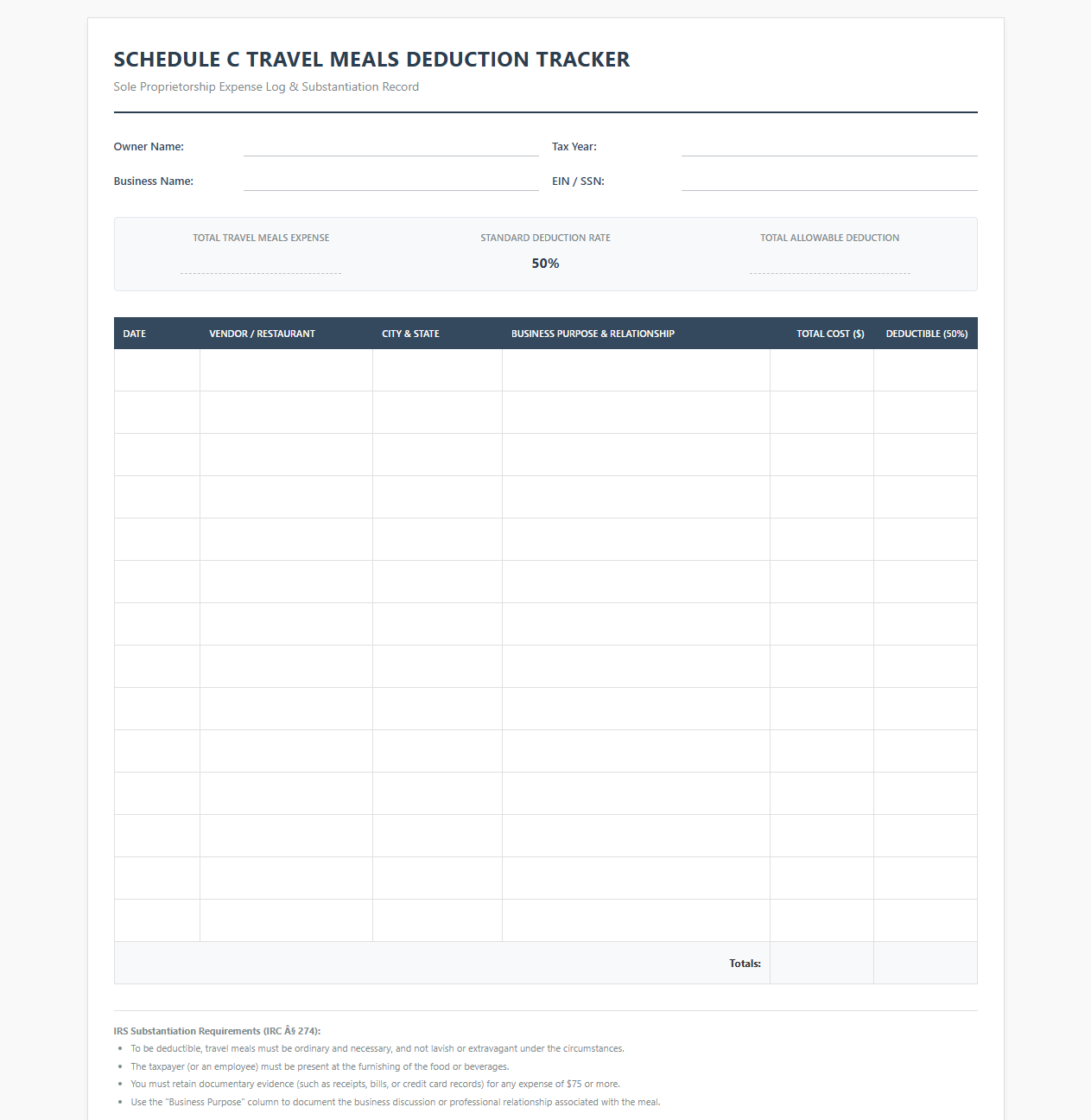 Download: .PDF
Sole Trader Travel Meal Receipt Template
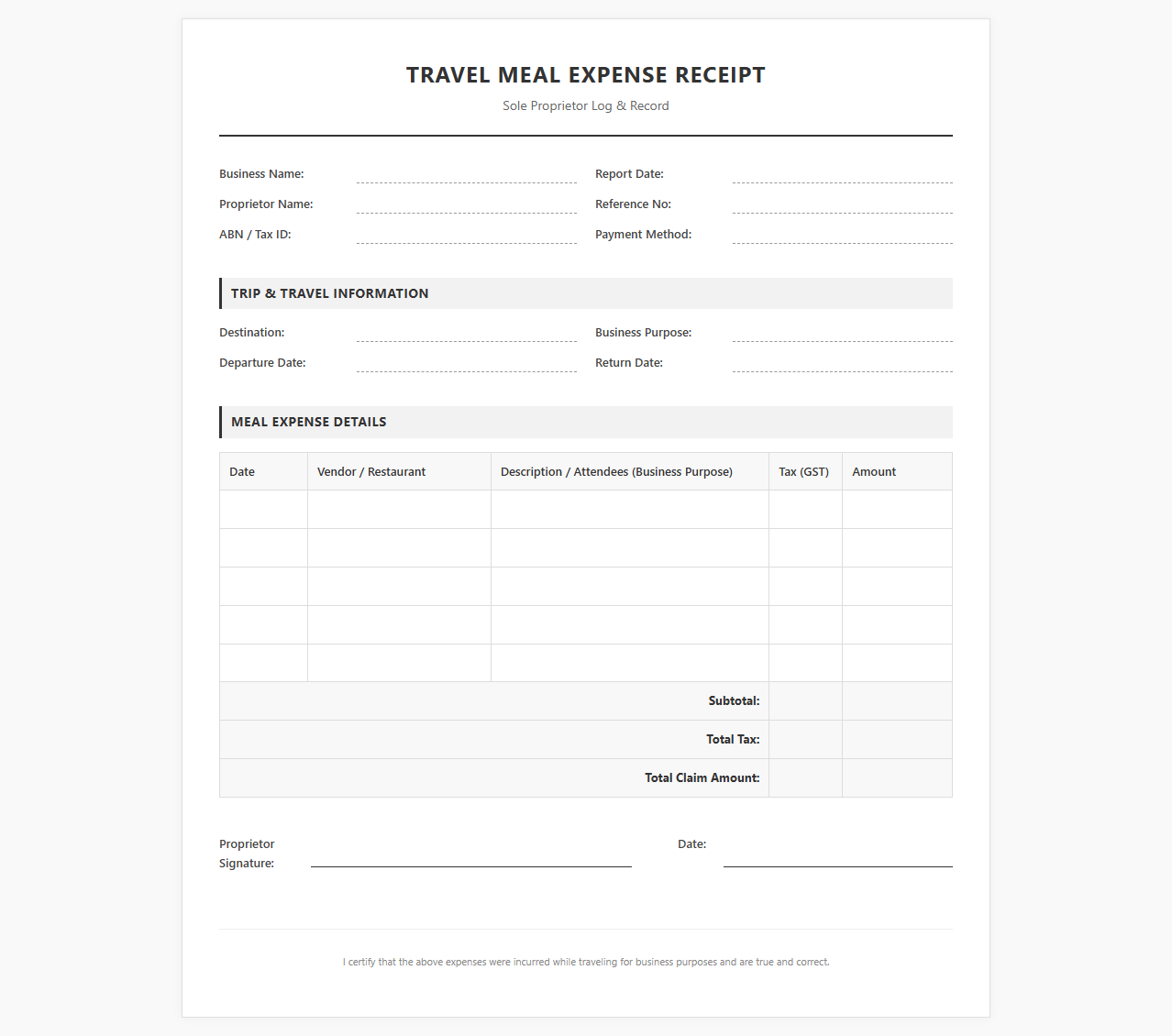 Download: .PDF
Freelancer Business Travel Meals Expense Sheet
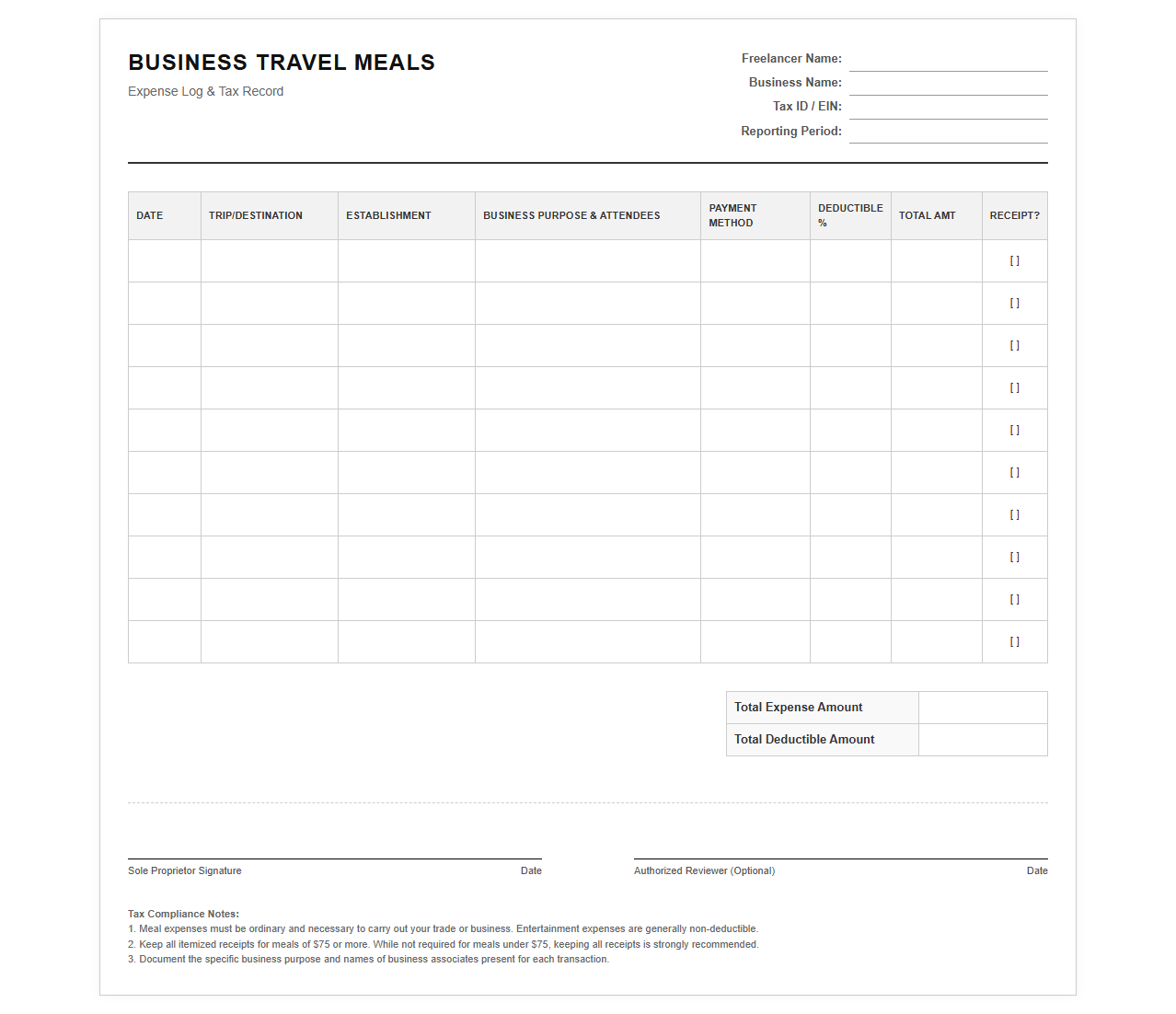 Download: .PDF
Independent Contractor Travel Dining Reimbursement Form
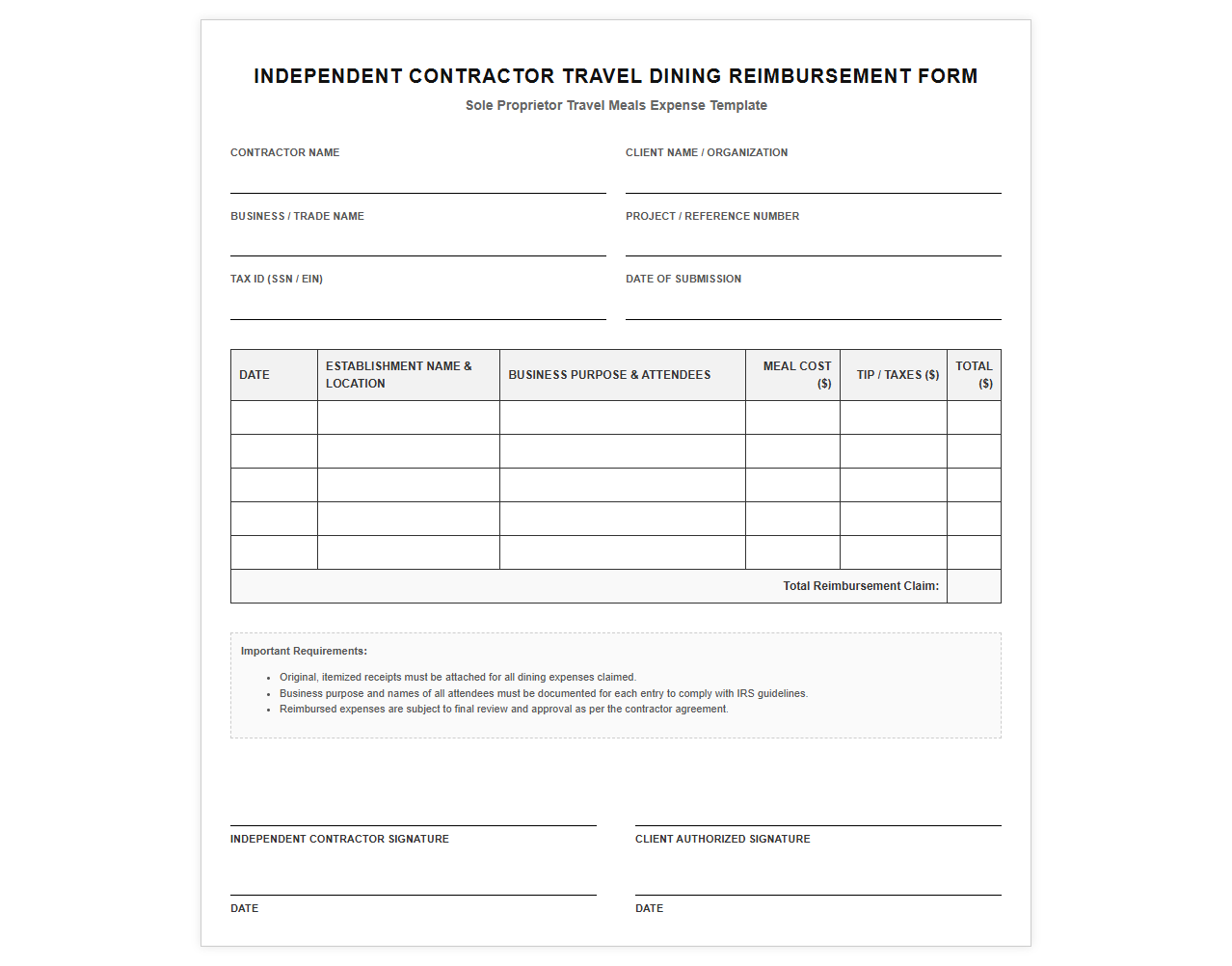 Download: .PDF
Sole Proprietorship Travel Food Expense Ledger
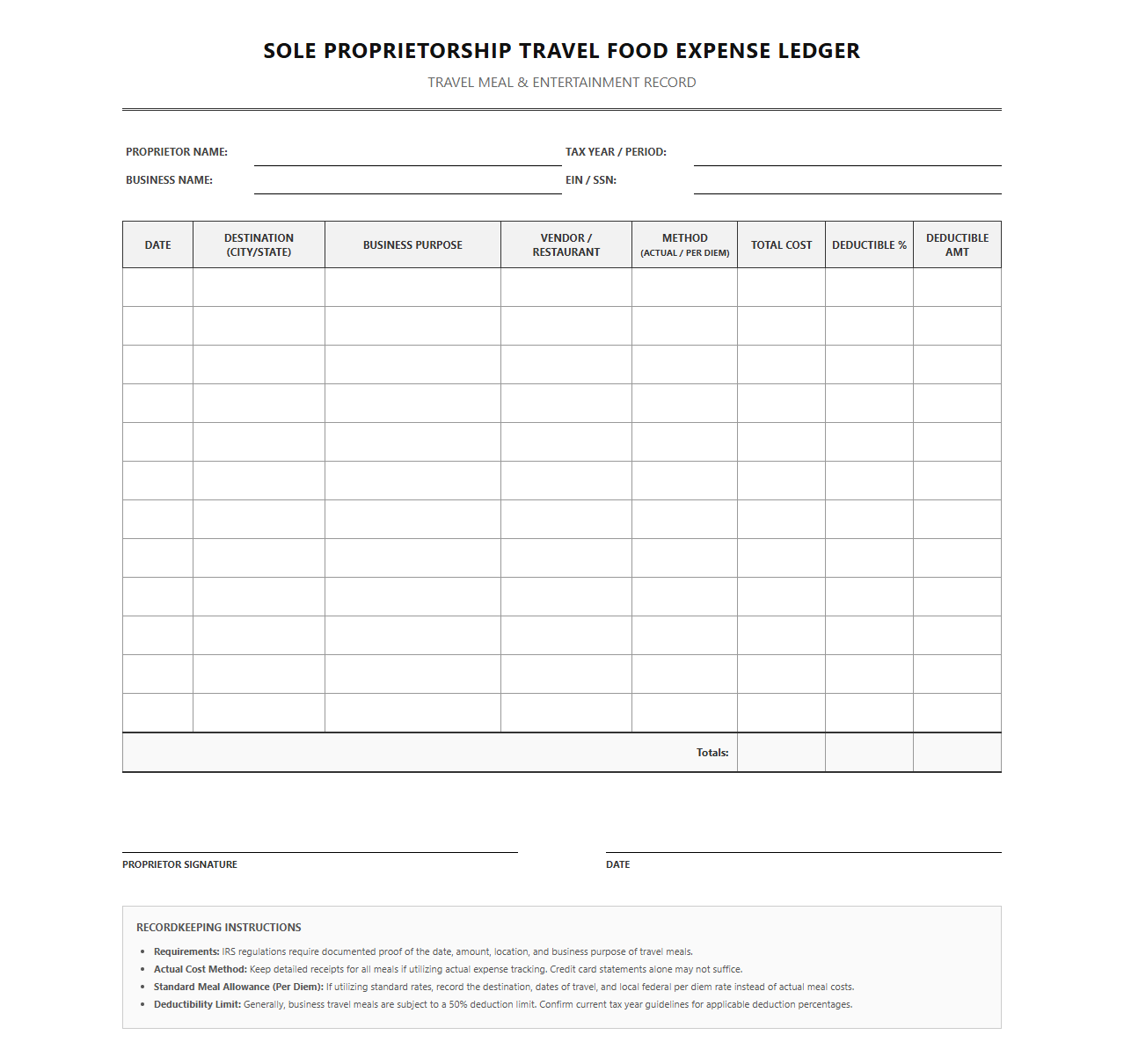 Download: .PDF
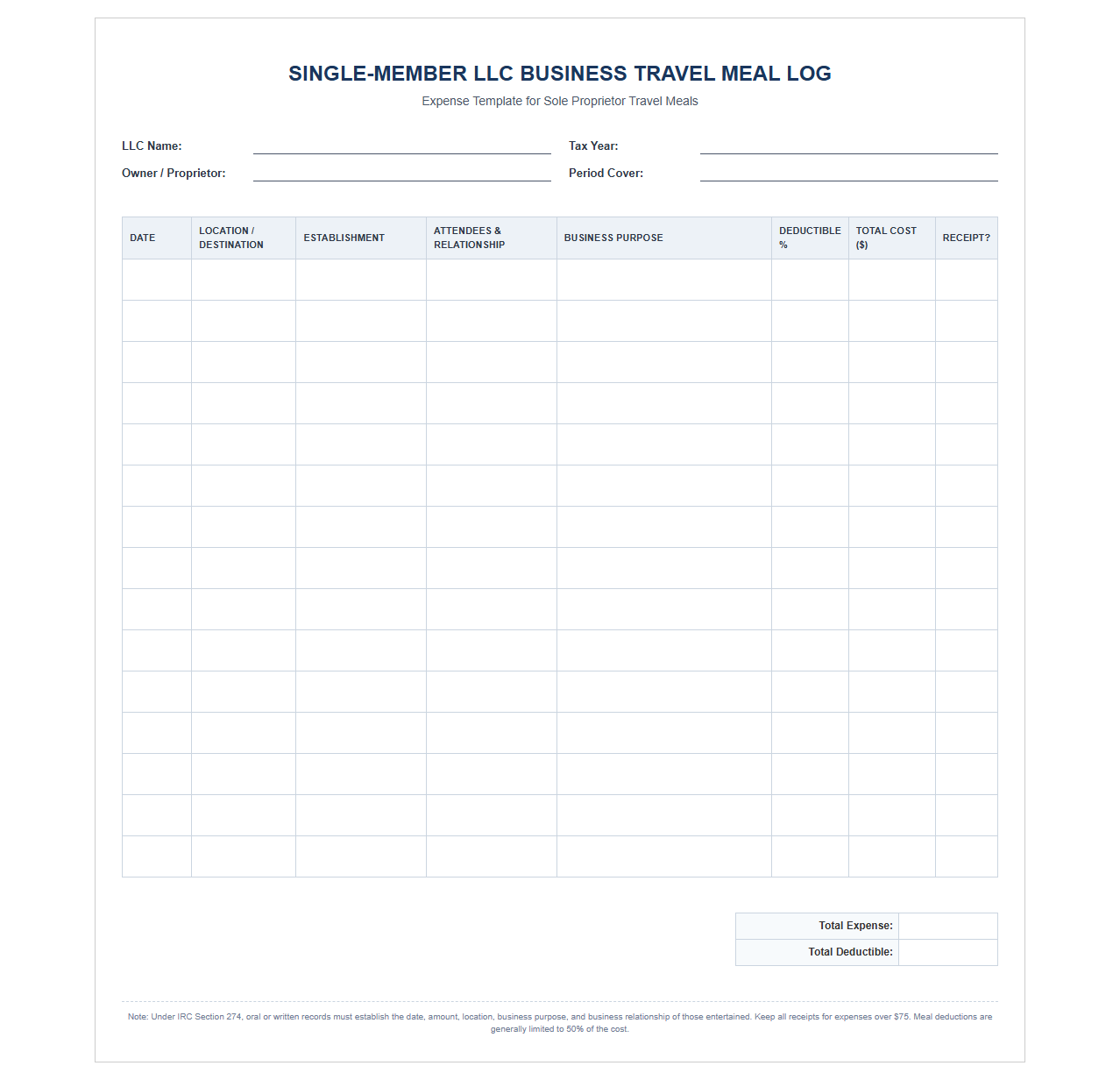
Single-Member LLC Business Travel Meal Log
 Download: .PDF
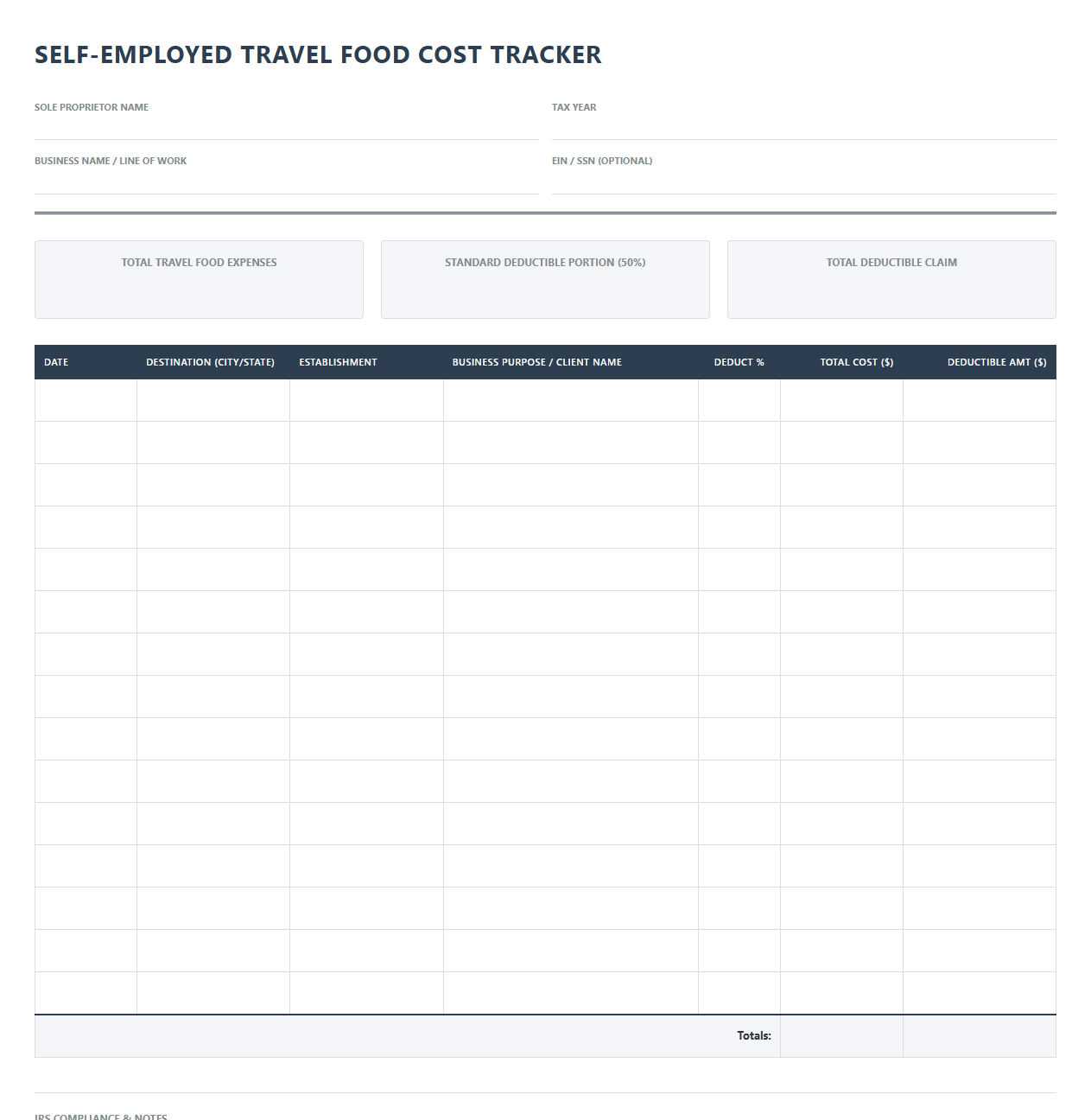
Self-Employed Travel Food Cost Tracker
 Download: .PDF
Demystifying IRS Rules for Sole Proprietor Travel Meals
For sole proprietors, managing business expenses is a daily balancing act, and tax deductions represent a major opportunity to save money. However, travel meals are one of the most frequently scrutinized deductions by the IRS. Proper record-keeping is not just a recommended practice; it is your shield against potential audits. By understanding how to track these expenses accurately, you can maximize your tax savings and secure absolute peace of mind when tax season arrives.
The Core IRS Deductibility Rules Explained
Navigating IRS rules requires a clear understanding of what makes a meal deductible. Generally, business meals are subject to a 50% deduction limit, meaning you can only deduct half of the total cost of the meal. To qualify, the expense must meet specific criteria defined by tax law.
To be deductible, your travel meals must be:
- Ordinary and necessary: An expense that is common, accepted, and helpful in your line of trade or business.
- Associated with tax travel: The meal must occur while you are traveling away from your general tax home for business purposes, requiring an overnight stay or a period of rest.
- Not lavish or extravagant: The expense must be reasonable under the circumstances, rather than excessively luxurious.
Five Must-Have Details for Every Meal Receipt
To satisfy IRS auditors, a simple receipt is often not enough. You must document the context surrounding the business meal. Legally, you need to capture the critical details of the transaction to prove its business purpose.
- When: The exact date and time the meal took place.
- Where: The name and location of the restaurant or establishment.
- What: The total amount spent, including tax and tip.
- Who: The names and business relationships of the attendees (or a note indicating you dined alone while on overnight business travel).
- Why: The specific business purpose or the nature of the business discussion held during or immediately after the meal.
Template 1: The Essential Travel Meal Log Spreadsheet
A spreadsheet is a reliable and straightforward tool for tracking your business meals. Setting up a dedicated sheet in Excel or Google Sheets allows you to compile your records chronologically, making it easy to hand over to your CPA at the end of the year.
| Date | Vendor Name & Location | Total Cost ($) | Attendees & Business Relationship | Business Purpose / Project |
|---|---|---|---|---|
| 10/12/2023 | The Daily Grind, Chicago IL | 45.50 | Self (Overnight Travel for Conference) | Attended Annual Tech Summit |
| 10/13/2023 | Bistro Central, Chicago IL | 112.40 | John Doe (Potential Client) | Discussed Q4 consulting contract |
Template 2: Digital Receipt Capture and Mobile Logging
For sole proprietors who are constantly on the move, maintaining a physical folder of paper receipts is inefficient. Utilizing mobile scanning templates and receipt-tracking apps can streamline your workflow by allowing you to snap photos and instantly digitize your records.
Pro Tip: Use mobile apps that utilize Optical Character Recognition (OCR) technology. This automatically extracts the date, vendor, and amount, saving you manual data entry time while ensuring you capture every write-off.
Best Practices to Safeguard Your Meal Deductions
Maintaining a compliant logging process is simple once you build the right habits. Implementing a few safeguards will ensure your records stand up to any IRS review.
- Always keep digital backups in a secure cloud storage folder organized by tax year.
- Separate your personal and business banking accounts entirely to avoid co-mingling funds.
- Standardize your routine by logging your meals weekly rather than waiting until the end of the year.
- Write the business purpose directly on physical receipts before scanning them.
Streamline Your Tax Season with Consistent Tracking
Taking control of your travel meal deductions protects your hard-earned revenue and removes the stress of tax preparation. By utilizing organized spreadsheets and modern digital tools, you establish an bulletproof system of compliance that keeps your sole proprietorship safe.
Do not wait for tax season to catch up on your bookkeeping. Start using these tracking templates today to secure your deductions and focus on growing your business with confidence. Visit the official IRS website to stay updated on the latest tax guidelines.
Read More
Leave a comment