

Managing equity transactions often introduces severe administrative bottlenecks, particularly during warrant exercises where minor calculation errors can lead to costly compliance disputes and strained investor relations. Before streamlining these transactions, organizations must first reconcile diverse agreement terms, vesting schedules, and fluctuating valuation dates that complicate modern capitalization tables.
Utilizing standardized statement templates grants finance teams immediate operational precision, reducing manual processing times from hours to minutes. However, as an educational stipulation, please note that while templates establish a robust baseline, they must always be customized to align with specific legal covenants and jurisdictional tax requirements. For instance, incorporating dedicated fields for "net-issue exercises" or "cashless formulas" serves as concrete proof of a template's ability to handle complex transactional math without errors.
In this article, we will examine the critical elements of a compliant warrant statement, provide adaptable templates for immediate use, and share best practices for maintaining absolute accuracy in your equity ledger.
Warrant Exercise Statement Template
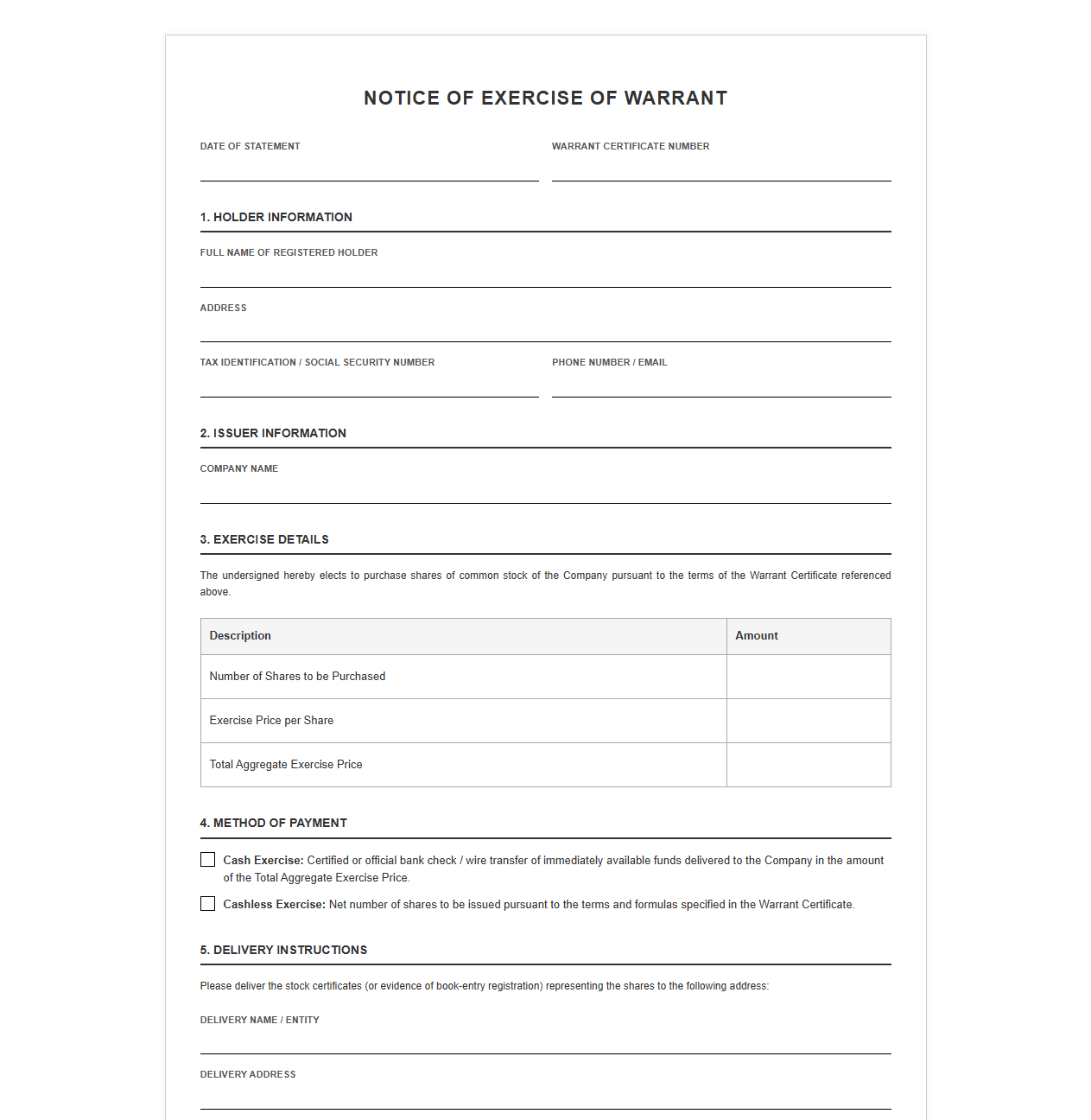 Download: .PDF
Notice of Warrant Exercise and Settlement Statement
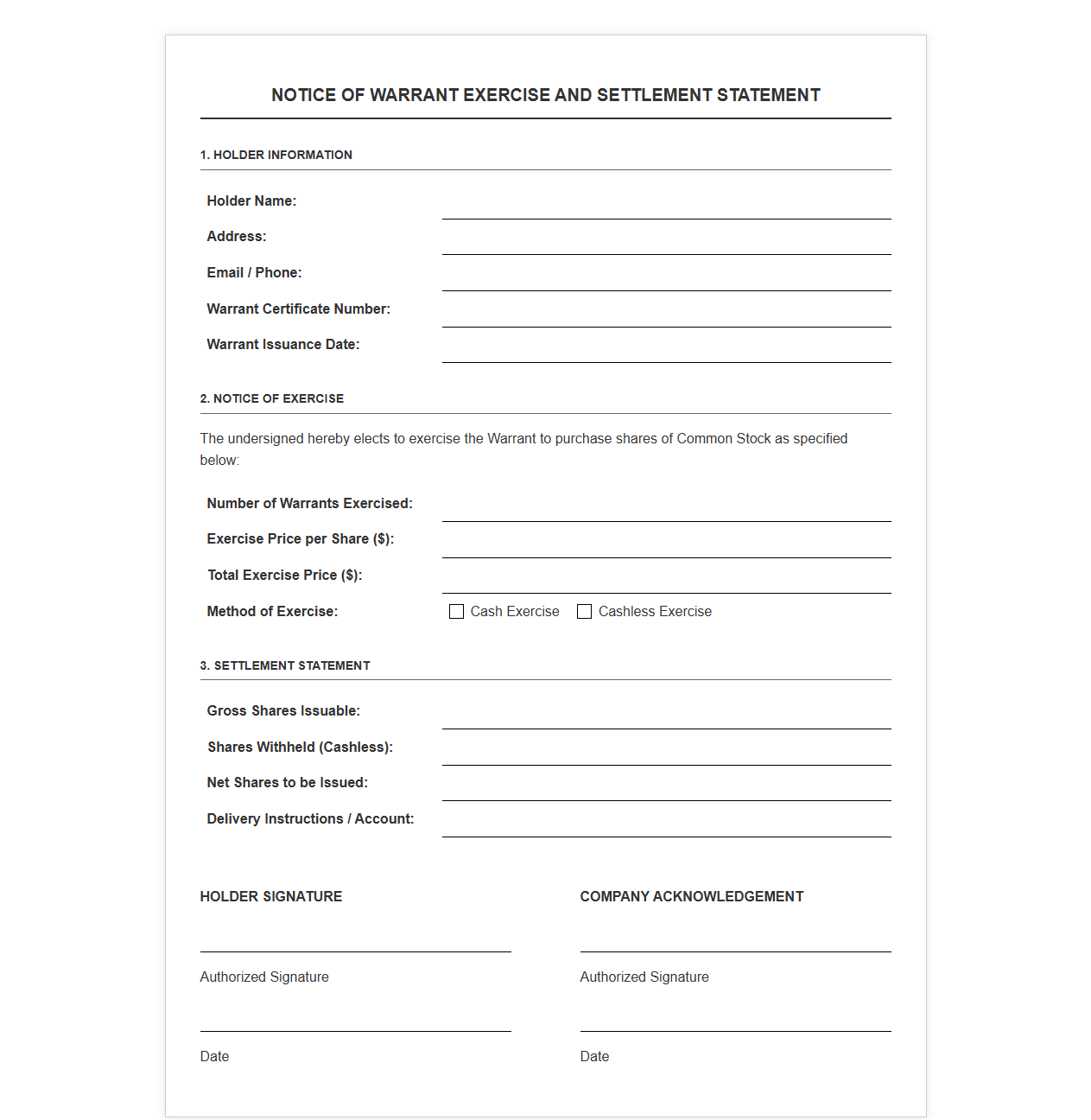 Download: .PDF
Share Warrant Exercise Confirmation Statement
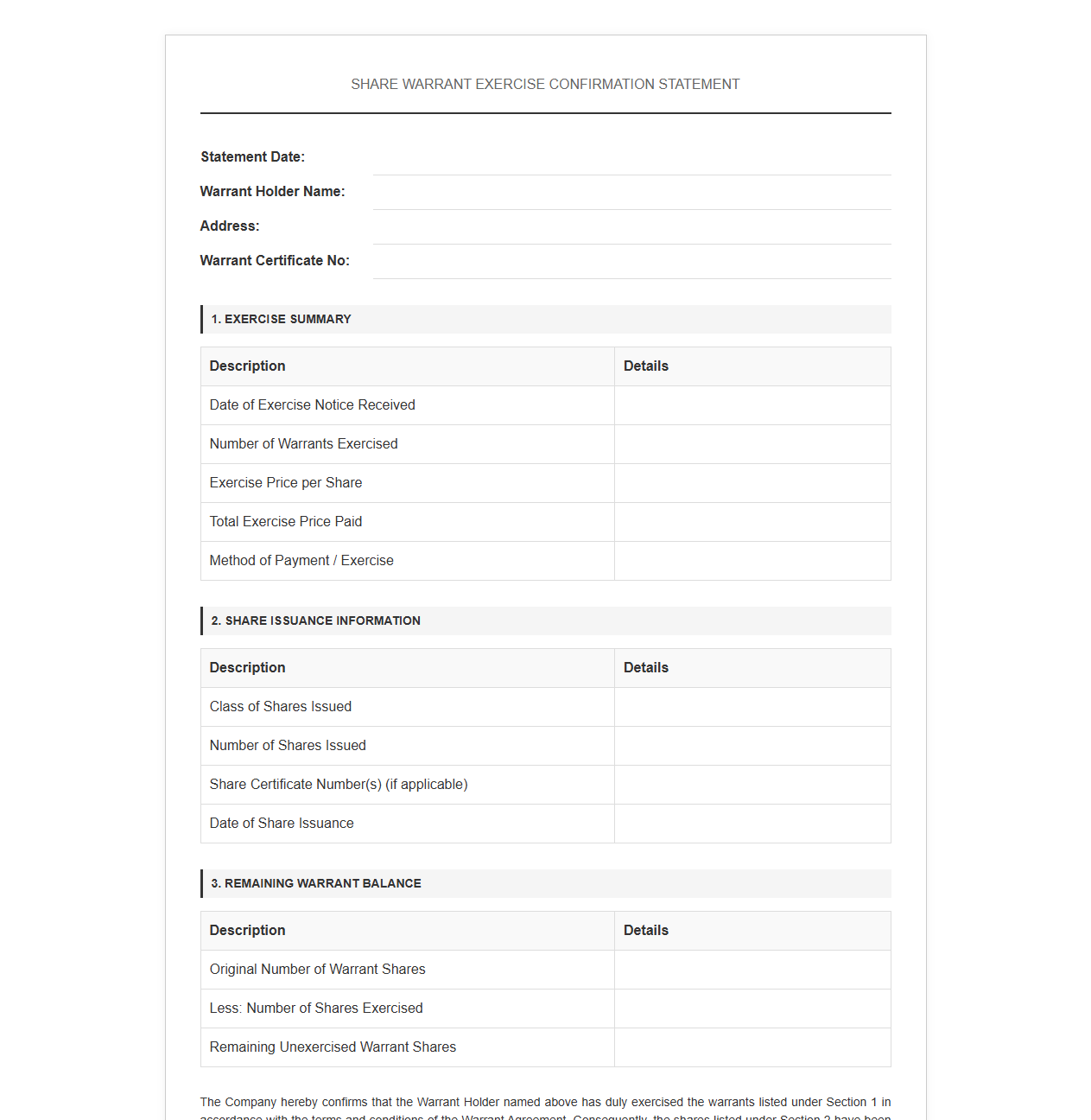 Download: .PDF
Stock Warrant Exercise and Issuance Statement
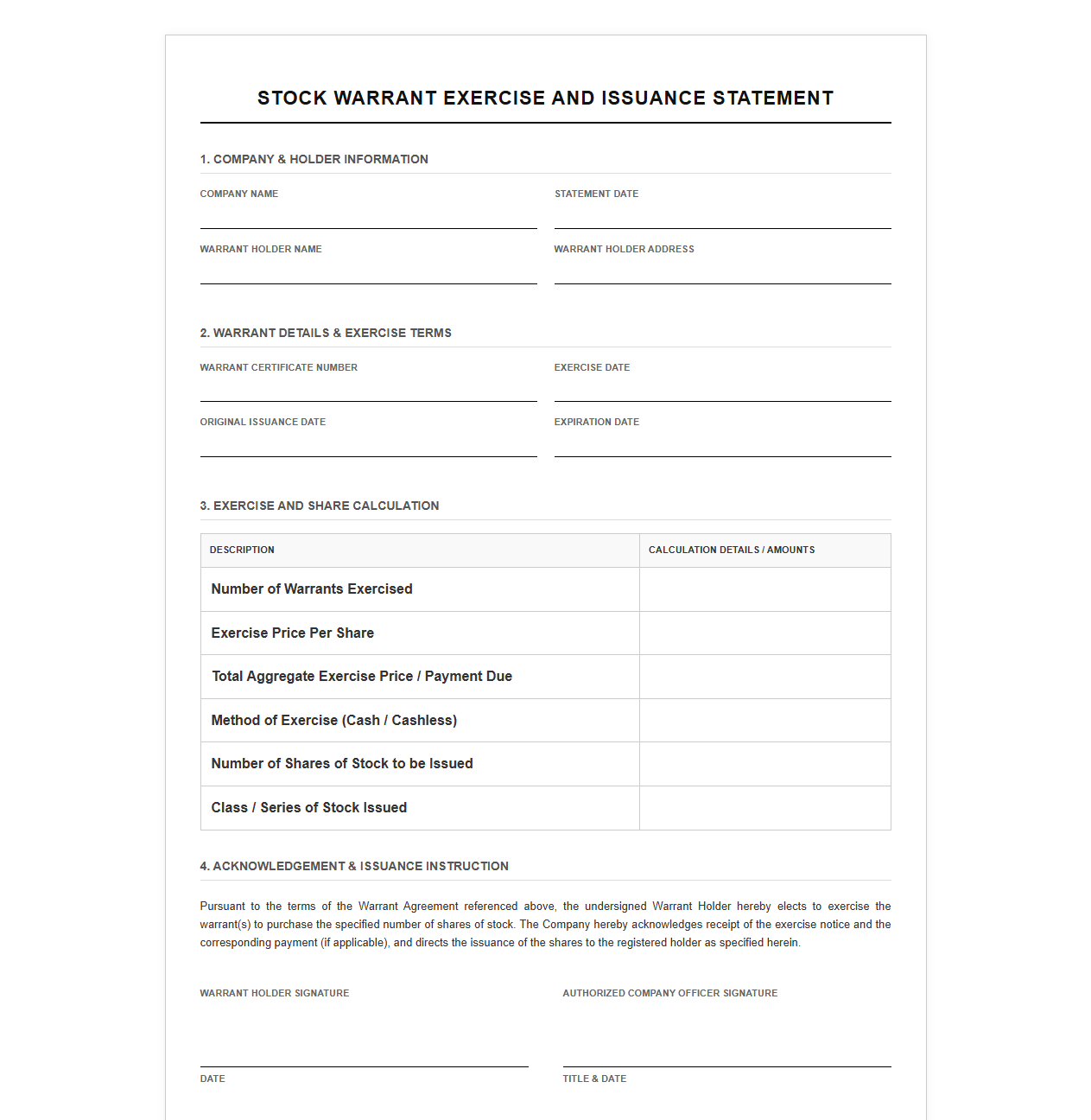 Download: .PDF
Investor Warrant Exercise Declaration Statement
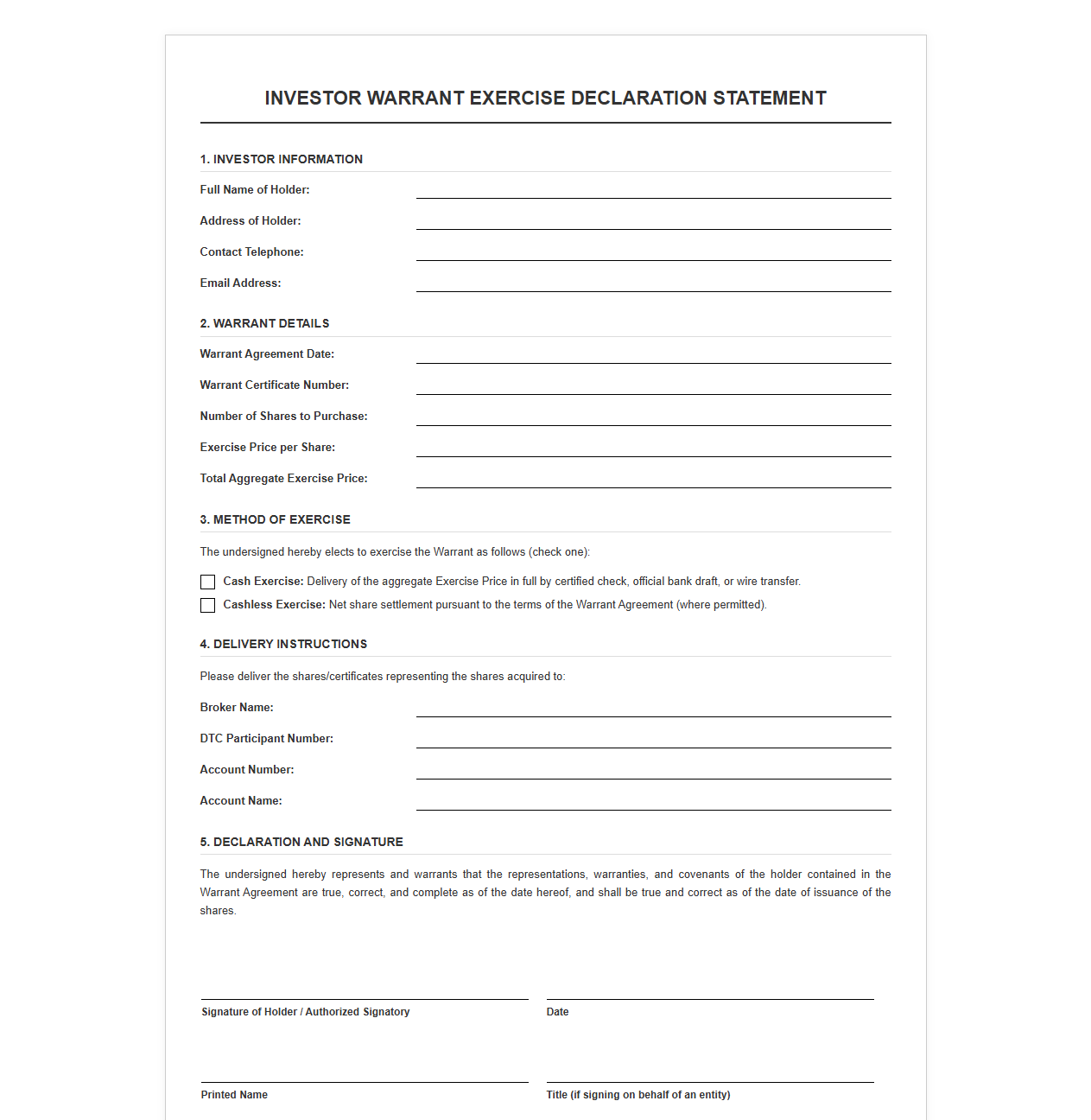 Download: .PDF
Statement of Common Stock Warrant Exercise
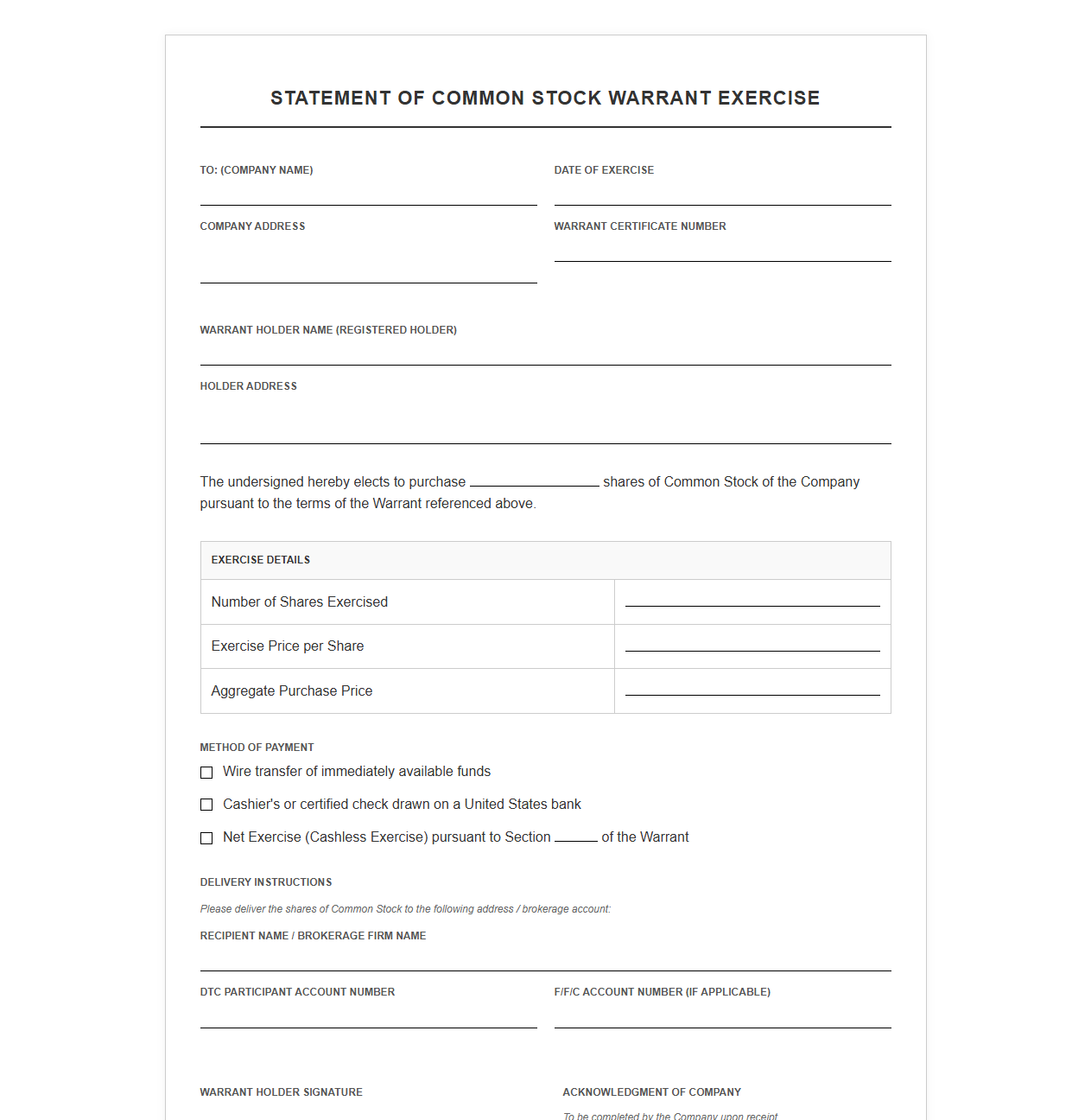 Download: .PDF
Warrant Agreement Exercise Election Statement
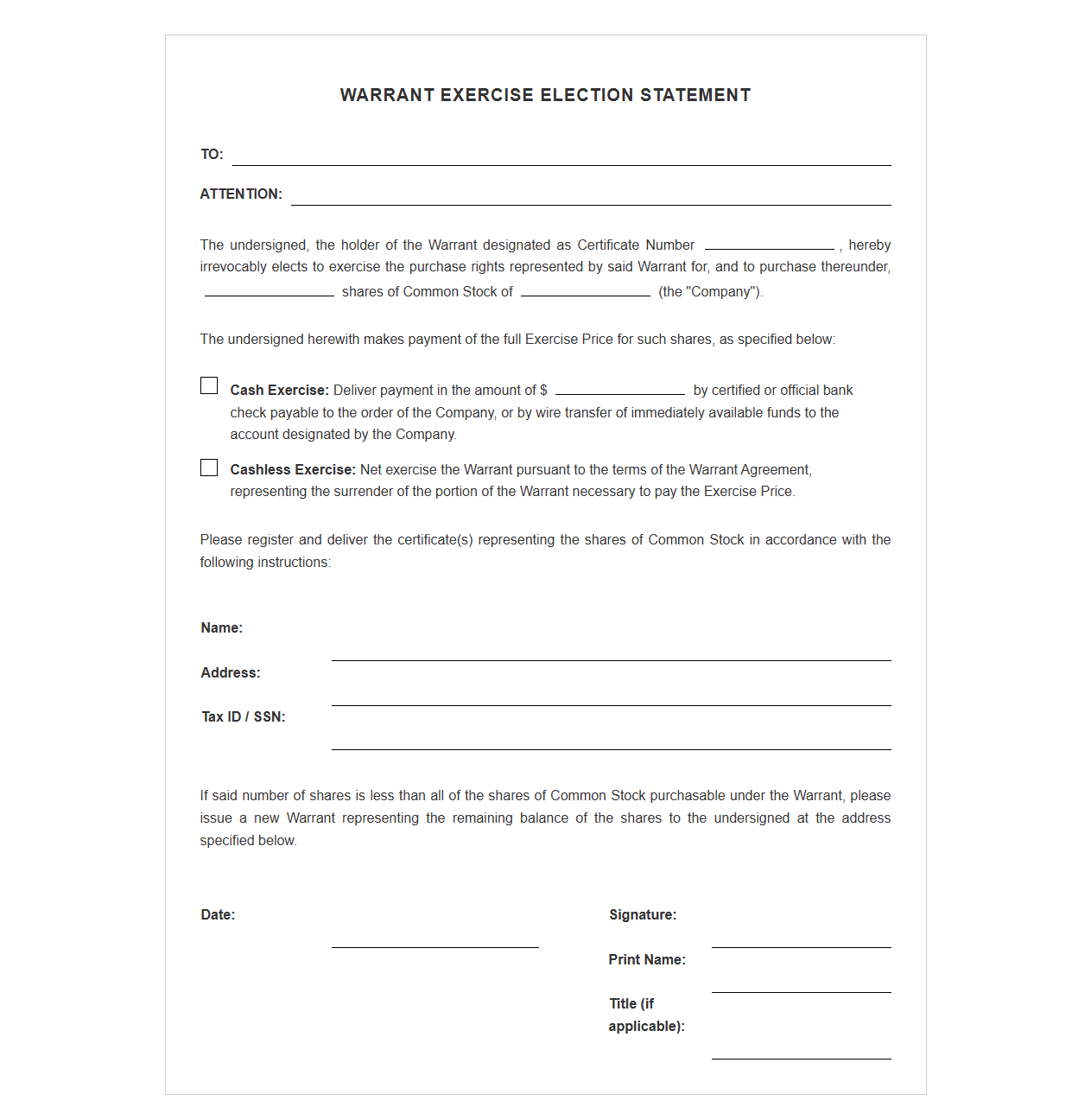 Download: .PDF
Company Statement for Warrant Shares Exercise
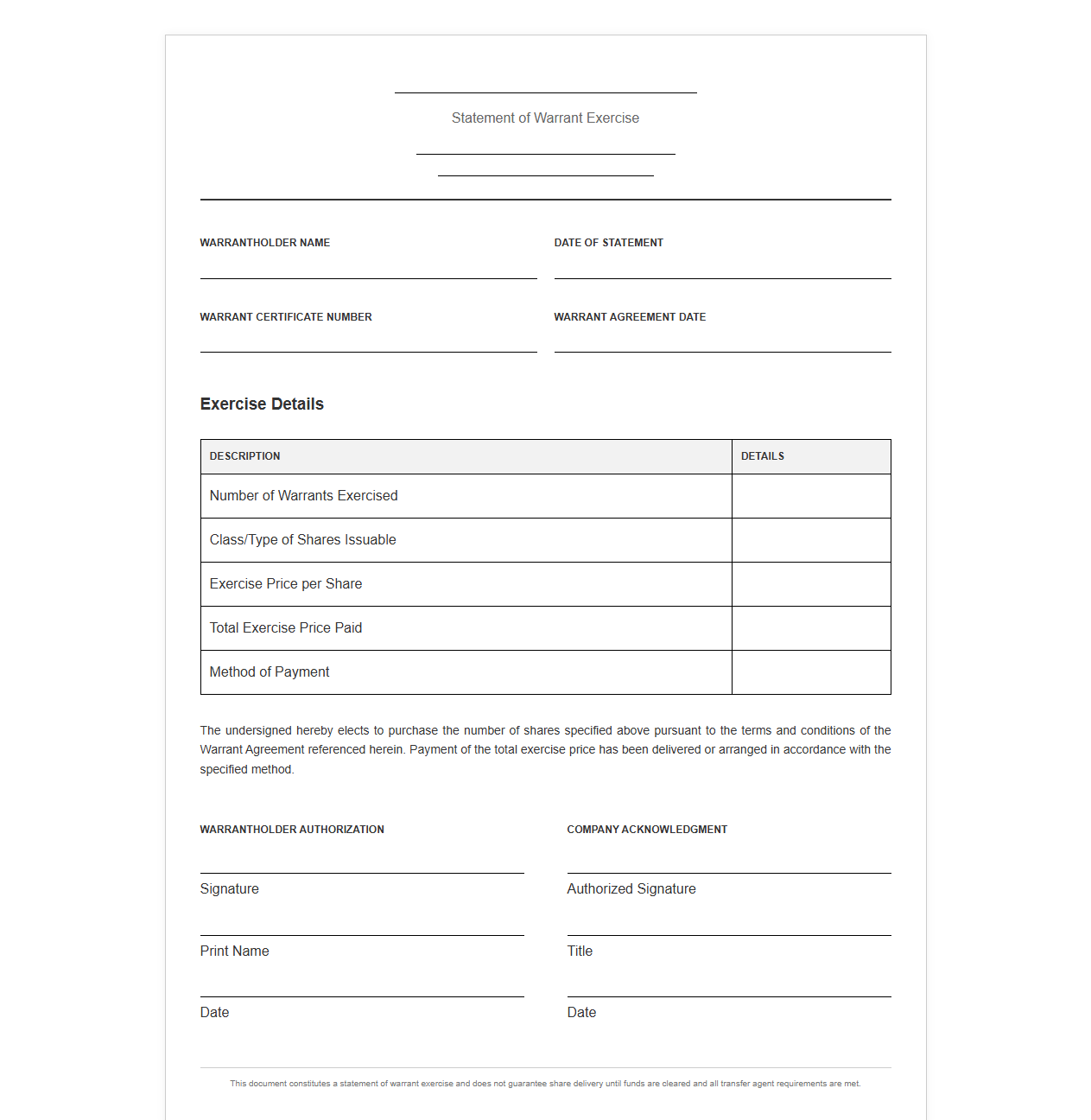 Download: .PDF
Demystifying Warrant Exercises in Equity Transactions
Navigating the terrain of corporate finance requires precision, particularly when dealing with equity derivatives like stock warrants. A warrant exercise represents a pivotal moment where a holder converts their rights into actual company shares, a process that triggers complex accounting, legal, and tax adjustments. Because these transactions involve shifting cap tables and direct cash flows, even minor administrative oversights can lead to costly legal disputes or compliance failures. Utilizing standardized statement templates is crucial for minimizing administrative errors, establishing a clear paper trail, and ensuring that both the corporation and the investor remain perfectly aligned throughout the execution process.
Anatomy of an Effective Warrant Exercise Template
To ensure legal validity and operational clarity, a warrant exercise statement must capture specific, immutable data points. Omitting critical details can delay share delivery or lead to discrepancies in the corporate ledger. Every robust template should explicitly feature the following fields:
- Holder Details: Full legal name, contact information, and taxpayer identification number of the warrant holder.
- Warrant Reference: The original warrant agreement number or series designation being exercised.
- Exercise Price: The pre-agreed strike price per share as dictated by the original contract.
- Share Count: The exact number of underlying shares the holder wishes to purchase.
- Execution Date: The official date on which the notice is signed and submitted to the issuer.
Template 1: The Notice of Intent to Exercise
The Notice of Intent to Exercise serves as the formal initiation of the transaction. The warrant holder must complete and submit this document to the issuing corporation to declare their binding commitment to purchase the underlying shares.
NOTICE OF EXERCISE
To: [Company Name]
Attention: Corporate Secretary
The undersigned holder of Warrant No. [____] hereby irrevocably elects to exercise the right to purchase [____] shares of Common Stock of [Company Name] at an exercise price of $[____] per share, pursuant to the terms of the Warrant Agreement dated [Date].
Payment is being delivered via:
[ ] Cash/Wire Transfer of $[____] (Full Payment)
[ ] Cashless Exercise (as permitted under Section [__] of the Agreement)
Holder Name: [Legal Name]
Signature: ___________________________
Date: [Execution Date]
Template 2: The Cash and Cashless Settlement Statement
Depending on the terms of the warrant agreement, holders may settle their transaction using physical cash or via a cashless net-exercise formula. The table below illustrates how the final share delivery is calculated under both scenarios, assuming a fair market value (FMV) of $10.00 and a strike price of $5.00 for 1,000 warrants.
| Settlement Method | Formula Applied | Cash Received by Company | Shares Delivered to Holder |
|---|---|---|---|
| Standard Cash Exercise | Warrants Exercised × 1-to-1 Ratio | $5,000.00 | 1,000 Shares |
| Cashless Net-Exercise | [(FMV - Strike) × Warrants] / FMV | $0.00 | 500 Shares |
Template 3: Board Approval and Issuance Resolution
Before the transfer agent can mint and distribute new shares, the company's board of directors must formally ratify the exercise. This step maintains corporate compliance and protects the integrity of the capital structure.
RESOLVED, that the Board of Directors hereby approves the exercise of Warrant No. [____] by [Holder Name] for the issuance of [____] shares of Common Stock. The executive officers of the Corporation are authorized and directed to instruct the transfer agent to issue stock certificates representing said shares, fully paid and non-assessable, as of the date of payment verification.
Critical Pitfalls to Avoid During Document Execution
Even with structured templates, manually processed equity transactions are highly susceptible to friction. Teams must remain vigilant against common operational errors that can jeopardize the validity of the issuance:
- Signature Mismatches: The signing entity on the exercise notice must match the registered warrant holder's name exactly.
- Incorrect Fractional Share Calculations: Warrant agreements often prohibit the issuance of fractional shares, meaning calculations must specify whether remaining fractions are rounded down or settled in cash.
- Stale Fair Market Value: For cashless exercises, using an outdated closing price to calculate the net share distribution can result in unauthorized dilution or cap table discrepancies.
Embracing Digital Workflows for Modern Equity Management
Relying solely on paper forms and manual tables introduces unnecessary risks into corporate capitalization management. Transitioning from static templates to automated equity management platforms allows companies to run real-time calculations, collect secure electronic signatures, and instantly update cap tables. Modern software reduces administrative friction, eliminates mathematical slip-ups, and ensures continuous regulatory compliance. By integrating these systems, corporations can execute warrant transactions with speed, transparency, and absolute accuracy.

Leave a comment